

Maddy summaryThis bill (HD 2566) requires health insurance carriers to pay emergency ambulance service providers directly for covered services, rather than billing patients. It sets payment rates based on municipal rates (if established) or 325% of Medicare rates, capping patient cost-sharing at $100. The law protects insured patients from surprise bills and prohibits providers from billing them further after receiving payment, while also limiting charges for uninsured patients to Medicare rates. It applies to all emergency ambulance services requiring immediate response, affecting patients, insurers, and ambulance providers across Massachusetts.
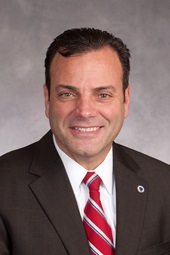
Rep. Paul McMurtry
Sponsored bills
Maddy summaryThis bill prohibits health insurance carriers from denying payment for covered services solely because a patient was referred by a provider outside the carrier's network. It directly affects insurance companies (carriers) and their enrollees (patients), ensuring referrals from out-of-network doctors don't lead to denied claims. The key provision appears repeatedly across multiple chapters of health insurance law, mandating that payment decisions cannot be based on the referral source alone. The bill does not change coverage for specific treatments or alter prescription rules, focusing solely on referral-based payment denials. It applies to all health plans governed by the referenced statutes.
By Representative Lipper-Garabedian of Melrose, a petition (accompanied by bill, House, No. 1249) of Kate Lipper-Garabedian, Steven Owens and Samantha Montaño relative to PANDAS/PANS screening in medical/clinical settings. Financial Services.
Maddy summaryThis bill allows alcohol retailers with multiple licenses to form cooperative purchasing groups. Specifically, it permits 3 to 7 license holders (or up to 9 licenses total) to jointly buy alcoholic beverages from wholesalers to qualify for quantity discounts. The discounted products must be distributed exclusively to the participating retailers in the agreement, not sold to third parties. This directly affects businesses operating multiple licensed retail locations in Massachusetts that purchase alcohol wholesale.
Maddy summaryThis bill reclassifies app-based delivery workers (like food or package couriers for companies such as DoorDash) as employees for wage purposes, requiring delivery network companies to pay them at least the state minimum wage for all "working time" (including both assigned delivery tasks and standby time). Companies must calculate wages to ensure workers earn the minimum wage on average for their first 40 hours per week, with an option to pay 150% of minimum wage for assigned time only if workers control their schedule. The bill mandates detailed payroll reporting for companies, including breakdowns of assigned time, standby time, and wages, and requires quarterly publication of aggregated data on pay and hours. It directly affects app-based delivery workers and the companies that employ them across Massachusetts.
Maddy summaryHD 2518 establishes a process for setting minimum hourly labor rates that Massachusetts insurance companies must pay to registered auto repair shops for collision repairs. It requires repair shops to submit 100 sequential customer-paid repair orders or 60 days of such orders to calculate their average hourly rate, which becomes the insurer's minimum payment rate after 30 days (subject to insurer audit and dispute). Insurers can challenge the rate, but repairers can appeal to the Commissioner of Insurance if they disagree, with insurers bearing the burden of proof in disputes. The bill also excludes these repair rates from cost-control programs under other insurance laws. This directly affects insurance companies, repair shops, and vehicle owners seeking repairs covered by insurance.
Maddy summaryThis bill allows the town of Westwood to issue new licenses for grocery stores to sell all alcoholic beverages (to be consumed off-premises) without requiring on-site consumption. It specifically authorizes licenses for "food stores" meeting strict criteria: retail space of at least 20,000 square feet selling groceries, fresh meats, dairy, produce, and baked goods (excluding convenience stores or gas stations). New applicants must provide proof of tax/fee compliance from state departments, and licenses cannot be transferred between locations but may be reissued to new applicants under the same conditions. The policy directly affects Westwood's licensing authority and qualifying large grocery stores seeking to sell alcohol off-premises.
Maddy summaryH 5032 requires that for public construction projects in Massachusetts exceeding $10 million in cost, contractors and subcontractors must ensure at least 15% of labor hours for each trade are performed by registered apprentices. This applies to all public works projects (like schools or roads) and directly affects construction companies bidding on such projects. Contractors must use apprentice programs approved by the Division of Apprentice Standards and maintain required apprentice-to-journeyperson ratios. Public agencies can exempt specific trades only after proving no qualified bidders with apprenticeship programs are available, with strict documentation requirements. The bill does not apply to projects under $10 million or exempt entire projects unless documented per trade.
By Mr. Rush, a petition (accompanied by bill, Senate, No. 1621) of Michael F. Rush and Paul McMurtry for legislation relative to medical records requests. Public Health.
Maddy summaryThis bill prevents local zoning rules from banning or restricting land used for agricultural fairs operated by nonprofit organizations. It specifically protects properties owned and managed by such nonprofits for their fair-related activities, ensuring zoning laws cannot interfere with these events. The law applies only to nonprofit corporations whose primary purpose is organizing agricultural fairs. This change takes effect immediately upon the bill's passage.