

Maddy summarySB 90 adds hypertension to Maryland's list of occupational diseases presumed to be work-related for specific emergency responders. It makes firefighters, fire fighting instructors, rescue squad members, advanced life support unit members, and State Fire Marshal personnel eligible for workers' compensation benefits if they have hypertension diagnosed by a provider, experience it for at least 90 consecutive days, have at least 2 years of cumulative service in those roles, and are currently employed in those positions. This creates a legal presumption that the hypertension is work-related, eliminating the need to prove direct causation, while clarifying that individuals cannot receive both workers' compensation and disability retirement benefits for the same hypertension condition. The bill takes effect October 1, 2026.
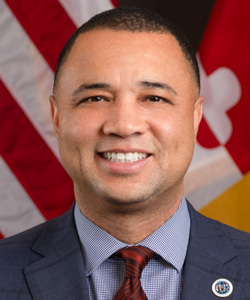
Sen. Antonio Hayes
Sponsored bills
Maddy summarySB 554 eliminates the Baltimore City Public School Board Community Panel, which previously selected nominees for the school board. It changes the appointment process so the Mayor directly appoints board members (subject to Senate confirmation), replacing the prior system where the panel submitted candidate lists. The bill also modifies term lengths and vacancy procedures for appointed members but removes specific demographic requirements for board appointments. This directly affects how Baltimore City's school board members are selected and serves the Baltimore City Public School System. The changes take effect upon enactment, streamlining the appointment process.
Maddy summarySB 815 requires Maryland's Department of Public Safety and Correctional Services (DPSCS), working with a Maryland university, to study prison industry programs in Maine, Ohio, Kansas, and California. The bill mandates an interim progress report by December 1, 2026, and a final report with improvement recommendations for Maryland Correctional Enterprises (MCE) by December 1, 2027. These recommendations must focus on enhancing MCE programs to support successful prisoner reentry. The bill expires automatically on December 31, 2027, without needing further legislative action.
Maddy summaryMaryland's SB 962 prohibits individuals convicted of crimes related to the January 6, 2021 Capitol attack from holding specific government positions. The bill applies to those convicted regardless of subsequent pardons and bars them from serving on state boards/commissions, in executive government roles, or in special appointments. Appointing authorities must immediately remove anyone violating this law. It does not apply to standing committees or committees established under Title 2 of state law. The law takes effect July 1, 2026.
Maddy summarySB 17 creates a new permit system for events related to the CIAA Basketball Tournament in Baltimore City. It requires promoters of such events to apply for a "related event promoter’s permit" from Baltimore’s Board of License Commissioners at least 30 days in advance, along with written consent from Visit Baltimore and a special event permit if needed. Caterers with state licenses must also obtain a temporary Class C event license to serve alcohol at these events. The law imposes fees ($50 application, $500-$1,000 permit) and fines ($1,000-$3,000) for operating without the required permits, affecting event promoters, caterers, and venues hosting CIAA-related gatherings. The permit is valid only for events coordinated with the CIAA tournament and expires June 30, 2029.
Maddy summarySB 971 establishes Gwynns Falls State Park as a partnership between Maryland’s Department of Natural Resources and Baltimore City, prohibiting entrance fees and requiring the park to include a specified area. The bill mandates the Department and Baltimore City to jointly develop a master plan with an independent consultant, hold community focus groups, and create a stakeholder advisory committee. It also allocates $4 million in fiscal year 2028 to renovate the Gwynns Falls/Leakin Park office into a shared partnership park office and visitor center. This bill directly affects the Department of Natural Resources, Baltimore City, and residents of Baltimore who will gain access to the new park without entry fees.
Maddy summarySB 817 requires appraisers to notify home buyers, sellers, or their agents if a property's appraisal value may be lower than the contract price or refinance estimate. It allows these parties to submit verified comparable sales data within two days to support the agreed price, provided the data follows a standard format. Appraisers must include a detailed addendum in their final report documenting all submitted information, the notification dates, and whether the data changed the valuation. The law applies to residential real estate appraisals in Maryland and takes effect October 1, 2026.
Maddy summarySB 883 authorizes the Maryland Stadium Authority to review and make recommendations about the Carroll Park Soccer Stadium and Facility in Baltimore City, which serves professional soccer and a soccer academy. The bill establishes a dedicated "Carroll Park Soccer Stadium and Facility Fund" to manage lease payments and requires the Authority to submit annual reports to the Governor and General Assembly. It also grants the Authority the power to acquire the stadium site through specified methods and mandates compliance with financing requirements for site acquisition, design, and construction. The legislation updates existing state law to include this facility within the Authority’s oversight for economic development projects.
Maddy summarySB 812 modifies Maryland's homeowners' property tax credit by raising the income eligibility threshold from $60,000 to $100,000 in the preceding calendar year and adjusting the credit calculation structure. The bill now applies 0% to the first $15,000 of combined income, 3% to the next $7,500, 6% to the following $7,500, and 9% to income exceeding $30,000. This change directly affects Maryland homeowners with combined gross income up to $100,000 who qualify for the credit. The bill takes effect for tax years beginning after June 30, 2026.
Maddy summarySB 75 allows qualifying food retailers to purchase Class A liquor licenses from existing license holders or apply directly to local licensing boards under specific conditions. To qualify, a food retailer must sell certain grocery items (like fresh produce, meat, and dairy), operate in at least 3,200 square feet, and maintain a 300-foot distance from schools or places of worship. The bill requires purchases to occur at "fair market value" and limits newly licensed retailers to selling only beer or beer/wine (not full liquor), with local boards issuing the appropriate license type based on available options. This change specifically affects large grocery retailers seeking to sell alcohol without needing to build new facilities, while maintaining existing restrictions on chain stores and supermarkets. The law takes effect July 1, 2026.