

Maddy summarySB 814 voids certain residential service agreements entered before June 1, 2023, if the service provider is deemed "defunct" (not in good standing with Maryland’s Department of Assessments and Taxation) on or after June 1, 2026. It specifically invalidates agreements that attempt to bind future property owners, create liens on homes, or allow unapproved transfers of service rights. Homeowners affected can seek court declarations that such agreements are void, along with damages and legal fees. The bill amends Maryland’s real property code to establish this automatic voiding mechanism, effective June 1, 2026. It directly impacts homeowners with outdated service contracts tied to providers who lost state authorization.

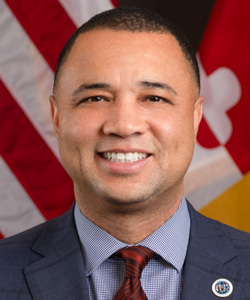
Sen. Antonio Hayes
Sponsored bills
Maddy summarySB 813 prohibits dental insurers and plan organizations from blocking direct payments to dentists (nonpreferred providers) when patients assign benefits to them, instead of paying patients who then pay dentists. It requires dentists to provide patients with clear cost disclosures - including potential balance billing - before services and submit a disclosure form to insurers. The bill applies specifically to dental care under Maryland law, amending sections 14-205.3 and adding 14-410.1 to the Insurance Article. Insurers may refuse direct payment only in limited cases, such as if a patient paid the dentist upfront or withdrew assignment after payment. This aims to simplify reimbursement for dental patients and dentists outside insurance networks.
Maddy summaryMaryland Senate Bill 469 modifies the purpose of the Maryland Automobile Insurance Fund to explicitly require that financial security provided by the Fund be offered at "affordable rates" to eligible drivers who cannot obtain insurance from private companies. It authorizes the Fund's Executive Director to establish a dedicated affordability program, allowing the program to operate even if it would otherwise conflict with standard insurance rate regulations. This change directly affects drivers unable to secure private auto insurance and shifts the Fund’s operational focus toward affordability. The bill takes effect October 1, 2026, and updates specific sections of Maryland’s Insurance Article (20-301, 20-507).
Maddy summarySB 972 authorizes Baltimore City's Board of License Commissioners to issue new Class B beer, wine, and liquor licenses for four specific restaurant locations in the 40th Alcoholic Beverages District. It directly affects restaurants on: - The even side of South Carrollton Avenue (requiring a memorandum with Hollins Roundhouse Association), - The odd side of North Howard Street (with strict indoor service hours and no license transfers), - The odd side of West Baltimore Street (requiring a memorandum with Hollins Roundhouse Association), and - The even side of North Charles Street (requiring a memorandum with Mount Vernon-Belvedere Association). Key provisions include waiving minimum seating requirements for some locations, restricting service to indoor patrons only during specific hours (10 a.m. to 9 p.m.), and limiting alcohol offerings to patrons receiving barbering services. The bill takes effect July 1, 2026.
Maddy summarySB 819 amends Maryland's tax foreclosure law to change how counties and municipalities must notify property owners when filing for judicial in rem foreclosure on vacant or abandoned properties. It replaces a specific 5-day mailing requirement with standard court service procedures under Maryland Rules, requiring notice to all interested parties via proper legal service. This directly affects property owners with delinquent taxes on vacant properties cited as unsafe, as well as local governments initiating foreclosure actions. The bill maintains existing requirements like a 6-month tax delinquency threshold and a 30-day delay before hearings, but streamlines the notice process to align with standard court procedures.
Maddy summarySB 927 creates a special permit process for the Kappa Alpha Psi 2027 Conclave in Baltimore City, requiring event promoters to apply 30 days in advance to the Board of License Commissioners. It mandates written consent from Visit Baltimore, a special event permit from Baltimore City Transportation, and a $50 application fee plus a $500-$1,500 permit fee based on venue capacity. Caterers must obtain a separate Class C per diem license before participating. The law expires December 31, 2027, and applies solely to this specific event, not general public gatherings.
Maddy summaryThis bill establishes the Maryland Advanced Manufacturing Grant Program within the Maryland Technology Development Corporation to support companies specializing in regenerative medicine and other advanced manufacturing sectors. The program will provide grants that recipients can use exclusively for acquiring or renovating manufacturing space, improving infrastructure, and purchasing necessary equipment. A dedicated fund will be created to hold grant money, with interest earnings credited back to the fund rather than the state's general fund. The Corporation will work with the Maryland Stem Cell Research Commission to set eligibility criteria, application procedures, and award amounts, with the program taking effect on July 1, 2026.
Maddy summarySB 816 establishes the Neighborhood Social Connection and Development Program within Baltimore City's West North Avenue Development Authority. It provides technical support and grants (up to $500,000) to local organizations like neighborhood associations, nonprofits, and volunteer groups operating in the West North Avenue corridor (between the 600 and 3200 blocks) to fund social activities such as block parties, cultural festivals, neighborhood newsletters, volunteer stipends, and community space projects. The program requires organizations to collaborate with residents in planning and mandates annual reports to the Governor and General Assembly starting in 2027, with a final evaluation due by 2029. This directly affects community groups and residents in the designated Baltimore corridor seeking to strengthen neighborhood connections through funded activities.
Maddy summarySB 858 establishes the Audit and Finance Compliance Unit within Maryland's Department of Budget and Management. The unit directly affects all Executive Branch state agencies by monitoring their progress in resolving audit findings from the Office of Legislative Audits. Key provisions require the unit to create a public dashboard on its website showing agency audit status (including resolution timelines and repeat findings), form a specialized team to assist agencies with four or more repeat audit issues, and report quarterly to the Joint Audit and Evaluation Committee. The dashboard must launch by October 1, 2027, and track corrective actions for all agencies annually.
Maddy summarySB 806 requires health professionals applying for new licenses in Maryland to undergo a criminal history records check starting July 1, 2027. This applies to professions including nursing, pharmacy, dentistry, and others regulated by specific state boards. Applicants must submit fingerprints and pay fees to a central repository, with results kept confidential and used only for licensing decisions. The bill also mandates a similar check for license renewals for professionals licensed before January 1, 2028, during their first renewal after that date.