

Maddy summaryHB 1366 requires Maryland health insurance plans to cover cervical Pap tests for all individuals and ovarian cancer surveillance tests (CA-125, ultrasound, or pelvic exams) for those with specific risk factors, such as a family history of ovarian cancer or BRCA gene mutations. It prohibits insurers from charging copayments, coinsurance, or deductibles for these tests, except in high-deductible health plans where the plan's standard deductible still applies. The law applies to all health insurers and health maintenance organizations providing coverage in Maryland and takes effect January 1, 2026. This directly affects individuals seeking preventive cancer screenings, particularly those at higher risk for ovarian cancer.
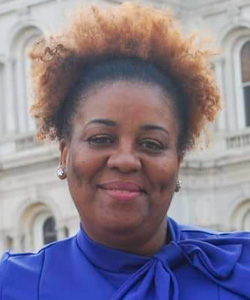
Del. Jackie Addison
Sponsored bills
Maddy summaryHB 694 requires Maryland county school boards to annually report (starting September 1, 2025) the number of public school main entrances not accessible for people with disabilities and not meeting federal ADA standards, publishing this data on their websites. It also mandates that local school systems send their updated emergency plans to the state Department of Education by September 1 each year (starting 2025), with the department analyzing these plans and reporting compliance status to the legislature by December 1 annually. The bill further ensures that students with disabilities have emergency evacuation plans included in their Individualized Education Programs (IEPs) or 504 plans. These provisions directly affect all Maryland public school systems and county boards of education.
Maddy summaryHB 1129 proposes amending Maryland’s constitution to replace gendered pronouns (like "his" and "him") with gender-neutral language in sections describing constitutional officers. It specifically targets Articles II (Executive Department), V (Attorney General), VI (Treasury), and IX (Militia), updating phrases such as "his election" to "the Governor’s election" and "himself" to "themselves." The bill does not alter the roles, powers, or eligibility requirements for these offices - only the language used to describe them. This is a purely linguistic change aimed at modernizing constitutional text to be inclusive of all gender identities.
Maddy summaryHB 1306 requires Maryland’s Department of Health to establish three specialized clinics for sickle cell disease treatment in Montgomery County, Harford County, and an Eastern Shore county by 2027. These clinics must operate under a hub-and-spoke model, providing comprehensive care including pain management, mental health services, genetic counseling, and telehealth access to specialists, while addressing social barriers like transportation and housing. The bill also creates a scholarship program for medical residents specializing in hematology with a sickle cell focus, requiring them to practice in Maryland after training. Funding of $6 million for fiscal year 2027 must cover clinic operations, staffing, social support services, and prioritizes hiring specialists and addressing health disparities. The Department must annually report on clinic outcomes, patient access, and efforts to reduce health disparities.
Maddy summaryHB 609 modifies Maryland's legislative scholarship programs to exempt students planning to complete the Real Property Appraiser Qualification Criteria program from standard exam requirements. It specifically allows senatorial and delegate scholarships to cover costs for the Practical Applications of Real Estate Appraisal Program (administered by the Appraisal Foundation). This change directly affects students pursuing real estate appraisal licensure who would otherwise need to meet typical scholarship exam rules. The bill amends Sections 18-402(4) and 18-405(b)(3) of the Maryland Annotated Code to include this program under eligible scholarship uses.
Maddy summaryHB 419 requires natural gas companies in Maryland to submit detailed plans to the Public Service Commission for infrastructure replacement projects. These plans must include project descriptions, safety analyses, leak reduction potential, cost comparisons with alternatives (like leak repair), and 2-year advance notices to customers about upcoming construction. The bill allows gas companies to recover costs through a capped monthly surcharge - maximum $2 per residential account - with non-residential rates set at least equal but subject to the same cap. It prioritizes projects based on public safety risk and cost-effectiveness, excluding projects that connect to new customers or increase company revenue. The law directly affects gas companies (requiring new filings) and ratepayers (via the surcharge), while ensuring transparency for customers near construction sites.
Maddy summaryHB 180 establishes Maryland's Gun Violence Victim Relocation Program within the Governor’s Office of Crime Prevention and Policy’s Victim Services Unit. It provides eligible victims of gun violence (who experienced violence near their home or live near a suspect and demonstrate safety risks) with relocation assistance, covering moving costs, security deposits, rent, counseling, legal aid, and job training. The program is funded through a permanent Gun Violence Victim Relocation Program Fund, with interest earnings credited back to the fund. It requires collaboration with housing and social services agencies to ensure safe relocations and protects program participants from housing discrimination.
Maddy summaryThis bill speeds up eviction cases when a property is listed for sale or lease. It requires courts to hold expedited hearings, serve notice in person or post it conspicuously on the property, and issue eviction warrants within a set timeframe if the landlord wins. The law applies only to cases where the property was advertised for sale or lease at the time the lawsuit began, directly affecting landlords seeking to quickly regain possession for sale or rental purposes. It modifies existing Maryland law (Section 14-132 of the Real Property Article) to streamline these proceedings.
Maddy summaryThis House Joint Resolution (HJ 4) is a non-binding ceremonial measure affirming Maryland's support for Diversity, Equity, and Inclusion (DEI) as foundational to the American Dream. It does not create new laws or policies but formally encourages state, local, and federal entities to uphold DEI principles. The resolution directs certified copies to federal leaders including the President, Vice President, and congressional leadership, citing DEI's historical role in civil rights advancements. As a procedural resolution, it has no direct policy impact on constituents or funding mechanisms.
Maddy summaryHB 927 requires that fiscal notes for bills reducing health and community support services funded by the Maryland Department of Health must include three specific elements: an estimate of the number of people who will lose services (by location), an assessment of how the loss affects health and well-being, and an evaluation of the financial impact on state health and social services costs. This applies to any bill that cuts funding for such services, ensuring these impacts are documented in the state's financial analysis. The bill amends existing law to add these requirements to the fiscal note process, which is used by the General Assembly to evaluate budget proposals. The changes will take effect on October 1, 2025.