

Maddy summaryHB 721 updates Maryland's family law to clarify when courts must grant grandparent visitation rights. It requires courts to grant visitation if a child lived with the grandparent for at least 12 months *or* if the child’s parent (the grandparent’s child) has died. The bill also mandates courts to consider the grandparent’s prior contact with the child and requires clear evidence - beyond just allegations - to deny visitation on grounds of interfering with parent-child relationships. This directly affects grandparents seeking visitation, parents, and children in custody disputes, making the process more structured and evidence-based.
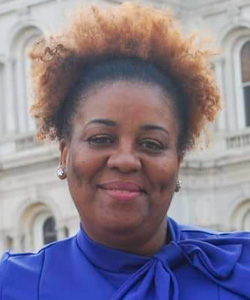
Del. Jackie Addison
Sponsored bills
Maddy summaryHB 1518 increases penalties for adults who store or leave a loaded firearm in a location where they knew or should have known an unsupervised minor could access it. The bill makes this a misdemeanor punishable by up to 2 years in jail, a $1,000 fine, or both. It directly affects property owners, caregivers, or anyone responsible for firearm storage near minors. Key exemptions include supervised access by an adult, lawful law enforcement use, or a minor possessing a valid hunter safety certificate. The law takes effect October 1, 2025.
Maddy summaryHB 607 establishes the PAREA Grant Program to provide financial assistance to minorities residing in historically redlined neighborhoods and underrepresented communities for training to become real estate appraisers. The program aims to close appraisal gaps in these areas, diversify the appraisal profession, and support individuals pursuing real estate appraisal careers. Administered by the Maryland Higher Education Commission, the grants directly target residents in communities historically excluded from the appraisal field. This policy creates a concrete pathway for career development in a specific profession while addressing documented disparities in real estate services.
Maddy summaryHB 941 requires the Governor to include at least $5 million annually in the state budget for the University of Maryland Eastern Shore (UMES) starting in fiscal year 2027, continuing until a total of $321,181,312 is appropriated. This addresses a historical funding disparity identified by the state legislature, where UMES (as Maryland’s 1890 land-grant institution) received less per-student state funding than UM College Park (the 1862 land-grant institution) from 1987-2020. Funds must be supplemental to existing appropriations and can be used for infrastructure, faculty, scholarships, or other institutional needs identified by UMES. The bill aims to fully remedy the $321 million shortfall over time through mandatory annual appropriations.
Maddy summaryHB 254 prohibits public libraries, housing grant recipients, public housing agencies, and local governments from requiring individuals experiencing homelessness to provide a current address for library cards, housing applications, or housing assistance. It amends Maryland law to ensure these entities cannot make address verification a condition of eligibility under specific programs. The bill defines "individual experiencing homelessness" as "homeless individual" under federal law and applies to programs funded through the Department of Housing and Community Development. The law takes effect October 1, 2025.
Maddy summaryHB 242 prohibits landlords in Maryland from using consumer credit history (including credit reports and scores) in reusable tenant screening reports. This directly affects landlords who screen applicants and prospective renters whose credit history would no longer be considered during rental applications. The bill requires landlords to disclose their screening policy (e.g., via rental listings) and bans fees for accessing reusable tenant screening reports, which must instead include criminal history, eviction records, employment verification, and rental history. It amends Maryland law to replace credit-based screening with these alternative checks for rental applications.
Maddy summaryHB 985 allows Maryland counties to establish a second administrative charging committee for reviewing police misconduct complaints, if the county governing body determines one committee is insufficient to serve all countywide and local law enforcement agencies. This bill amends existing law by adding a new provision (Section 3-104(a)(1)(II)) that permits counties to authorize a second committee under specific circumstances. The key mechanism requires county officials to formally decide that a single committee cannot adequately handle the volume of cases, without changing the committee composition or disciplinary standards. The bill directly affects county governments and law enforcement agencies by providing administrative flexibility in handling misconduct investigations.
Maddy summaryHB 1422 establishes the Maryland Reparations Commission to study and recommend benefits for individuals whose ancestors were enslaved in Maryland or were impacted by historical inequitable government policies (such as housing segregation and redlining during the Jim Crow era). The Commission, composed of 15 members including state officials, historians, community representatives, and public members, will examine U.S. reparations models and potential benefits like monetary compensation, tax rebates, or housing assistance. It must submit a preliminary report by January 2027 and a final report by November 2027 to the Governor and General Assembly. The bill focuses solely on research and recommendations, not on implementing specific reparations.
Maddy summaryHB 1431 restricts federal immigration enforcement agencies from accessing Maryland state and local government databases without a valid warrant. It requires state/local law enforcement agencies, DMV, and other government units to deny federal requests for personal information, photos, or facial recognition data unless accompanied by a federal or Maryland court warrant. The bill also mandates annual reporting to the legislature on all such federal requests received, including how many were denied or granted with warrants. This directly affects Maryland state agencies, local governments, and federal immigration officers seeking access to these databases.
Maddy summaryHB 868, nicknamed "Granny's Law," allows personal representatives (executors) to petition courts to interpret wills regarding health-related legacies based on the decedent’s intent to address health equity. It applies when a will leaves money to health providers or charities but doesn’t explicitly require it for health equity, even if the decedent lived with health equity interests. The bill creates a rebuttable presumption that such legacies must address health equity unless proven otherwise, and requires beneficiaries to show how the legacy was used for that purpose within three years. It also lets courts defer to personal representatives who include specific language in wills authorizing them to act without court approval for health equity efforts. The law applies retroactively to wills probated after a certain date.