

Maddy summaryHB 1473 requires Maryland state departments, agencies, and programs to provide equal access to public services for individuals with limited English proficiency (LEP) and disabilities. It mandates these entities to develop language access plans by July 2027, including accommodations like interpreters, sign language, and plain language materials. The Governor’s Office of Immigrant Affairs will oversee compliance, investigate complaints, and receive $400,000 annually starting in fiscal year 2027 to support implementation. The bill expands existing LEP protections to explicitly include disability accommodations under defined "equal access" standards.
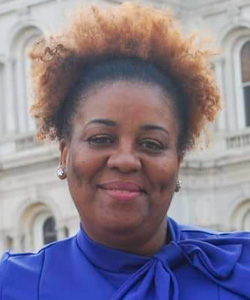
Del. Jackie Addison
Sponsored bills
Maddy summaryHB 1126 establishes a one-year pilot program in Maryland's Department of Labor to connect unemployed individuals with overdue child support payments (arrears) to employment opportunities, including state government jobs. The program requires the Department of Labor to collaborate with the Departments of Human Services and Budget and Management to securely share participant information and implement procedures. It mandates a final report to the Governor and General Assembly by July 1, 2026, evaluating the program's effectiveness before its automatic expiration on June 30, 2026. The bill directly affects unemployed residents with child support arrears and state agencies managing workforce and social services. This policy change creates a structured pathway to address both unemployment and child support obligations through job placement.
Maddy summaryHB 1193 (Maryland Housing Data Transparency Act) requires large Maryland local governments (those with at least 150,000 residents or issuing 50+ annual residential permits) to submit monthly reports to the state Department of Planning starting January 2027. These reports must include specific details for each housing development permit, such as permit numbers, approval dates, housing type (e.g., apartments, single-family), unit counts, construction costs, and processing times. The state Department of Planning must then publish this data on a public, searchable website by July 2027, organized by housing type and county. The bill aims to increase transparency around housing development by making permit data accessible to the public and policymakers.
Maddy summaryHB 879 establishes a 13-member Task Force to study chronic absenteeism in Maryland schools, with members appointed by legislative leaders and the State Superintendent. The Task Force will analyze attendance data, identify best practices, and develop recommendations - including a standardized definition of chronic absenteeism - by December 31, 2025. It will create culturally responsive toolkits for school leaders and guidance for local systems, to be distributed by June 2026. The bill itself does not implement new policies but sets up the process for future regulations. This procedural bill expires automatically on December 31, 2026.
Maddy summaryHB 840 requires Maryland's public senior higher education institutions (including the University System of Maryland, Morgan State, and St. Mary's College) to create and publish student support plans for pregnant and parenting students. The plans must include referrals to government assistance programs (like child care scholarships and Medicaid), adoption resources, priority class registration, flexible scheduling, and health care provider networks. Institutions must post these plans online by August 1, 2026. The law aims to ensure these students have access to necessary resources while complying with federal anti-discrimination protections under Title IX.
Maddy summaryHB 853 (Maryland Second Look Act) allows individuals serving prison sentences of 20+ years to petition courts for sentence reduction under specific conditions. To qualify, petitioners must have served at least 20 years and wait 5 years after any prior petition, with a maximum of three petitions total. Courts must hold hearings considering factors like rehabilitation, victim input, the individual’s age at the offense, and safety risks, and must publicly state their reasons for granting or denying relief. The law applies retroactively to eligible individuals already serving long sentences.
Maddy summaryHB 446 creates a new commercial fishing license specifically for harvesting blue and flathead catfish using trotlines in the Chesapeake Bay. It directly affects licensed commercial fishers by allowing them to fish in the main stem of the Chesapeake Bay south of the Chesapeake Bay Bridge, a location previously restricted by Department regulations. The bill prohibits the Department of Natural Resources from banning this activity within that area while requiring license holders to pay a $15 annual fee for a one-year license. This establishes a permanent regulatory framework for targeted commercial fishing of these species, rather than implementing a temporary pilot program.
Maddy summaryHB 646 extends the deadline for a task force studying the creation of a Division of Returning Citizens and expanded reentry services. The bill delays the task force's report submission date from December 31, 2025, to October 31, 2026, and extends the task force's termination date from 2026 to 2027. This procedural bill amends previous legislation (Chapters 936 and 937 of the 2024 Acts) without changing the task force's purpose or creating new services. It directly affects the existing task force by providing additional time to complete its work.
Maddy summaryHB 1226 authorizes Baltimore City to use stop sign monitoring systems in school zones, if permitted by local law, to capture vehicles failing to stop. It establishes a process where drivers recorded violating stop signs receive citations and face civil penalties, with fines required to fund public safety programs like pedestrian safety initiatives. The bill prohibits contractors from being paid based on the number of citations issued and specifies that contested cases must go through district court. This applies specifically to Baltimore City school zone enforcement, not statewide.
Maddy summaryHB 1189 authorizes Baltimore City to establish a special property tax rate for nonprofit-owned properties no longer used for their charitable purpose for at least three consecutive tax years. It creates a new tax subclass for such properties, allowing the city to impose a rate up to 10 times the standard rate. This directly affects nonprofit organizations in Baltimore whose properties have been vacant or unused for their intended purpose. The bill requires the city to report annually on the tax rate, number of properties affected, revenue generated, and whether properties could be repurposed. It takes effect for taxable years beginning after June 30, 2025.