

National Heritage Area Act This act establishes a National Heritage Area System. The Department of the Interior may provide technical and financial assistance to local coordinating entities to support the establishment, development, and continuity of such areas. The National Heritage Area System shall be composed of each National Heritage Area, National Heritage Corridor, National Heritage Canalway, Cultural Heritage Corridor, National Heritage Route, and National Heritage Partnership designated by Congress before or on enactment of this act; and each National Heritage Area designated by Congress after enactment of this act. A National Heritage Area shall not be considered to be a unit of the National Park System nor subject to the authorities applicable to such units. Interior may carry out or review a study to assess the suitability and feasibility of each proposed heritage area for designation as a National Heritage Area. Interior must review and certify whether the proposed area meets specified requirements, including that it has natural, historic, and cultural resources that represent distinctive aspects of the heritage of the United States. An area shall be designated as a National Heritage Area only by an act of Congress. Interior shall conduct studies to assess the suitability and feasibility of designating specified areas in Hawaii as the Kaena Point National Heritage Area and in Virginia and North Carolina as the Great Dismal Swamp National Heritage Area. The act also (1) establishes or extends specified National Heritage Areas, (2) redesignates the America's Agricultural Heritage Partnership in Iowa as the Silos & Smokestacks National Heritage Area, and (3) extends the deadline for the management plans for certain heritage areas.
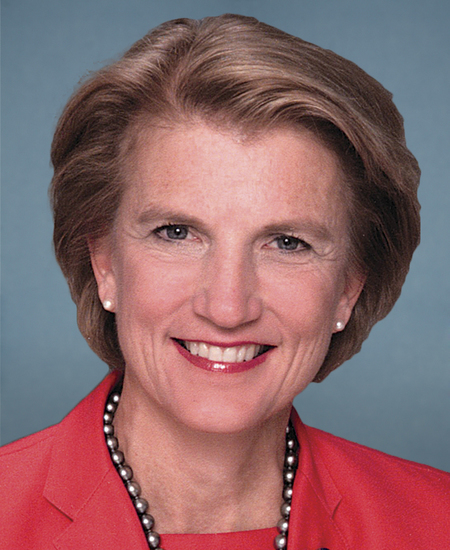
Sen. Shelley Moore Capito
Sponsored bills
Emmett Till and Mamie Till-Mobley Congressional Gold Medal Act of 2021 This act provides for the posthumous presentation of a Congressional Gold Medal in commemoration of Emmett Till and Mamie Till-Mobley. After it is awarded, the medal shall be given to the National Museum of African American History and Culture.
Law Enforcement De-Escalation Training Act of 2022 This act directs the Department of Justice (DOJ) to develop scenario-based training curricula (or identify existing curricula) that includes topics such as alternatives to the use of force, de-escalation tactics, and safely responding to an individual experiencing a mental, behavioral health, or suicidal crisis. The act also directs DOJ to make grants to states for costs associated with providing the training to law enforcement officers or mental health professionals.
Supply Chain Disruptions Relief Act This bill modifies the treatment of liquidations of new motor vehicle inventory as qualified LIFO (last in first out accounting method) inventory. It allows new motor vehicle dealers to elect to wait until the end of 2025 to replace their inventory for purposes of determining income attributable to the sale of such inventory during 2020 and 2021.
Maddy summaryThis Senate resolution designates September 18-24, 2022, as "Community School Coordinators Appreciation Week" to symbolically recognize the work of community school coordinators. It does not create new programs, funding, or policy changes. The resolution thanks coordinators for their role in supporting students, families, and communities through collaborative school-community partnerships. It encourages public participation in events celebrating these coordinators' contributions to student success and community well-being. As a commemorative resolution, it has no direct legal or financial impact on affected individuals or entities.
Safeguarding Treatment for the Restoration of Ecosystems from Abandoned Mines Act or the STREAM Act This bill allows a state to set aside up to 30% of its annual grant for abandoned mine reclamation provided under the Infrastructure Investment and Jobs Act for the treatment and abatement of acid mine drainage, which is the release of acidic water from abandoned coal mines.
Network Equipment Transparency Act or the NET Act This bill requires the Federal Communications Commission (FCC) to determine (subject to available data) whether the lack of network equipment significantly impacted the deployment of broadband and other advanced telecommunications capability. The FCC must include this determination in its biennial report on the state of the communications marketplace.
Preventing PFAS Runoff at Airports Act This act temporarily allows the Federal Aviation Administration (FAA) to cover 100% of the costs for airports to purchase and deploy equipment to test fire suppression systems that contain perfluoroalkyl and polyfluoroalkyl substances (PFAS) without discharging such substances. (PFAS are manmade substances and may have adverse human health effects.) The FAA must also (1) conduct outreach to inform airports of the availability of the increased cost-sharing; and (2) brief Congress on options to reimburse airports that acquired equipment without, or with reduced, federal funding and other matters.
Pro bono Work to Empower and Represent Act of 2021 or the POWER 2.0 Act This act makes permanent the requirement for the chief judge of each federal judicial district to lead, at least annually, a public event to promote pro bono legal services for survivors of domestic violence, dating violence, sexual assault, and stalking. The requirement was enacted in 2018; it is scheduled to sunset after a four-year period.
Data Mapping to Save Moms' Lives Act This act directs the Federal Communications Commission (FCC) to include data on maternal mortality and severe maternal morbidity in its broadband health mapping tool. This is an online platform that allows users to visualize, overlay, and analyze broadband and health data at national, state, and county levels. The FCC must consult with the Centers for Disease Control and Prevention regarding the data to incorporate into the tool.