

Maddy summaryS 3660, the Credit Card Fairness Act, limits late fees charged by large credit card issuers (those with 1 million+ open accounts) to a maximum of $8 per late payment. The bill requires that late fees be proportional to the actual costs incurred by issuers for late payments, not set arbitrarily. It allows the Consumer Financial Protection Bureau (CFPB) to adjust the $8 cap annually based on inflation (using the Consumer Price Index), but the fee must never exceed the issuer's documented costs. This bill directly affects major credit card companies and aims to prevent excessive late fees, codifying the CFPB's existing rule into law.
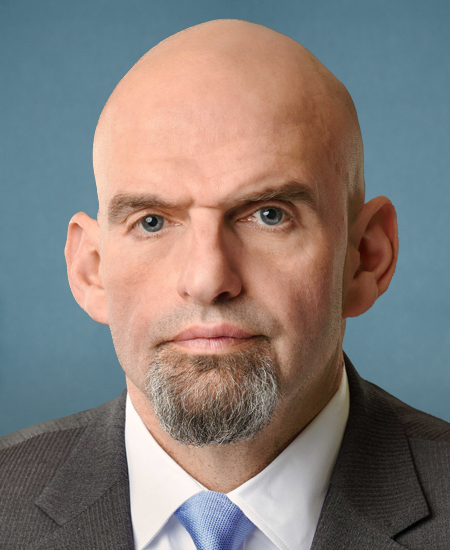
Sen. John Fetterman
Sponsored bills
Maddy summaryThis bill amends the National School Lunch Program to allow schools participating in the program to serve whole milk as an option to students, in addition to reduced-fat and fat-free milk. It permits schools to offer whole milk (organic or non-organic), reduced-fat, low-fat, and fat-free milk, as well as lactose-free milk and nutritionally equivalent nondairy beverages that meet specific nutritional standards. The bill clarifies that milk fat in whole milk should not be counted as saturated fat for compliance with meal nutrition standards. Additionally, it requires schools to include food allergy information in training for food service personnel. These changes directly affect schools participating in the National School Lunch Program and the students who eat school meals.
Maddy summaryThe REAADI for Disasters Act requires federal, state, and local governments to ensure people with disabilities and older adults have equal access to disaster services through accessible communication (including American Sign Language, captions, and plain language), inclusive planning processes, and accessible shelters. It establishes a new Disaster Human Services Emergency Fund to provide rapid support during disasters, including accessible housing, transportation, case management, and community-based services. The bill mandates that people with disabilities and older adults be included as key decision-makers in all phases of disaster planning, response, recovery, and mitigation, and requires adherence to accessibility standards for rebuilding damaged housing. It also creates training centers to help emergency management agencies better serve these communities and ensures that all disaster-related communications and services meet accessibility requirements.
Maddy summaryThis bill increases base pay for Federal correctional officers by 35% above their current General Schedule or law enforcement officer rates, replacing their existing base pay for all compensation purposes. It directly affects Bureau of Prisons correctional officers whose duties involve inmate custody, control, or routine direct contact in custodial settings, including certain supervisory roles. The pay increase is capped at the rate for Executive Schedule Level V (for officers) or Level IV (for Federal Wage System employees), and expires after five years unless the Department of Justice Inspector General certifies progress in reducing non-custodial staff "augmentation" and excessive overtime. The law requires a review 180 days before expiration to assess staffing changes and impacts on recruitment, retention, and safety.
Maddy summarySRES 288 is a Senate resolution condemning recent ideologically motivated attacks on Jewish individuals, including a violent assault in Boulder, Colorado, on June 1, 2025, and other incidents like the attack on Israeli Embassy staff in Washington, D.C., and fires at the Pennsylvania Governor’s Residence. The resolution formally expresses the Senate’s condemnation of these acts as part of a growing pattern of antisemitism and politically motivated violence. It reaffirms the Senate’s commitment to protecting peaceful assembly and religious practice, while urging federal, state, and local law enforcement to thoroughly investigate such incidents and calling on community leaders to publicly oppose antisemitism. This resolution has no legal effect but serves as a formal statement of the Senate’s position.
Maddy summaryThis resolution commemorates the fifth anniversary of the January 6, 2021, Capitol attack and honors the U.S. Capitol Police, Metropolitan Police Department, and Capitol staff (including custodial, janitorial, and maintenance personnel) who protected the building during the assault. It recognizes their bravery in defending Congress during the attack, which injured over 100 officers and contributed to five officer deaths, and acknowledges their ongoing essential work in maintaining Capitol operations. The resolution expresses Senate gratitude for their service and reaffirms commitment to protecting democratic processes. As a commemorative resolution, it does not create new laws or funding.
Maddy summaryThis bill requires investment advisers managing $150 million+ in private funds and certain issuers conducting large securities offerings (over $25 million) to disclose investments in "countries of concern" - nations designated as adversaries by the government. Advisers must report annually the percentage of their private fund assets held in each such country, while issuers must detail the intended use of proceeds (broken down by country and industry) for large exempted transactions. The SEC will publish aggregated, public reports annually showing which advisers and issuers have disclosed such investments. It focuses on transparency, not restricting investments, with disclosure rules applying one year after enactment.
Maddy summaryThe Schedules That Work Act would require employers in retail, food service, cleaning, hospitality, and warehouse sectors to provide workers with at least 14 days' advance notice of their schedules and pay predictability pay for last-minute changes. It gives employees the right to request schedule changes for reasons including health conditions, caregiving responsibilities, or enrollment in career training programs. Employers must engage in a good-faith process to address these requests unless they have a legitimate business reason to deny them. The bill aims to address widespread problems with unpredictable schedules that make it difficult for low-wage workers to manage family responsibilities, access healthcare, and secure stable housing and child care.
Maddy summaryThe Black Lung Benefits Improvement Act of 2025 streamlines the process for coal miners and their families to obtain benefits for black lung disease. Key provisions include a program to cover attorneys' fees and medical expenses for qualifying claims, clearer eligibility standards based on medical evidence like CT scans and biopsies, and ensuring benefits adjust for inflation to maintain their value. The bill also requires a strategy to reduce case backlogs and improves the financial security of the trust fund that pays benefits. This legislation directly affects coal miners diagnosed with black lung disease, their surviving spouses, and dependent family members who rely on these benefits for financial support.
Maddy summaryS 3505, the Relief for Survivors of Miners Act of 2025, simplifies benefit claims for survivors of miners who died from black lung disease (pneumoconiosis). It creates new rebuttable presumptions making it easier to prove a miner's death was caused by the disease, and restores pre-1981 rules for survivors of miners who were totally disabled by the disease. The bill also establishes a program to cover legal fees and unreimbursed medical costs (up to $4,500 total per claim) for contested claims pending over a year. Additionally, it requires a Government Accountability Office report examining interim payments, benefit adequacy, and potential claim filing changes under the Black Lung Benefits Act. This legislation directly affects survivors of coal miners and their legal representatives handling benefit claims.