

Maddy summaryThe Veteran Families Health Services Act of 2025 would provide fertility treatment and counseling to active duty military members and their spouses, partners, and gestational surrogates without regard to sex, gender identity, sexual orientation, or marital status. It requires the Department of Defense to establish procedures for preserving reproductive genetic material before deployment or hazardous assignments and to coordinate with the Department of Veterans Affairs for seamless care transitions. The bill also extends similar fertility services to veterans through the Department of Veterans Affairs, including adoption assistance with a limit of three covered adoptions. It would amend existing law to include fertility treatment under the definition of medical services for veterans.
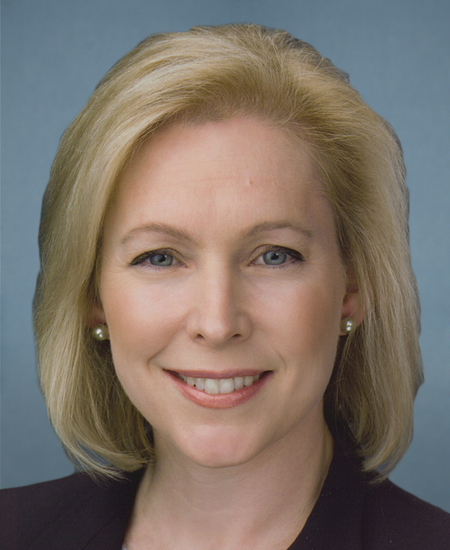
Sen. Kirsten E. Gillibrand
Sponsored bills
Maddy summaryS 2549, the Time Off to Vote Act, requires employers with 25 or more employees to provide workers with 2 hours of paid leave during open voting hours for federal elections. This covers voting in person, returning mail ballots, or other voting activities, with employers allowed to set the specific 2-hour window (excluding lunch breaks) but not denying the leave. The law prohibits retaliation against employees who take this leave and authorizes the Department of Labor to enforce it, imposing civil penalties of up to $10,000 per violation for noncompliance. It does not override stricter state voting leave laws but takes effect before the next federal election after enactment.
Maddy summaryThis bill permanently extends the enhanced premium tax credit for Affordable Care Act marketplace insurance plans, directly affecting millions of lower-income households (earning 150%-400% of the federal poverty level) who purchase coverage through state or federal marketplaces. It establishes a sliding-scale percentage system where the tax credit reduces monthly premiums based on income, starting at 0% for households earning up to 150% of poverty and increasing to 8.5% for those earning 300%-400% of poverty. The bill replaces temporary provisions with permanent rules, ensuring consistent cost-sharing support for eligible buyers. The changes apply to tax years beginning after December 31, 2025.
Maddy summaryThe Servicemembers and Veterans Empowerment and Support Act of 2025 improves support for veterans who experienced military sexual trauma by reforming how disability claims are processed and expanding access to care. It establishes specialized teams to review claims, changes evidence standards to include non-military sources like counseling records, and requires VA communications to include trauma resources. The bill expands eligibility for counseling and treatment to all former reserve members, ensures veterans get connected to health care services when submitting claims, and provides care options for those who withdraw from service academies. It also mandates annual accuracy reviews of claim processing and requires improved training for VA staff handling these cases.
Maddy summaryThis resolution (SRES 343) is a non-binding Senate recognition of the U.S. Preventive Services Task Force (USPSTF), which develops evidence-based recommendations for preventive health services. It specifically calls on the Department of Health and Human Services to reconvene the Task Force after a scheduled meeting was canceled, emphasizing that its work - covering preventive services like cancer screenings and chronic disease prevention - must continue without interruption or funding disruption. The resolution affirms the Task Force’s role in guiding insurance coverage of recommended preventive care under the Affordable Care Act. As a procedural resolution, it does not create new laws or alter policies.
Maddy summaryThe Medical Debt Relief Act of 2025 would prevent medical debt from appearing on credit reports and bar creditors from using medical debt to deny or limit credit. It defines medical debt as any balance from medical services, products, or devices and amends the Fair Credit Reporting Act to exclude such debt from adverse credit reporting. The bill also requires the Consumer Financial Protection Bureau to update regulations within one year to prohibit creditors from considering medical debt during credit decisions. This change would directly protect consumers - especially those with unexpected medical bills - from credit score damage unrelated to financial management.
Maddy summaryThe EATS Act of 2025 (S 2512) expands eligibility for the Supplemental Nutrition Assistance Program (SNAP) to include most college students. It directly affects full-time undergraduate students enrolled at least half-time in recognized higher education institutions by removing their current exclusion from SNAP benefits. The bill revises the definition of "household" under SNAP rules and eliminates the prior requirement that students meet separate conditions to qualify. This change, effective January 2026, would allow millions of students to access food assistance without additional barriers.
Maddy summaryThe John R. Lewis Voting Rights Advancement Act of 2025 strengthens voting rights protections by requiring preclearance for certain voting changes in jurisdictions with a history of discrimination. It establishes new preclearance requirements for changes to election methods, district boundaries, voter ID rules, and polling locations. The bill updates standards for determining when voting practices deny or abridge rights, particularly for racial, ethnic, and language minority groups. It also requires transparency about voting changes through public notices and strengthens enforcement mechanisms for voting rights violations. The bill directly affects states and localities with documented histories of voting discrimination, aiming to protect minority voters' rights.
Maddy summaryThis bill establishes that food products cannot use dairy product names like "yogurt," "milk," or "cheese" unless they meet specific U.S. Food and Drug Administration (FDA) standards for dairy. It directly affects food manufacturers who currently market non-dairy products (e.g., plant-based milks) using traditional dairy names. The bill amends federal law to require that any food using such names must be made primarily from mammal milk (lacteal secretion), not plant-based ingredients, and clarifies that the FDA will enforce this rule through new guidance. The FDA must issue enforcement guidance within 180 days and report on enforcement actions to Congress within two years.
Maddy summaryThis bill authorizes $50 million annually from 2026 through 2031 for the Centers for Disease Control and Prevention (CDC) to fund research on firearms safety and gun violence prevention. It directly affects the CDC and researchers by providing dedicated funding to study these topics under the Public Health Service Act. The key mechanism is a specific annual funding allocation, added to existing resources, to support new or ongoing research initiatives. The bill does not create new regulations or restrict gun ownership but focuses solely on enabling evidence-based research. This is a funding measure, not a policy change affecting the public directly.