

Maddy summaryThe Restoring Essential Healthcare Act repeals a provision that blocked Medicaid payments to certain healthcare providers. Specifically, it removes a restriction from Public Law 119-21 that prevented Medicaid from paying "prohibited entities" for services provided between the law's enactment and this bill's effective date. Payments for those services will now be made retroactively, as if the restriction had never existed. This directly affects Medicaid programs and the healthcare providers previously excluded from receiving these payments.
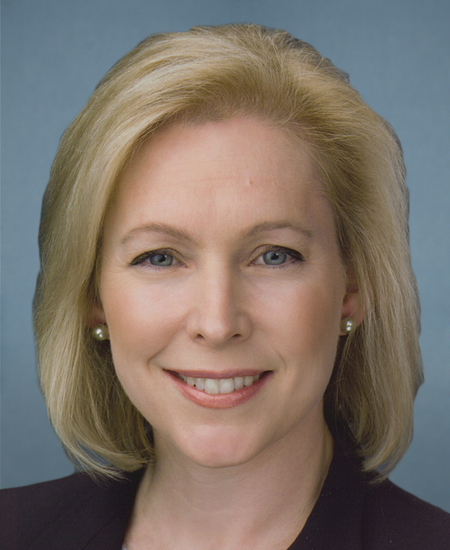
Sen. Kirsten E. Gillibrand
Sponsored bills
Maddy summaryThe Setting Consumer Standards for Lithium-Ion Batteries Act requires the Consumer Product Safety Commission (CPSC) to adopt three existing voluntary safety standards for lithium-ion batteries used in consumer products like e-bikes and personal electric mobility devices within 180 days of the bill's enactment. These standards, currently used by manufacturers, become mandatory for products defined as "consumer goods" under existing law. The bill also establishes a process for updating these standards if revised by the original organizations, giving the CPSC 90 days to decide whether to adopt changes. Additionally, the CPSC must submit a report to Congress within five years detailing battery-related fire or explosion incidents, including product models, compliance status, and manufacturer information.
Maddy summaryThis bill requires the Department of Defense to request modifications to stormwater discharge permits at military facilities, mandating quarterly testing for PFAS (chemicals used in firefighting foams and other military products) and implementation of best practices to reduce discharges. It applies to all DoD facilities with active permits under the Clean Water Act, with exceptions for permits already containing these requirements. The bill also directs that at least 1% of annual funds allocated for PFAS remediation must be used for monitoring and reduction activities at these facilities. These provisions aim to standardize PFAS testing and controls across military sites without creating new regulatory standards.
Maddy summarySRES 338 is a non-binding Senate resolution recognizing how the Americans with Disabilities Act (ADA) of 1990 enables independent living and economic self-sufficiency for people with disabilities. It highlights that over one-third of disabled individuals rely on Medicaid for health coverage and community-based care, yet many remain in segregated institutions due to Medicaid limitations and insufficient community services. The resolution calls for bipartisan action to strengthen Medicaid funding, oppose cuts or work-reporting requirements that hinder access to care, and expand home-based services to support employment and community living. It specifically urges federal agencies to improve accessibility in housing, transportation, emergency services, and competitive employment opportunities for people with disabilities, particularly those of color facing systemic barriers. This resolution does not create new law but advocates for policy changes to fulfill the ADA’s promise.
Maddy summaryThe Transformation to Competitive Integrated Employment Act (S 2438) aims to transition people with disabilities from special certificates (which allow employers to pay below minimum wage) to competitive integrated employment. It establishes grant programs for states and eligible entities to help employers transform their business models to provide competitive wages (at least minimum wage or customary rates for similar work) and integrated services. The bill phases out special certificates with a 5-year sunset provision (ending 5 years after enactment) and requires employers to transition employees to competitive integrated employment settings. It also mandates data collection, evaluation, and stakeholder engagement, with a focus on involving people with disabilities and their families in the transition process.
Maddy summaryThe Resident Physician Shortage Reduction Act of 2025 adds 14,000 new residency training positions over seven years (2027-2033), distributing 2,000 annually through a structured application process. It directly affects hospitals applying for these positions, requiring them to commit to filling the new spots and prioritizing rural hospitals, those serving health shortage areas, and hospitals affiliated with historically Black medical schools. Key mechanisms include seven annual application rounds, rules for carrying over unused positions, and minimum distribution quotas (e.g., 10% to rural hospitals). The bill also mandates a study on increasing diversity in the health workforce, with a report due to Congress within two years.
Maddy summaryThis bill establishes minimum salary ($45,000 annually for full-time) and wage ($30/hour for part-time) standards for paraprofessionals and education support staff in public schools. It authorizes $25 billion in federal funding for fiscal year 2026 with annual increases tied to inflation or 2%, to help states meet these requirements. States must submit implementation plans to ensure full-time staff meet the minimum salary and part-time staff meet the minimum wage within four years, with 98% of funds going directly to local school districts. The legislation directly affects school support staff, school districts, and state education agencies across the country.
Maddy summaryThis bill expands health coverage access for military families by modifying the TRICARE Young Adult Program. It directly affects military service members' children aged 21-26 who previously faced eligibility restrictions or separate fees. Key changes include removing a prior age limit that excluded some young adults and eliminating a separate premium for this coverage. The result is simplified access to health care under TRICARE without additional costs for qualifying dependents. These updates apply to existing TRICARE benefits, not new programs.
Maddy summaryThe O DAIRY Act of 2025 provides targeted support for organic dairy farmers by extending emergency disaster assistance to cover losses from rising organic feed costs that reduce net income by over 10% annually. It requires the USDA to collect and publish detailed cost-of-production data for organic milk, including regional feed prices and milk sales data through a new monthly "Organic All Milk Prices Survey." The bill also mandates the development of a safety net program prioritizing small organic dairy operations and establishes a $20 million infrastructure funding program to support regional processing facilities, farm aggregation systems, and new organic dairy processing plants serving small producers. Additionally, it creates five-year-funded "Regional Organic Dairy Market Specialists" to research marketing challenges and recommend policies to improve market access and competition.
Maddy summaryThe Stop the Scammers Act establishes a whistleblower reward program for individuals reporting violations of federal consumer financial law (e.g., scams, fraud). Whistleblowers who provide original information leading to successful enforcement actions by the Consumer Financial Protection Bureau (CFPB) may receive 10-30% of recovered civil penalties (minimum $50,000 if penalties are under $1 million). The bill mandates strong confidentiality protections for whistleblowers, prohibits employers from waiving these rights via contracts, and requires the CFPB to report annually on the program. It directly affects whistleblowers in consumer finance cases and the CFPB’s enforcement process, not the general public.