

Maddy summaryThis bill (S 614) designates a specific street area in Washington, D.C. (Sumner Row NW between 16th Street and L Street NW) as "Alexei Navalny Way." It directly affects the physical location by requiring the District of Columbia to install new street signs bearing this name, replacing references to the area in official records. The bill honors Alexei Navalny, a Russian anti-corruption activist and dissident who died in a Russian prison in February 2024 after enduring government persecution, including poisoning attempts. The designation serves as a symbolic gesture of U.S. solidarity with Russian citizens advocating for democratic freedoms.
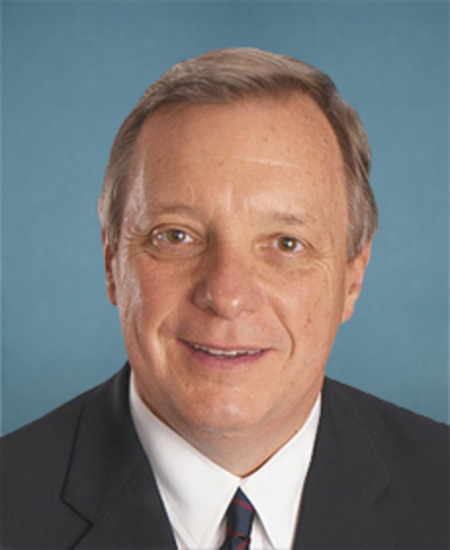
Sen. Richard J. Durbin
Sponsored bills
Maddy summarySRES 80 is a Senate resolution introduced on February 13, 2025, expressing gratitude to the Joint Congressional Committee on Inaugural Ceremonies, the Architect of the Capitol, the Sergeant at Arms, the Secretary of the Senate, law enforcement officers, emergency personnel, and volunteers. It specifically acknowledges their work during the January 20, 2025 inauguration of President Donald J. Trump, noting their efforts to adapt to cold weather challenges that required relocating events indoors. The resolution has no policy impact and serves solely as a ceremonial acknowledgment of their contributions to the inauguration's security and success.
Maddy summaryThe Department of Energy Quantum Leadership Act of 2025 enhances the Department of Energy's quantum research program by creating new initiatives to advance quantum information science, engineering, and technology. It establishes National Quantum Information Science Research Centers, a Quantum Instrumentation and Foundry Program to develop domestic quantum supply chains, and a Quantum User Expansion program to enable software development for quantum systems. The bill includes specific funding levels through 2030 ($175 million annually for the main program, $50 million annually for instrumentation), requires coordination with other federal agencies, and includes restrictions on funding for quantum research involving certain foreign entities of concern. It also includes provisions for workforce development through traineeships focused on underrepresented students in quantum fields. These changes aim to accelerate U.S. leadership in quantum technology development and commercialization.
Maddy summaryThe SAD Act prohibits crisis pregnancy centers (CPCs) from making deceptive claims about offering abortion services, contraception, or licensed medical care. It targets CPCs - anti-abortion organizations that mislead patients with false information, often near community health centers - to prevent them from discouraging access to reproductive care. The Federal Trade Commission (FTC) enforces the law, with penalties up to $100,000 per violation or 50% of a CPC’s revenue, and requires annual FTC reports on enforcement actions. This directly affects CPCs and aims to ensure accurate information for people seeking abortion care, particularly low-income women and women of color facing heightened barriers post-Dobbs.
Maddy summaryThis bill amends the Clean Air Act to expand fuel options for retailers and support small refineries. It allows fuel blends containing 10-15% ethanol to meet vapor pressure requirements during high ozone seasons, replacing previous state-specific limits with a nationwide standard. Additionally, it enables small refineries to reclaim retired renewable fuel credits from 2016-2018 compliance years or apply them to future obligations under specific conditions. The changes directly affect fuel retailers selling ethanol-blended gasoline and small refineries participating in the renewable fuel program.
Maddy summaryThis bill establishes a new Office of Gun Violence Prevention within the Department of Justice to coordinate federal efforts addressing gun violence. The Office, led by a Director appointed by the Attorney General, will integrate existing Justice Department programs (like background checks and victim services), evaluate their effectiveness, identify data gaps, and develop evidence-based recommendations for Congress and the President. It will also conduct public education campaigns on safe firearm storage and suicide prevention, assist communities after gun violence incidents (such as mass shootings), and coordinate with other federal agencies including Health and Human Services and Education. The Office must issue annual reports detailing gun violence trends and policy recommendations, supported by an Advisory Council including survivors, public health officials, and community representatives.
Maddy summaryThe Age 21 Act (S 597) would prohibit individuals under 21 years old from purchasing certain firearms and related items. The bill specifically targets semiautomatic assault weapons, certain pistols, shotguns, and large-capacity ammunition feeding devices by amending Section 922 of Title 18. It defines detailed categories of firearms that would be covered, including specific models like AR-15s and AK-47s, as well as features like detachable magazines that hold more than 10 rounds. The bill would require sellers to verify that buyers are at least 21 years old for these specific firearms and ammunition types. This would directly affect young adults aged 18-20 who would no longer be able to purchase these defined firearms.
Maddy summaryThis resolution expresses the Senate's non-binding position that the U.S. should not deploy military assets or personnel to Gaza for the purpose of "taking over" the territory. It directly addresses the executive branch, opposing any military actions that could lead to U.S. control of Gaza, which the Senate cites as violating constitutional requirements for congressional authorization of military force. The resolution references President Trump's February 4, 2025, comments about taking over Gaza and emphasizes concerns about regional relations, humanitarian impacts, and taxpayer costs. It does not create new law but formally states the Senate's opposition to such military deployments.
Maddy summaryThis bill allows states to waive the 35-mile rule for certain rural hospitals seeking Critical Access Hospital (CAH) designation under Medicare. It targets hospitals that are sole community hospitals, Medicare-dependent small rural hospitals, low-volume hospitals, or subsection (d) hospitals located in high-poverty or health professional shortage areas, with two consecutive years of negative margins. To qualify, hospitals must commit to adding high-demand services like obstetrics or behavioral health and submit annual reports on these services. The bill caps total CAH designations at 120 nationwide (5 per state) and requires transition to new payment models after 9 years. It also mandates studies by GAO and MedPAC to evaluate impacts on access and costs.
This resolution supports the designation of Career and Technical Education Month to celebrate career and technical education across the United States.