

Protecting Sensitive Locations Act This bill prohibits immigration enforcement actions within 1,000 feet of a sensitive location except in exigent circumstances, such as the imminent risk of death, violence, or physical harm to any person. Sensitive locations include health care facilities; schools and school bus stops; places that provide assistance for people such as children, pregnant women, and abuse victims; child care facilities; places that provide disaster or emergency services; places of worship; courthouses and lawyers’ offices; facilities used as polling places; certain labor union facilities; and public assistance offices. The prohibition shall apply to Department of Homeland Security officers and agents, as well as state employees pursuing immigration enforcement actions. If an enforcement action is carried out in violation of this prohibition (1) no information resulting from the action may be entered into the record in a resulting removal proceeding, and (2) the affected individual may move to immediately terminate such a proceeding. U.S. Immigration and Customs Enforcement and U.S. Customs and Border Protection shall annually report to Congress about enforcement actions taken at sensitive locations in the preceding year.
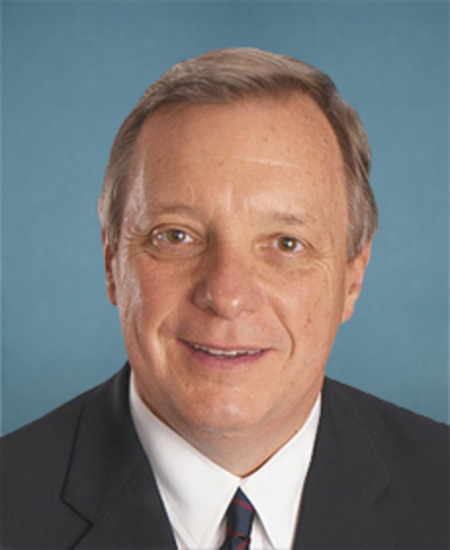
Sen. Richard J. Durbin
Sponsored bills
Maddy summaryS 468, the SECURE Firearm Storage Act, requires federally licensed firearm importers, manufacturers, and dealers to securely store firearms and paper records when their business premises are closed. It mandates that firearms must be secured using a hardened steel rod through the trigger guard (with specific locks and anchoring) or stored in locked fireproof safes, cabinets, or vaults. The bill also requires secure storage for paper transaction records and allows the Attorney General to set additional security rules for businesses. Violations trigger tiered penalties: $1,000-$10,000 fines for first offenses, license suspension for second offenses, and license revocation for third offenses. The storage requirements for firearms take effect one year after enactment, while paper record rules begin 90 days after enactment.
Maddy summaryThis bill creates a new "Director of Foreign Assistance" position within the U.S. Department of State, requiring Senate confirmation and mandating that the Director report directly to the Deputy Secretary of State. The Director's duties include coordinating all U.S. foreign aid programs across agencies (like USAID and the Treasury), aligning aid with national security goals, tracking results through data analysis, and improving transparency in spending. The bill also requires all foreign aid funds to be obligated (committed for spending) within 90 days of congressional appropriations. This position directly affects how the State Department and other federal agencies manage and report on foreign assistance programs.
This resolution condemns Russia's nuclear escalatory rhetoric and implied threats on the potential use of nuclear weapons in the context of its invasion of Ukraine. The resolution also (1) condemns Russia's purported suspension of participation in the New START Treaty, (2) emphasizes the value of arms control agreements between the United States and Russia, and (3) calls on the administration to continue pursuing nuclear arms control and risk reduction with Russia and China.
Maddy summaryThis bill expands access to job-protected leave under the Family and Medical Leave Act (FMLA) by reducing the required employment duration from 12 months to 90 days for most workers. It also broadens coverage to apply to all employers, regardless of size (down from the previous 50+ employee threshold), affecting nearly all private and public sector workers. Key provisions include modifying FMLA eligibility rules, adjusting federal employee leave requirements, and updating congressional employee provisions to align with the new 90-day standard. The changes apply to leave taken on or after the bill's enactment date.
Maddy summaryThe "No Tax Breaks for Outsourcing Act" (S 409) amends U.S. tax rules to prevent corporations from avoiding taxes through foreign operations. It changes the definition of taxable foreign income from "global intangible low-taxed income" to "net CFC tested income" and requires country-by-country reporting of income for tax purposes. The bill also limits interest deductions for certain corporations in international financial reporting groups and modifies rules for "inverted corporations" (foreign companies that acquire U.S. companies to avoid taxes). These changes aim to close tax loopholes that allow companies to outsource operations to foreign jurisdictions while reducing their U.S. tax burden. The bill's provisions would generally apply to taxable years beginning after December 31, 2024.
Maddy summaryS 422, the Right to Contraception Act, establishes a federal statutory right for individuals to access contraceptives and for healthcare providers to offer contraceptive services, free from state restrictions. It directly affects all Americans seeking or providing contraception, particularly protecting historically marginalized groups like people of color, immigrants, LGBTQ+ individuals, and low-income or rural residents who face barriers to care. The bill overrides state laws that restrict access - such as bans on specific contraceptives, provider refusal policies based on personal beliefs, or Medicaid restrictions - and prohibits government actions that impede this right. Enforcement allows the Attorney General or affected individuals to challenge violations in court, with courts required to strike down restrictive laws.
Maddy summaryThe Caring for All Families Act expands family medical leave eligibility under the FMLA to include domestic partners, in-laws, grandparents, grandchildren, siblings, and others with a "close association equivalent to a family relationship." It adds a new provision allowing employees to take up to 24 hours per year for school activities, routine medical care for family members, or care for elderly individuals considered family. The bill specifies that this new leave can be taken intermittently, may be substituted with accrued paid leave, and requires employees to provide at least 7 days' notice for scheduled leave. This policy change directly affects private employers covered by FMLA and federal employees who qualify for leave under these expanded provisions.
Maddy summarySRES 55 is a Senate resolution designating January 2025 as "National Mentoring Month." It formally recognizes the value of mentoring relationships in supporting youth development, highlighting benefits like improved academic outcomes, mental health, career exploration, and reduced juvenile delinquency. The resolution encourages expanding mentoring programs in communities, schools, and workplaces to address the "mentoring gap" where one-third of U.S. youth lack consistent mentorship. As a symbolic measure, it aims to raise public awareness and promote cross-sector collaboration without creating new laws or funding.
Maddy summaryS 391, the Access to Counsel Act of 2025, requires U.S. Customs and Border Protection to provide certain immigrants access to legal counsel during immigration inspections at ports of entry or during deferred inspection. It directly affects individuals including lawful permanent residents returning from travel, visa holders, refugees, asylees, and parolees. The bill mandates that immigration officers ensure a meaningful opportunity for counsel consultation within one hour of inspection starting, including phone access, and allows counsel to present evidence to officers. Special rules require lawful permanent residents to receive legal advice before signing a form abandoning their status, unless they voluntarily waive this right in writing. The law takes effect 180 days after enactment and does not override existing rights to counsel under other immigration laws.