

Maddy summaryS 726, titled "Ethan's Law," requires gun owners to store firearms securely in homes where minors (under 18) or individuals ineligible to own guns (per federal/state law) reside. It makes unsecured storage unlawful if a person "knows or reasonably should know" access is possible, with exceptions for gun safes, secure locations, or carrying firearms on one's person. Violations incur $500 fines per offense, and enhanced penalties apply if injury or death occurs. The bill also creates a federal grant program to support states with similar secure-storage laws and states that non-compliance constitutes negligence. This law directly affects households with minors or prohibited individuals, aiming to reduce accidental shootings, youth access, and firearm thefts.
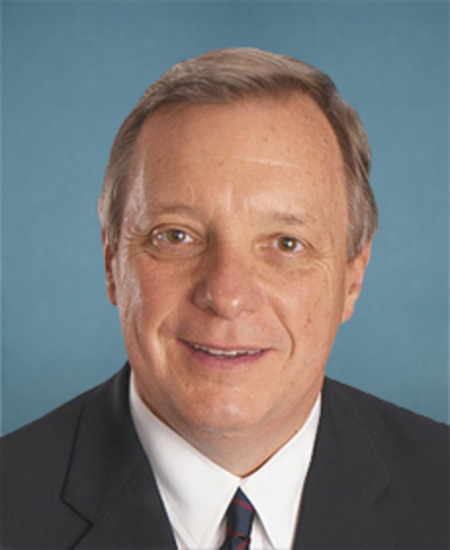
Sen. Richard J. Durbin
Sponsored bills
Maddy summaryThis Senate resolution (SRES 91) commemorates the third anniversary of Russia's full-scale invasion of Ukraine (launched February 24, 2022) and expresses U.S. Senate support for Ukraine. It symbolically affirms U.S. solidarity with Ukraine, rejects Russia's territorial seizures, reaffirms U.S. support for Ukraine's sovereignty and territorial integrity within its 1991 borders, and encourages continued international efforts to counter Russian aggression. As a non-binding resolution, it does not create new laws or directly affect any individuals or groups but serves as a formal statement of congressional support for Ukraine.
Maddy summaryS 696 creates "Ukrainian guest status" for individuals paroled into the U.S. under the Uniting for Ukraine program (announced April 2022). This status, effective from their initial parole date, grants eligible Ukrainians employment authorization and temporary legal presence. The status expires 120 days after the Secretary of State certifies that Ukraine hostilities have ended and safe return conditions exist. It can be revoked if the Secretary of Homeland Security determines an individual meets specific grounds under immigration law. This bill directly affects Ukrainians admitted through the Uniting for Ukraine parole process.
Maddy summaryThis Senate resolution (SRES 88) designates March 7, 2025, as "National Speech and Debate Education Day" to recognize the value of speech and debate programs in schools. It directly affects educational institutions, teachers, and students by encouraging schools and communities to celebrate this day. The resolution does not create new laws or funding but formally acknowledges speech and debate education as vital for developing communication, critical thinking, and civic skills. It urges educational institutions, businesses, and the public to promote awareness of these programs. (Note: As a commemorative resolution, it has no binding policy impact.)
Maddy summarySRES 89 is a symbolic Senate resolution designating February 15-22, 2025, as "National FFA Week." It recognizes the National FFA Organization’s role in developing student leadership through agricultural education and celebrates two milestones: the 90th anniversary of New Farmers of America (a historically Black agricultural youth group) and the 75th anniversary of the Federal charter for Future Farmers of America (signed by President Truman in 1950). The resolution does not create new laws or obligations but formally expresses congressional support for these observances. It affects no specific group or policy, serving solely as a ceremonial acknowledgment.
Maddy summaryThis resolution designates February 2025 as "American Heart Month" in the United States. It is a symbolic recognition, not a law with new funding or requirements, aimed at raising public awareness about cardiovascular disease (CVD). The resolution encourages Americans to learn about CVD risks and supports existing efforts to promote heart health awareness, research, and prevention. It does not create new policies or affect specific groups, but aligns with the longstanding tradition of presidential proclamations for this observance.
Maddy summaryThis bill prohibits federal funding for Executive Order 14160 (and any successor policies), which attempted to deny U.S. citizenship to children born in the U.S. to non-citizen parents. It directly affects the executive branch by blocking financial support for the controversial order, which contradicted the 14th Amendment and established court precedent like *United States v. Wong Kim Ark*. The bill’s key mechanism is a funding ban, ensuring no government resources can be used to implement policies that undermine birthright citizenship guaranteed by the Constitution and immigration law. It does not alter citizenship rules but prevents enforcement of the challenged executive order.
Maddy summaryS 652 requires social media influencers and healthcare providers to avoid false or misleading promotions of FDA-approved drugs on social media, including disclosing key safety information like side effects in a summary format similar to traditional drug ads. It makes these individuals liable for civil penalties if they knowingly or recklessly omit critical facts or fail to include required safety summaries. The bill also directs the FDA to issue new guidance on enforcement, monitor drug ads using AI, and conduct market surveillance on social media platforms. This affects influencers, healthcare providers, and drug manufacturers who pay for such promotions, with the FDA authorized to spend $15 million annually for enforcement.
Maddy summaryThis bill (S 661) amends existing law to expand legal protections for postal facilities. It replaces the term "post office" throughout Section 404(d) with a broader definition covering "any acceptance, processing, shipping, delivery, distribution, or other facility owned or operated by the Postal Service that supports one or more post offices." This directly affects mail processing centers, distribution hubs, and other support facilities operated by the U.S. Postal Service. The key change ensures these supporting facilities receive the same legal protections previously applied only to traditional post offices.
Maddy summaryThis bill (S 634) amends U.S. Code § 4001 to prohibit federal authorities from detaining individuals solely based on protected characteristics. It directly affects anyone detained by federal law enforcement, banning detention based on race, ethnicity, national origin, religion, sex, gender identity, sexual orientation, disability, or any additional characteristic the Attorney General designates. The key provision adds a new subsection requiring that no one be imprisoned or detained "based solely on an actual or perceived protected characteristic," with the Attorney General having authority to expand the list of protected traits. This creates a clear legal standard to prevent discriminatory detention practices under federal law.