This resolution designates the week of May 9-May 15, 2021, as National Police Week.
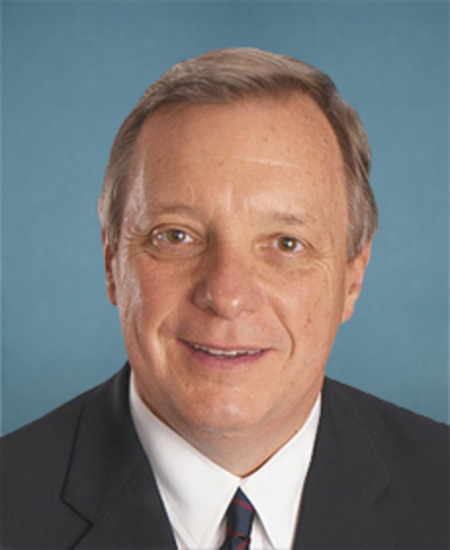
Sen. Richard J. Durbin
Sponsored bills
Protect Women's and Girls' Rights in Afghanistan Act of 2021 This bill requires the Department of State to periodically report to Congress on the conditions of women and girls in Afghan civil society following the departure of U.S. and NATO forces. The reports shall also assess the status of assurances made by the Taliban related to preserving the rights of women and girls in Afghanistan.
Gym Mitigation and Survival Act of 2021 or the GYMS Act of 2021 This bill establishes a grant program to provide economic support to eligible fitness facilities in response to the COVID-19 (i.e., coronavirus disease 2019) pandemic. Specifically, the bill authorizes the Small Business Administration to make initial and supplemental grants to privately owned fitness facilities that primarily provide health or fitness services and that do not offer golf, hunting, sailing, or riding facilities. The total amount of grant funds for a recipient may not exceed $25 million, and the recipient must use these funds for payroll costs, rent or mortgage obligations, and other ordinary and necessary business expenses.
Merger Filing Fee Modernization Act of 2021 This bill modifies and expands the schedule for graduated merger filing fees and requires that such fees be adjusted each year based on the Consumer Price Index.
This resolution designates May 9-May 15, 2021, as Doula Week and recognizes the role of doulas in providing maternal health services.
Flood Mapping Modernization and Homeowner Empowerment Pilot Program Act of 2021 This bill directs the Federal Emergency Management Agency (FEMA) to carry out a pilot program to make grants to local governments to (1) enhance the production of maps relating to urban flooding and associated property damage; and (2) increase the availability of such maps to homeowners, businesses, and localities to enable them to minimize urban flooding risk. The grants may only be made to local governments in urbanized areas with populations greater than 50,000 or to stormwater management authorities in those localities.
Citizenship for Essential Workers Act This bill establishes a mechanism for eligible aliens who worked as essential workers during the declared COVID-19 (i.e., coronavirus disease 2019) public health emergency to apply for and obtain permanent resident status. The bill also narrows certain grounds for deportability and inadmissibility. To be eligible for permanent resident status under this bill, an alien must have earned income at any point during the COVID-19 emergency period doing work deemed essential by the Department of Homeland Security (DHS) or a state or local government. An alien may also be eligible if that alien is a parent, spouse, or child of (1) an eligible alien who died from COVID-19, or (2) a member of the Armed Forces. Certain aliens shall be ineligible, such as an alien who was a refugee on January 1, 2021. To obtain permanent resident status under this bill, an applying alien must satisfy additional requirements, including by passing a background check. Furthermore, the bill repeals provisions providing for three-year bars and permanent bars to admission into the United States. (Generally, these bars apply to aliens who were previously removed or unlawfully present in the United States.) The bill also narrows the scope of certain crime-based grounds for inadmissibility or deportability, such as by redefining the term conviction to exclude expunged convictions. The Department of Justice or DHS may waive certain grounds of inadmissibility or deportability (1) for humanitarian purposes, (2) to ensure family unity, or (3) for the public interest.

This resolution supports the designation of National Crime Victims' Rights Week and its theme— Support Victims. Build Trust. Engage Communities .
Disclosure of Tax Havens and Offshoring Act This bill requires certain issuers of securities to annually disclose information related to the tax jurisdiction, income, and assets of their constituent entities on a country-by-country basis.
Student Food Security Act of 2021 This bill expands the Supplemental Nutrition Assistance Program (SNAP) and establishes programs to address food insecurity among college students. Specifically, the bill permanently modifies the eligibility requirements to allow additional college students to receive SNAP benefits, and it establishes a demonstration program to allow college students to use SNAP benefits on college campuses instead of meal plans. The bill also advances implementation of certain data-sharing agreements and notifications to help students who apply for federal financial aid to also apply for and receive other federal means-tested benefits (e.g., Section 8 tenant-based housing assistance, Medicaid, and Supplemental Security Income). In addition, the bill (1) requires questions about food and housing insecurity to be incorporated into the National Postsecondary Student Aid Study, and (2) establishes a grant program to support research and address incidences of food and housing insecurity among college students.