

Military Child Care Expansion Act of 2021 This bill modifies and implements policies to update child care facilities and administration at the Department of Defense (DOD). Specifically, the bill removes certain requirements for members of the Armed Forces to receive funding for an in-home child care provider under the DOD pilot program that provides financial assistance to such members who pay for in-home child care. The bill also allows DOD to expand the pilot program to additional locations (currently it is authorized for five). DOD must establish a three-year pilot program to expand access to child care for members of the Armed Forces by entering into agreements with public or private child care facilities or development centers. Under the bill, DOD must determine the (1) root causes contributing to poor or failing facility conditions at its child development centers, and (2) total cost to improve the conditions of such centers. The Government Accountability Office must review the determinations and make recommendations on how to improve DOD child development center conditions. Lastly, DOD must utilize its existing authority to carry out minor military construction projects to construct child development centers.
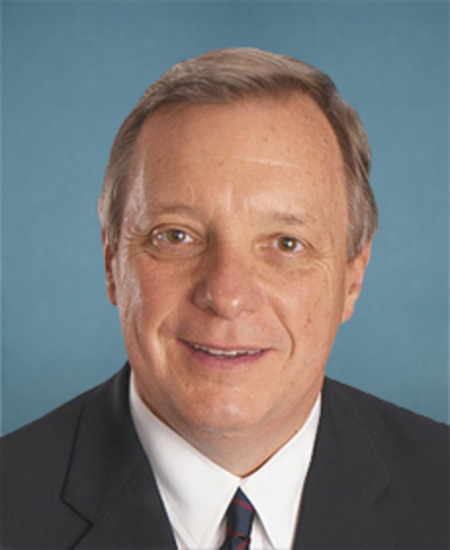
Sen. Richard J. Durbin
Sponsored bills
Helping to Encourage Real Opportunities (HERO) for Youth Act of 2021 This bill modifies the work opportunity tax credit to (1) change the credit for summer youth employees to a credit for youth employees who will be employed for not more than 20 hours per week during any period between September 16 and April 30 in which the youth employee is attending any secondary school, (2) increase the amount of the credit for youth employees, and (3) expand the credit to include disconnected youth. The bill defines disconnected youth to include any individual who (1) is certified as having attained age 16 but not age 25 on the hiring date; and (2) has self-certified as not having regularly attended any secondary, technical, or post-secondary school during the 6-month period preceding the hiring date, has not been regularly employed during such period, and is not readily employable due to a lack of basic skills. The term also includes individuals who have been certified (1) as having attained age 16 but not age 21 on the hiring date, and (2) as eligible foster children in foster care during the 12-month period ending on the hiring date.
Servicemember Parental Leave Equity Act This bill modifies Department of Defense parental leave provisions for members of the Armed Forces. Specifically, the bill increases parental leave for primary caregivers to 18 weeks (currently 12) following the birth of a child and to 12 weeks (currently 6) following the adoption of a child. The bill increases parental leave for a secondary caregiver from 21 days to 12 weeks in connection with the birth or adoption of a child. Primary or secondary caregivers of a long-term foster child are authorized to take up to 12 weeks of leave in connection with such placement. Parental leave for a primary or secondary caregiver for a birth, adoption, or foster child placement may be taken in more than one increment. For primary caregivers, the leave must be utilized within one year of the event. The bill authorizes up to 12 weeks of leave to certain service members who would have been secondary caregivers but for a miscarriage, stillbirth, or infant death. The following activities required of an active-duty member within a 12-month postpartum period must have the approval of a health care provider and be at the election of the member or in the interest of national security: (1) an order of temporary duty overnight travel or to participate in physically demanding field training exercises, (2) meeting of body composition standards, or (3) passing a physical fitness test. The bill also reduces the service commitment required for participation in the Career Intermission Program.
Technical Reset to Advance the Instruction of Nurses Act or the TRAIN Act This bill modifies the methodology and application of Medicare Advantage nursing and allied health education payments for hospitals. Specifically, for 2010-2019, the bill eliminates the annual cap on total payments and excludes any resulting increase from factoring into calculations for graduate medical education payments for such hospitals. (The Centers for Medicare & Medicaid Services recently issued guidance providing for the recalculation and correction of certain payments to account for the annual payment cap.)
Creating Pathways for Youth Employment Act This bill directs the Department of Labor to award grants, on a competitive basis, to assist states, local governments, and Indian tribes or community-based organizations in providing subsidized summer and year-round employment opportunities to certain at-risk youth who are not younger than 14 or older than 24, and are unemployed.
America's Red Rock Wilderness Act This bill designates specified lands in the following areas of Utah as components of the National Wilderness Preservation System: (1) Great Basin, (2) Grand Staircase-Escalante, (3) Moab-La Sal Canyons, (4) Henry Mountains, (5) Glen Canyon, (6) San Juan-Anasazi, (7) Canyonlands Basin, (8) San Rafael Swell, and (9) Book Cliffs and Uinta Basin. The bill sets forth administrative requirements for (1) the exchange of state-owned lands within such areas, (2) federal reservation of water rights, (3) measurement of setbacks for roads with adjacent wilderness, (4) authorized livestock grazing, and (5) withdrawal of such lands from disposition under certain public land laws.
This resolution sets forth procedures that allow Senators to cast their votes from outside of the Senate chamber. Specifically, these votes may be cast using certain technology approved by the Secretary of the Senate and Sergeant at Arms and Doorkeeper if the majority leader and minority leader jointly determine that an extraordinary crisis of national extent exists in which it would be infeasible for Senators to cast their votes in person.
This resolution thanks the teachers of the United States and promotes the teaching profession by encouraging students, parents, school administrators, and public officials to recognize National Teacher Appreciation Week.
This resolution condemns the acts of gun violence that led to the tragic loss of eight lives in Georgia on March 16, 2021.
This resolution condemns all manifestations of expressions of racism and anti-Asian and Pacific Islander or ethnic intolerance and calls for specified actions by the Senate Judiciary Committee, the Department of Justice (DOJ), and federal law enforcement. The resolution (1) calls on the Senate Judiciary Committee to consider holding a hearing related to the surge in violence against Asian Americans and Pacific Islanders, and (2) applauds DOJ's commitment to conducting a 30-day review of violence against Asian Americans and Pacific Islanders. The resolution calls on federal law enforcement officials, working with state and local officials, to expeditiously and vigorously investigate all reports of hate crimes against Asian Americans and Pacific Islanders in the United States, work to improve the reporting of such hate crimes, and hold the perpetrators of those crimes accountable and bring the perpetrators to justice.