End the Threat of Default Act This bill repeals the public debt limit, which applies to most debt held by the federal government.
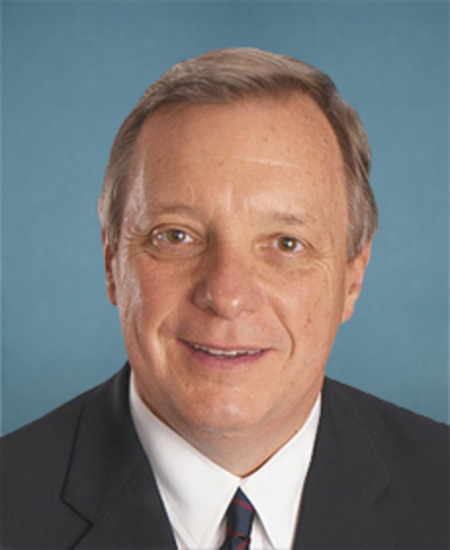
Sen. Richard J. Durbin
Sponsored bills
COVID - 19 Hate Crimes Act This bill requires a designated officer or employee of the Department of Justice (DOJ) to facilitate the expedited review of hate crimes and reports of hate crimes. DOJ must issue guidance for state, local, and tribal law enforcement agencies on establishing online hate crime reporting processes, collecting data disaggregated by protected characteristic (e.g., race or national origin), and expanding education campaigns. Additionally, DOJ and the Department of Health and Human Services must issue guidance aimed at raising awareness of hate crimes during the COVID-19 (i.e., coronavirus disease 2019) pandemic. The bill establishes grants for states to create state-run hate crimes reporting hotlines. It also authorizes grants for states and local governments to implement the National Incident-Based Reporting System and to conduct law enforcement activities or crime reduction programs to prevent, address, or respond to hate crimes. Finally, in the case of an individual convicted of a hate crime offense and placed on supervised release, the bill allows a court to order that the individual participate in educational classes or community service as a condition of supervised release.
This resolution calls for the immediate cessation of hostilities in the Tigray region of Ethiopia and condemns all violence against civilians. Further, the resolution calls on Eritrea to withdraw its military forces from Ethiopia, and it urges all parties to the conflict to cease hostilities and work to protect human rights. The resolution also calls on relevant U.S. agencies to take specified actions that encourage an end to the conflict and provide humanitarian support.
Census Improving Data and Enhanced Accuracy Act or the Census IDEA Act This bill prohibits the Department of Commerce, in the 2030 decennial census of population and each decennial census thereafter, from (1) implementing any major operational design element that has not been researched, studied, and tested for a period of at least three years before the decennial census date; or (2) including on the questionnaire for the census any subject, type of information, or question that was not submitted to Congress. The Government Accountability Office shall determine and report to Congress on whether the subjects, types of information, and questions to be included in that decennial census have been adequately researched, studied, and tested to the same degree as in previous decennial censuses.
Helping American Victims Afflicted by Neurological Attacks Act of 2021 or the HAVANA Act of 2021 This bill specifically authorizes the Central Intelligence Agency, the Department of State, and other agencies to provide payments to agency personnel who incur brain injuries from hostilities while on assignment. Specifically, the bill allows agency personnel and their families to receive payments for brain injuries that are incurred (1) during a period of assignment to a foreign duty station; (2) in connection with war, insurgency, hostile acts, terrorist activity, or other agency-designated incidents; and (3) not as the result of willful misconduct. The bill's authority applies to injuries incurred before, on, or after the date of the bill's enactment. Agencies must submit classified reports on the bill's implementation, including the number of payments made and the amount of each payment. Since 2016, some intelligence, diplomatic, and other governmental personnel have reported experiencing unusual cognitive and neurological impairments while on assignment (particularly abroad), the source of which is currently under investigation. Symptoms were first reported by personnel stationed in Cuba and have since been collectively referred to as Havana Syndrome .

This resolution expresses the sense of the Senate that the United States must (1) accelerate the electrification of households, buildings, and businesses; (2) modernize the electricity grid; and (3) continue on the path towards decarbonizing electricity generation by 2035.
This resolution expresses support for the goals and ideals of National Sexual Assault Awareness and Prevention Month.
This resolution urges the Senate to give its advice and consent to the ratification of the United Nations Convention on the Law of the Sea. The resolution affirms that it is in the national interest for the United States to become a formal signatory of the convention, and it recommends that this ratification remain a top federal priority.
This resolution urges the United Kingdom (UK) and the European Union (EU) to support peace on the island of Ireland and the principles, objectives, and commitments of the Good Friday Agreement. The resolution also expresses support for subsequent agreements relating to the relationship between Northern Ireland and the Republic of Ireland, including the agreement concerning the UK's withdrawal from the EU. (The island of Ireland is divided between Northern Ireland, which is part of the UK, and the Republic of Ireland, an EU member state.)
Paying a Fair Share Act of 2021 This bill requires an individual taxpayer whose adjusted gross income exceeds $1 million (high-income taxpayer) to pay a minimum tax rate of 30% of the excess of the taxpayer's adjusted gross income over the taxpayer's modified charitable contribution deduction for the taxable year (tentative fair share tax). The amount of the tax is the excess (if any) of the tentative fair share tax over the excess of (1) the sum of the taxpayer's regular tax liability, the alternative minimum tax (AMT) amount, and the payroll tax for the taxable year; over (2) certain tax credits. The bill provides for a phase-in of such tax and requires an inflation adjustment to the $1 million income threshold for taxable years beginning after 2021. The bill also expresses the sense of the Senate that Congress should enact tax reform that repeals unfair and unnecessary tax loopholes and expenditures, simplifies the tax system, and makes sure that the wealthiest taxpayers pay a fair share of taxes.