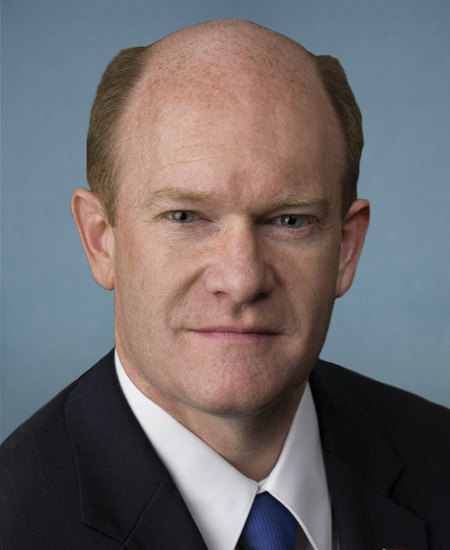
This resolution recognizes the 30th anniversary of the founding of the Department of Defense State Partnership Program and its outsized influence in developing and supporting enduring relationships around the world. The resolution also expresses deep gratitude for the service of members of the National Guard to the program.
Sen. Christopher A. Coons
Sponsored bills
Maddy summarySRES 20 is a Senate resolution condemning the February 1, 2021, military coup in Burma (Myanmar) and the Burmese military's detention of civilian leaders, including State Counsellor Aung San Suu Kyi. It calls for the immediate, unconditional release of all detained political prisoners, restoration of the elected parliament, and accountability for military violence that has killed over 2,800 civilians since the coup. The resolution urges the U.S. government to impose targeted sanctions on the military junta, support democratic restoration, and coordinate with international partners to address humanitarian needs. As a non-binding resolution, it expresses the Senate's position but does not enact new laws or policies.
Maddy summaryThe DOULA for VA Act of 2023 establishes a 5-year pilot program to provide doula support services to pregnant and postpartum veteran women enrolled in the VA healthcare system. It directs the VA to offer up to 10 doula sessions per veteran - including three to four sessions before birth, one during labor, and three to four postpartum sessions via VA Video Connect - through the Whole Health model. The program targets VA facilities with high or low female veteran enrollment and prioritizes consultation with veteran groups, doulas, and health equity experts. The VA must report annually on outcomes and recommend whether to expand the model, with funding authorized through 2029 and a $3,500 per veteran payment cap for services.
Maddy summaryS 2496, the VALID Act of 2023, amends disclosure requirements for FHA-insured loans. It requires lenders to include specific information about VA loans - specifically the loan-to-value ratio and VA loan details assuming prevailing interest rates - when discussing FHA loans. This change directly affects borrowers applying for FHA-insured mortgages by providing clearer comparative information about VA loan options. The bill does not alter VA loan eligibility or require lenders to verify borrower eligibility for VA loans. The key provision is a mandatory update to existing disclosure language under the National Housing Act.
Maddy summary# Summary of Proposed Election Reform Legislation This comprehensive legislative document outlines a wide-ranging election reform bill with multiple titles addressing various aspects of voting rights, election administration, and election integrity. Key provisions include: 1. **Democracy Restoration** (Title I): - Restores voting rights for citizens with criminal convictions (except those serving felony sentences in correctional institutions) - Requires states to notify individuals of restored voting rights upon completion of sentence or release from custody - Includes enforcement mechanisms for states to comply with the restoration provisions 2. **Voter Identification Requirements** (Title II): - Establishes a standardized system for voter identification requirements - Specifies acceptable forms of identification (including many government-issued documents) - Requires states to provide free identification documents to eligible voters - Includes funding ($5 million annually for 5 years) to cover costs 3. **Voter List Maintenance** (Title III): - Prohibits "voter caging" (using undeliverable mail to challenge voter eligibility) - Requires states to verify voter ineligibility using objective and reliable evidence - Limits removal of voters from registration lists to specific circumstances (death, permanent move) - Mandates notice requirements for voters removed from lists 4. **Election Integrity** (Title IV): - Prohibits interference with voter registration (Section 612) - Restricts removal of local election administrators to cases of inefficiency, neglect, or malfeasance - Prohibits harassment and intimidation of election workers - Bans deceptive practices in elections (false information about voting procedures, qualifications, or endorsements) The legislation aims to expand voting access while maintaining election integrity, with specific focus on eliminating barriers for people with criminal convictions, ensuring fair voter list maintenance, and protecting election workers from harassment and intimidation. It also includes provisions for enforcement through civil actions, criminal penalties, and reporting requirements.

Maddy summaryS 2477 (Equitable Community Access to Pharmacist Services Act) expands Medicare Part B coverage to include specific pharmacist services previously only covered when provided by physicians. It directly affects Medicare beneficiaries and pharmacists by allowing coverage for services like evaluating patients for COVID-19, flu, or respiratory illnesses, and addressing public health emergencies - provided pharmacists are licensed or operating under federal emergency authority. The bill establishes payment at 80% of the lesser of actual charge or 85% of physician payment rates (100% during federal emergencies) and prohibits balance billing for these services. It also clarifies that existing Medicare enrollment pathways for pharmacists remain available. This bill modifies Medicare Part B coverage under the Social Security Act without restricting current pharmacy reimbursement options.
Maddy summaryThis bill authorizes the U.S. President to negotiate a tax agreement with Taiwan through the American Institute in Taiwan (AIT). It would create a formal tax treaty to prevent double taxation and reduce tax evasion for U.S. businesses and taxpayers operating with Taiwan, directly benefiting companies engaged in cross-border trade and investment. The agreement must follow standard U.S. tax convention rules (like the 2016 Model Convention) and requires congressional approval via a specific concurrent resolution before taking effect. The bill does not finalize the treaty but establishes the process for negotiation and U.S. approval.
Maddy summaryThis bill (S 1396) amends the Small Business Act to improve commercialization outcomes for small businesses participating in the SBIR and STTR programs. It requires federal agencies to include commercialization likelihood and add at least one commercialization expert to peer reviews, shortens review timelines from 1 year to 180 days, and mandates each agency to appoint a Technology Commercialization Official to assist awardees. The bill also establishes a new annual "commercialization impact assessment" to track metrics like sales, outside investment, patents, and spin-out companies from SBIR/STTR projects. These changes directly affect small business innovators receiving SBIR/STTR grants and the federal agencies managing these programs.
Maddy summaryThe Peace Corps Reauthorization Act of 2023 (S 1203) authorizes $410.5 million annually for Peace Corps operations through fiscal year 2028 and includes numerous provisions to improve volunteer support and program operations. Key changes include increasing readjustment allowances for volunteers from $125 to $375, extending health care coverage for returning volunteers, and establishing a comprehensive zero-tolerance drug policy for volunteers. The bill also codifies special hiring preferences for returning volunteers in federal positions, creates new protections against retaliation for volunteers reporting issues, and requires the Peace Corps to develop strategies for expanding volunteer presence in Oceania. These provisions directly affect Peace Corps volunteers, returning volunteers, and Peace Corps staff by enhancing support systems and program operations.
Maddy summaryS 936 amends the Small Business Act to integrate career and technical education (CTE) into small business support programs. It requires Small Business Development Centers (SBDCs) and Women’s Business Centers (WBCs) to help small businesses hire CTE program graduates and assist CTE graduates in starting businesses. The bill defines "career and technical education" using the Perkins Act standard and adds specific new service requirements to existing SBDC and WBC programs. This directly affects small businesses seeking talent and CTE students/graduates aiming to launch ventures, with no new funding or tax changes.