

Maddy summaryThe Break the Cycle of Violence Act creates federal grant programs to fund community-based violence intervention initiatives that aim to reduce gun violence in high-risk communities. It authorizes $300 million in 2024, increasing to $700 million annually from 2026-2031, for grants to community organizations and local governments to implement evidence-based strategies that provide trauma-informed services, job training, and wraparound support to individuals at high risk of violence. The bill establishes a National Community Violence Response Center to coordinate efforts, collect data, and share best practices, while also creating IMPACT grants for job training programs targeting opportunity youth in communities disproportionately affected by gun violence. The legislation specifically addresses racial disparities in violence exposure, with findings showing Black children and teens are over 12 times more likely to be shot to death than White peers. The program requires grantees to use strategies that reduce violence without contributing to mass incarceration, and to partner with community organizations reflecting the populations impacted by violence.
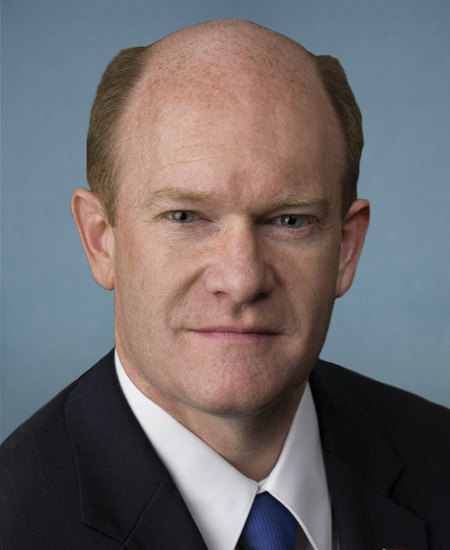
Sen. Christopher A. Coons
Sponsored bills
Financing Our Energy Future Act This bill expands the types of partnerships that qualify for treatment as publicly traded partnerships instead of as corporations for tax purposes. Under current law, partnerships that meet certain gross income requirements (i.e., at least 90% of the partnership's gross income in a taxable year consists of qualifying income) are excepted from being treated as a corporation for tax purposes. This bill expands the sources of income that are considered qualifying income and make a partnership eligible for such an exception. Specifically, the bill provides that income derived from the generation of specified alternative energy, alternative fuel projects, or the associated property, storage, or transportation for such projects (e.g., the conversion of renewable biomass into renewable fuel or the storage or transportation of such fuel) is considered qualifying income.
Maddy summaryThis bill clarifies that equipment used to test for fentanyl or xylazine in substances is not subject to restrictions under the Controlled Substances Act. It directly affects people who use drugs and harm reduction organizations providing testing supplies. The key provision amends Section 422 of the Act to explicitly state that testing equipment for these substances is exempt from legal restrictions on possession, sale, or transportation. This allows safer access to testing tools without legal penalties. The bill does not create new programs or funding, only adjusting existing legal language.
Maddy summaryThe Safer Supervision Act of 2023 reforms federal post-prison supervision by requiring courts to conduct individualized assessments before imposing supervision terms and considering early termination. It establishes a presumption for early termination after 50% of the supervision term (66.6% for certain offenses) if defendants demonstrate good conduct and pose no public safety risk, while requiring courts to consider offense nature, criminal history, and victim input. The bill also ensures crime victims’ rights apply in termination hearings and allows courts to appoint counsel for defendants seeking early release. Additionally, it mandates a GAO study on post-release supervision and a report on pay parity for probation officers.
Maddy summaryThis bill amends federal law to remove an age restriction for clearing certain drug-related court records. It eliminates the requirement that nonviolent offenders must have been under 21 years old at the time of simple possession of controlled substances to qualify for record expungement. The change directly affects individuals convicted of nonviolent drug possession who were 21 or older when the offense occurred, allowing them to seek record clearance under the same terms previously available only to younger offenders. The key mechanism is a specific amendment to Section 3607(c) of Title 18, U.S. Code, broadening eligibility for expungement.
Maddy summaryThe Better CARE for Animals Act of 2023 strengthens enforcement of the existing Animal Welfare Act by requiring dealers and exhibitors to maintain valid licenses for animal sales or transport. It expands enforcement authority for both the USDA and the Attorney General to pursue civil penalties (up to $10,000 per violation per day), seize animals in violation cases, and use penalty funds to cover temporary care costs for animals during legal proceedings. The bill also clarifies that enforcement applies to rules and regulations under the Act, and mandates a new coordination agreement between the USDA and DOJ to address repeat violators. These changes directly affect animal dealers, exhibitors, and federal enforcement agencies, improving accountability for animal welfare violations.
Maddy summaryThis bill reauthorizes the Project Safe Neighborhoods program, which helps local law enforcement reduce violent crime, through fiscal years 2024-2028. It allows funding to be used for hiring crime analysts, covering overtime for officers and prosecutors, and purchasing crime-fighting technology. The bill also requires the Attorney General to annually report to Congress on how funds are spent, prosecution outcomes, community outreach, and specific violent crime statistics (like murder and assault) in each participating area. This directly affects all 94 federal judicial districts across the U.S. and their law enforcement partners.
Maddy summaryThe Strong Communities Act of 2023 creates a new grant program (COPS Strong Communities Program) under the Omnibus Crime Control Act. It provides competitive federal grants to local law enforcement agencies to cover training costs for officers and recruits at eligible entities like colleges or police departments, with the requirement that participants serve full-time in their local communities for at least four years within specified distances from their long-term residence. If participants don't complete this service, they must repay the training benefits, though regulations will allow for exceptions due to extenuating circumstances. This directly affects local law enforcement agencies, officers, and recruits who participate in the training program.
Maddy summaryThe Promotion and Expansion of Private Employee Ownership Act of 2023 aims to increase employee ownership in S corporations by making it easier for companies to adopt Employee Stock Ownership Plans (ESOPs). Key provisions include extending tax deferral for sales of company stock to ESOPs, creating a Treasury Department office to provide technical assistance for ESOPs, and amending small business laws to ensure ESOP-owned businesses remain eligible for small business programs. The bill also establishes a dedicated Advocate for Employee Ownership within the Department of Labor to promote ESOP adoption, provide education, and help resolve disputes related to ESOPs. This legislation directly affects S corporations considering employee ownership transitions, their employees who would become partial owners, and small businesses that want to maintain eligibility for small business programs after an ESOP transition. The bill seeks to expand a model that studies show provides employees with retirement savings and greater job stability compared to traditional companies.
Maddy summarySCONRES 2 is a symbolic congressional resolution commending Iranian protesters who risked their safety to demonstrate against the Iranian regime's human rights abuses, particularly following the death of Mahsa Amini after her arrest by morality police for alleged hijab violations. It specifically highlights protests in over 133 cities where demonstrators, including women removing headscarves, have faced violent crackdowns, with reports of over 500 deaths and 19,000 arrests. The resolution condemns the regime's brutality, supports internet freedom tools to bypass censorship, and urges the administration to impose human rights sanctions on officials responsible for repression. As a non-binding resolution, it expresses congressional support for protesters but does not enact new laws or policies.