

Maddy summaryThis bill reauthorizes a federal pilot program (extending it through 2030) to provide housing support for individuals recovering from substance use disorders. It requires states receiving funds to use at least $50 million annually for stable housing, including a new allowance for up to 1% of funds to purchase furniture for temporary housing. States must report annually on housing projects, resident demographics, program outcomes, and strategies for expanding recovery housing. The program directly affects states administering housing grants and individuals seeking stable housing during opioid recovery.
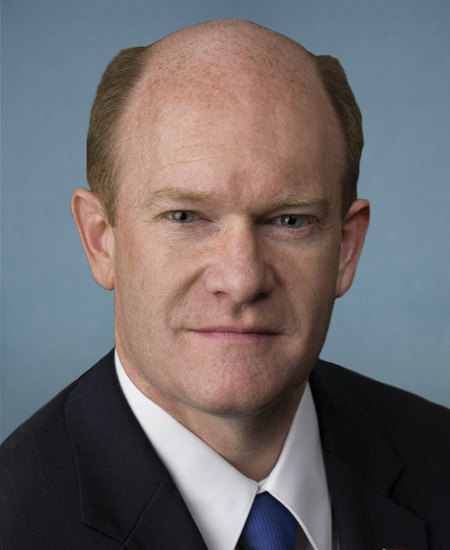
Sen. Christopher A. Coons
Sponsored bills
Maddy summaryS 1480 (American Infrastructure Bonds Act of 2025) creates a tax credit for state and local governments that issue qualifying infrastructure bonds. It allows issuers to receive a 28% credit from the Treasury on each interest payment made on these bonds, paid simultaneously with the interest. The bonds must meet specific criteria: interest would normally be tax-exempt under federal law, they cannot be private activity bonds, and the issuer must elect to use this credit. This provision reduces the cost of issuing infrastructure bonds for governments, making it cheaper to finance projects like roads, bridges, and water systems.
Maddy summaryThe COAST Anti-Drilling Act of 2025 prohibits new oil and gas leasing in four specific coastal planning areas of the outer Continental Shelf: the North Atlantic, Mid-Atlantic, South Atlantic, and Straits of Florida. It amends the Outer Continental Shelf Lands Act to require the Secretary not to issue any leases or authorizations for exploration or production in these areas. The bill directly affects oil and gas companies seeking to develop resources in these coastal regions by blocking new federal leasing activities. This policy change prevents future drilling permits in these designated zones, as defined in the 2023 Bureau of Ocean Energy Management leasing program.
Maddy summaryThe provided context does not include a substantive summary or bill text beyond the short title. Without details on the bill's specific provisions, mechanisms, or affected parties, a factual summary cannot be generated. The title "Interagency Patent Coordination and Improvement Act of 2025" suggests a focus on federal patent processes, but no concrete policy changes are described in the given text. For an accurate summary, the full bill language or official summary would be required.
Maddy summaryThis bill requires the Federal Trade Commission (FTC) to study how pharmacy benefit managers (PBMs) and other intermediaries affect prescription drug prices and competition. Specifically, the FTC must report within one year on whether PBMs charge different prices to pharmacies, steer patients toward pharmacies they own, use pharmacy data for profit, or design formularies to favor expensive drugs. The bill also mandates an interim report within six months and a separate study on sole-source drug manufacturers and enforcement challenges. It does not directly change drug prices or create new regulations, but instead seeks to gather data to inform potential future policy actions. The study focuses on transparency and competition in the pharmaceutical supply chain, with no immediate price-reducing mechanisms.
Maddy summaryThe NO FAKES Act of 2025 establishes legal rights for individuals to control how their voice and visual likeness is used in AI-generated digital replicas. It defines "digital replicas" as highly realistic computer-generated representations that are readily identifiable as an individual's voice or appearance, granting individuals (and their heirs) the right to authorize or prohibit such uses. The law creates liability for unauthorized use of digital replicas or distribution of products designed to create them without authorization, while providing safe harbors for online services that follow specific procedures for handling claims. It preempts state laws regarding voice and visual likeness rights in digital replicas (with limited exceptions) and establishes a 10-year post-mortem right that can be renewed for additional 5-year periods if there's active public use.
Maddy summaryThe GOSAFE Act prohibits the import, sale, manufacture, transfer, or possession of gas-operated semi-automatic firearms and large capacity ammunition feeding devices (those holding more than 10 rounds). It defines gas-operated firearms as those using gas pressure to cycle the action and requires the Attorney General to publish a list of prohibited firearms within 180 days. The bill includes exemptions for single-shot weapons, muzzle-loaders, firearms with permanently fixed magazines under 10 rounds, and certain other specific types. Manufacturers must now seek approval for new semi-automatic firearms through a process requiring detailed documentation, and the bill establishes a Firearm Safety Trust Fund to cover administrative costs. Violations of these provisions can result in fines up to $5,000 or up to 12 months in prison.
Maddy summaryThe BUMP Act (S 1374) bans devices that increase the firing rate of semiautomatic firearms to mimic machineguns, directly affecting owners of modified firearms. It prohibits importing, selling, or possessing devices (like "bump stocks") that speed up firing or eliminate the need for separate trigger pulls, and requires registration of existing modified semiautomatics within 120 days. The law exempts government agencies and pre-enactment modifications that are registered. This targets specific firearm modifications, not all semiautomatic weapons.
Maddy summaryThis bill, the Tax Cut for Workers Act of 2025, expands the Earned Income Credit (EIC) to make it more accessible and generous for low-income workers without children. It lowers the minimum age for the credit from 25 to 19 (with exceptions for students, former foster youth, and homeless youth), removes the maximum age limit, and increases the credit amount and income thresholds. The bill also adjusts these amounts for inflation and allows taxpayers to use their prior year’s earned income if it was higher, applying to taxable years starting after 2025. These changes extend the credit to U.S. territories like Puerto Rico and American Samoa without prior time limits.
Maddy summaryThe American Family Act creates a new monthly child tax credit that would provide $300 per month for each child under age 6 and $300 per month for each child age 6 and older, with income-based eligibility limits. The credit would be refundable, meaning it could be paid even if a family owes no income tax, and would replace the current annual child tax credit. The bill establishes income thresholds ($150,000 for joint filers) above which the credit begins to phase out, with full phase-out at $400,000 for joint filers. It also includes provisions for "presumptive eligibility" to allow for advance payments based on previous tax returns or government program data. The bill would terminate the existing annual child tax credit after 2024, replacing it with this monthly payment system.