

Maddy summaryThe NO TIME TO Waste Act (S 1395) establishes a new Office of Food Loss and Waste within the Department of Agriculture to coordinate federal efforts to reduce food waste. The bill creates grant programs for states, local governments, and nonprofits to collect data on food waste policies and develop model approaches for reducing waste, with a goal of cutting food loss and waste by 50% by 2030. It requires federal contractors to report on their food waste prevention efforts and funds public-private partnerships to help communities reduce food loss and waste. The legislation also creates a national education campaign to teach consumers about food safety, preservation, and upcycled food products. The bill mandates annual reports tracking progress toward the 2030 goal and sets funding levels for these programs through 2030.
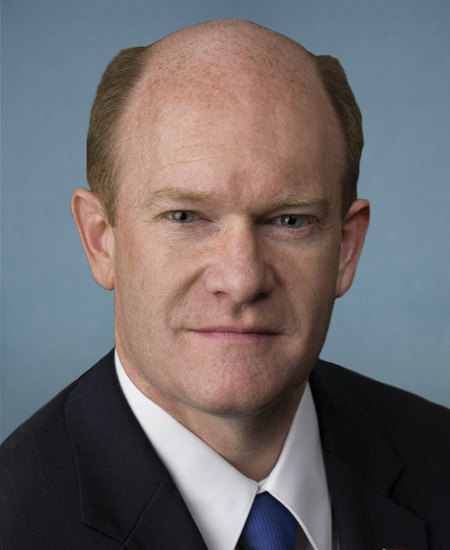
Sen. Christopher A. Coons
Sponsored bills
Maddy summaryS 1399, the Health Tech Investment Act, creates a new Medicare payment category for algorithm-based healthcare services (like AI tools used in diagnosis or treatment) starting January 1, 2026. It requires Medicare to pay based on manufacturer costs (including software, staff, and overhead) and protects these services in the special payment category for at least five years, preventing reassignment without sufficient claims data. This directly affects Medicare beneficiaries receiving these AI-driven services and healthcare technology companies developing them. The bill also codifies existing Medicare payment rules for software-as-a-service starting January 1, 2023.
Maddy summaryThis bill prioritizes states that have never received a Department of Veterans Affairs (VA) suicide prevention grant. It requires the VA Secretary to give all eligible applicants in such states a scoring preference during grant evaluations until at least one grant is awarded there. The law directly affects veterans in states without existing VA suicide prevention grants by ensuring these states receive fair consideration for funding. Key mechanisms include prioritizing entities in states with prior unawarded applications and applying a scoring preference for all applicants in states with no prior grants. This aims to expand access to mental health support for veterans nationwide.
Maddy summaryThe BRAIN Act creates new research initiatives to improve brain tumor treatment and care. It establishes a searchable database of NIH-funded brain tumor biospecimens, funds a Glioblastoma Therapeutics Network with $50 million annually, and supports cellular immunotherapy research with $10 million annually. The bill also mandates a national awareness campaign about clinical trials and biomarker testing, and funds pilot programs to improve care coordination for brain tumor survivors. These provisions directly affect over 1 million Americans living with brain tumors and aim to improve research coordination, treatment options, and quality of life through concrete funding and policy changes.
Maddy summaryThe Raise the Wage Act of 2025 gradually increases the federal minimum wage from $9.50 to $17.00 per hour over six years, with future annual increases tied to median wage growth. It eliminates the separate lower minimum wage for tipped workers (currently $2.13/hour base), requiring employers to pay the full minimum wage to all tipped employees starting in 2031. The bill also ends the special $4.25/hour starting wage for workers under 20, phasing it out by 2030. Additionally, it prohibits new special wage certificates for disabled workers under Section 14(c) and requires their phaseout by 2030, while providing transition support for affected employers and workers.
Maddy summaryThis bill creates a new $30 million annual Weatherization Readiness Fund (2026-2030) to help states fix structural defects in low-income homes before weatherization can be installed. It directly affects low-income households in states receiving Weatherization Assistance Program funds, by requiring states to use these funds to repair hazards that block weatherization work. The bill also raises the maximum per-unit cost limit for fully weatherized homes from $6,500 to $15,000 and adds flexibility for the Secretary to adjust costs based on market conditions. These changes aim to streamline the weatherization process and increase funding efficiency for eligible homes.
Maddy summaryThe Advancing Quantum Manufacturing Act of 2025 requires the Department of Energy and National Science Foundation to coordinate their quantum research through a dedicated liaison and cover a broad range of quantum technologies, including computing, sensing, and enabling tools like lasers and cryogenics. It directs the Commerce Department to establish a new Manufacturing USA institute focused on scaling up quantum manufacturing - providing end-to-end capabilities for design, fabrication, testing, and workforce development in quantum computing, sensing, and communication systems. The bill also mandates two studies: one by the National Academies to assess progress in the National Quantum Initiative Program, and another to identify collaboration barriers between research centers, industry, and academia. These provisions aim to accelerate domestic quantum technology production for national security and economic competitiveness.
Maddy summaryThe Public Service Freedom to Negotiate Act of 2025 establishes federal minimum standards for collective bargaining rights for public employees and supervisory employees. The Federal Labor Relations Authority will determine if states' laws "substantially provide" these rights, and if not, the federal standards will apply to affected workers. The bill guarantees rights like forming labor organizations, negotiating wages and working conditions, and resolving disputes through mediation or arbitration, while prohibiting strikes that would disrupt emergency services. Existing collective bargaining agreements and units are protected from the bill's implementation.
Maddy summaryThis resolution (SRES 159) is a ceremonial Senate measure honoring the late Senator John Bennett Johnston, Jr. (1932-2024), who represented Louisiana in the U.S. Senate from 1972 to 1997. It commemorates his career, including his work on energy policy, flood control, and Louisiana conservation efforts, and requests the Senate adjourn in his memory while sending condolences to his family. As a non-binding resolution, it has no policy impact or direct effect on any individuals or laws.
Maddy summarySRES 158 is a non-binding Senate resolution expressing the chamber's view that paraprofessionals (like paraeducators) and education support staff (including clerical, custodial, and food service workers in schools) deserve fair treatment. It outlines specific expectations for their workplaces, such as livable wages, affordable healthcare, job security, paid leave, and meaningful input in school policies - directly affecting over 3 million frontline workers supporting 49 million students. The resolution does not create new laws but urges federal and state action to address current gaps, including ending seasonal layoffs and ensuring access to benefits. It emphasizes these staff’s critical role in school environments while clarifying that it does not override existing collective bargaining agreements.