Accountability for Online Firearms Marketplaces Act of 2021 This bill removes the federal liability protection that a provider of an interactive computer service (e.g., a social media company) receives for content provided by third parties if the provider operates an online firearms marketplace. Online firearms marketplace refers to an interactive computer service that (1) facilitates firearm-related transactions, (2) advertises or otherwise makes available proposals for transferring firearms, or (3) makes digital instructions for programming a three-dimensional printer to make a firearm.
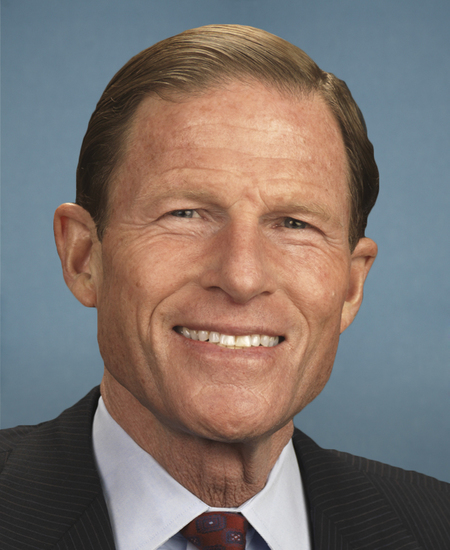
Sen. Richard Blumenthal
Sponsored bills
For the People Act of 2021 This bill addresses voter access, election integrity and security, campaign finance, and ethics for the three branches of government. Specifically, the bill expands voter registration (e.g., automatic and same-day registration) and voting access (e.g., vote-by-mail and early voting). It also limits removing voters from voter rolls. The bill requires states to establish independent redistricting commissions to carry out congressional redistricting. Additionally, the bill sets forth provisions related to election security, including sharing intelligence information with state election officials, supporting states in securing their election systems, developing a national strategy to protect U.S. democratic institutions, establishing in the legislative branch the National Commission to Protect United States Democratic Institutions, and other provisions to improve the cybersecurity of election systems. Further, the bill addresses campaign finance, including by expanding the prohibition on campaign spending by foreign nationals, requiring additional disclosure of campaign-related fundraising and spending, requiring additional disclaimers regarding certain political advertising, and establishing an alternative campaign funding system for certain federal offices. The bill addresses ethics in all three branches of government, including by requiring a code of conduct for Supreme Court Justices, prohibiting Members of the House from serving on the board of a for-profit entity, and establishing additional conflict-of-interest and ethics provisions for federal employees and the White House. The bill requires the President, the Vice President, and certain candidates for those offices to disclose 10 years of tax returns.

Nursing Home Improvement and Accountability Act of 2021 This bill establishes reporting, staffing, and other quality control requirements for Medicare skilled nursing facilities and Medicaid nursing facilities. For example, the bill requires facilities to have registered professional nurses available 24-7 and to provide infection control services overseen by infection preventionists at least 40 hours per week. It also establishes civil penalties for facilities that submit inaccurate reports relating to staffing data and prohibits facilities from entering into pre-dispute arbitration agreements. Additionally, the Centers for Medicare & Medicaid Services (CMS) must conduct additional quality control and oversight, including (1) auditing facility cost reports; (2) reviewing the quality and effectiveness of compliance surveys; and (3) establishing on-site educational programming for facilities that fail to meet applicable standards. The CMS must also establish minimum staff-to-resident ratios for nursing staff, as it determines appropriate. The bill also establishes a demonstration program to evaluate the impact of certain changes to facility design, staffing, and care coordination on the health outcomes of residents in skilled nursing facilities. Among other requirements, selected facilities must serve between 5 and 14 residents, offer private rooms, and have resident and family councils.
Frank Harrison, Elizabeth Peratrovich, and Miguel Trujillo Native American Voting Rights Act of 2021 This bill addresses the voting rights of Native American and Alaska Native voters and voting access on tribal lands. The bill includes provisions expanding the types of facilities that can be used as voter registration agencies; increasing polling site accessibility, including by expanding early in-person voting and providing ballot drop boxes; providing enforcement power to citizens and attorneys general; requiring approval for actions like moving a polling place; validating certain tribal identification for voting or registering to vote; permitting voters to designate another individual to return a ballot on their behalf; and expanding requirements for bilingual voting accessibility. In addition, the bill establishes a Native American voting task force grant program for the purpose of increasing voter outreach, education, registration, turnout, and accessibility for Native American communities. The bill also directs the Government Accountability Office to study and report on (1) the prevalence of nontraditional or nonexistent mailing addresses among Indians, members of tribes, and individuals residing on Indian lands; and (2) the alternatives for removing barriers to voter registration, receipt of voter information and materials, and receipt of ballots.
Diversifying Investigations Via Equitable Research Studies for Everyone Trials Act or the DIVERSE Trials Act This bill requires activities to increase diversity in clinical trials. It also expands reporting by laboratories that test for and diagnose COVID-19 and requires a study on data collection and data sharing during public health emergencies. Specifically, the Food and Drug Administration (FDA) must issue guidance on decentralized clinical trials to promote meaningful demographic and geographic diversity in patient engagement, enrollment, and participation. Decentralized clinical trials include those executed through telemedicine or other digital technologies to allow for the remote collection and assessment of clinical trial data. The FDA may also work with foreign regulators to harmonize international regulations governing decentralized clinical trials and the use of digital health technology. In addition, the Department of Health and Human Services (HHS) may support community education, outreach, and recruitment activities for clinical trials of treatments for conditions that disproportionately impact populations underrepresented in clinical trials. The bill also specifies that drug or device manufacturers may provide, subject to some limits, free digital health technologies and other remuneration to patients in approved clinical trials without violating laws that address fraud and abuse in federal programs. Furthermore, laboratories that test for and diagnose COVID-19 must report additional demographic data, including information about social determinants of health. HHS must also contract with the National Academy of Medicine to study and propose a design for an interoperable platform to facilitate data sharing during public health emergencies.
Helping Emergency Responders Overcome Act or the HERO Act This bill establishes and authorizes behavioral health programs for law enforcement officers, firefighters, emergency medical services personnel, 9-1-1 operators, and other public safety officers. Specifically, the Fire Administration within the Federal Emergency Management Agency must develop resources for educating mental health care providers about treating firefighters and emergency medical services personnel. In addition, the Department of Health and Human Services (HHS) must develop best practices and resources for identifying, preventing, and treating post-traumatic stress disorder and co-occurring disorders in public safety officers. HHS must work with relevant federal departments to incorporate these resources into federal training programs for public safety officers. The bill also authorizes HHS to set up a public safety officer suicide-reporting system and a grant program for peer-support behavioral health and wellness programs within fire departments and emergency medical services agencies.
Veterans Emergency Care Reimbursement Act of 2021 This bill modifies the limitation on reimbursement for emergency treatment of amounts a veteran owes to a third party or owes under a health plan contract. Specifically, the bill allows the Department of Veterans Affairs to reimburse copayments of $100 or more and excludes deductibles and coinsurance from the limitation. This modification must apply with respect to any reimbursement claim for emergency treatment furnished on or after February 1, 2010, including claims submitted by a member of the certified class seeking relief in Wolfe v. McDonough .
This resolution designates September 2021 as National Workforce Development Month.
This resolution addresses issues related to individuals with disabilities. Specifically, the resolution recognizes the importance of independent living for individuals with disabilities made possible by the enactment of the Americans with Disabilities Act of 1990 and encourages all Americans to celebrate the advancement of inclusion and equality of opportunity made possible by its enactment; pledges to continue to work on a bipartisan basis to identify and address the remaining barriers that undermine the national goals of equality of opportunity, independent living, economic self-sufficiency, and full participation for individuals with disabilities; pledges to work with states to improve access to home- and community-based services for individuals with disabilities; calls on the Department of Labor to provide information, resources, and technical assistance to enable individuals with disabilities to achieve economic self-sufficiency; and calls on the Department of Health and Human Services to provide information, resources, and technical assistance regarding such services that enable individuals with disabilities to live independently.
This resolution expresses the condolences of the Senate regarding the death of the Honorable Maurice Robert Gravel, former Senator from Alaska.