

Do No Harm Act This bill prohibits the application of the Religious Freedom Restoration Act of 1993 (RFRA) to specified federal laws or the implementation of such laws. Currently, RFRA prohibits the government from substantially burdening a person's exercise of religion even if the burden results from a rule of general applicability, except in furtherance of a compelling governmental interest when using the least restrictive means. Under the bill, RFRA is inapplicable to laws or the implementation of laws that protect against discrimination or the promotion of equal opportunity (e.g., the Civil Rights Act of 1964); require employers to provide wages, other compensation, or benefits, including leave; protect collective activity in the workplace; protect against child labor, abuse, or exploitation; or provide for access to, information about, referrals for, provision of, or coverage for, any health care item or service. The bill prevents RFRA from being used to deny (1) goods or services the government has contracted, granted, or made an agreement to provide to a beneficiary of or participant in a program or activity funded by such government contract, grant, agreement, or other award; or (2) a person's full and equal enjoyment of a government-provided good, service, benefit, facility, privilege, advantage, or accommodation. In order for a person to assert a RFRA claim or defense in a judicial proceeding, the government must be a party to the proceeding.
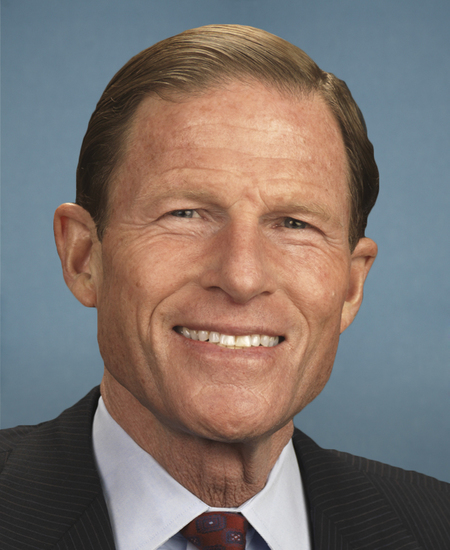
Sen. Richard Blumenthal
Sponsored bills
This bill posthumously provides for the award of a Congressional Gold Medal in commemoration of the 13 service members who died on August 26, 2021, while stationed at Hamid Karzai International Airport in Afghanistan.
This resolution supports the designation of a Muslim-American Heritage Month. The resolution also honors the contributions and integral role of Muslim Americans in the economy, culture, and identity of the United States.
This resolution expresses support for the goals of National Physician Suicide Awareness Day.
This resolution recognizes the courage and resolve shown by the Ukrainian people in their pursuit of sovereignty and democracy. It also condemns the illegal military invasion and occupation of Crimea by Russia and the violence fomented by proxies of Russia in eastern Ukraine.
This resolution expresses support for the designation of September 2021 as PCOS Awareness Month. Polycystic ovary syndrome (PCOS) is caused by a hormone imbalance, which may result in infertility, weight gain, excess hair growth, and other symptoms.
Device Access for Every American Act This bill requires the Federal Communications Commission (FCC) to establish a program that provides a $400 voucher to a low-income individual for the purchase of a connected device (i.e., a desktop, laptop, or tablet computer) for which the FCC shall reimburse the retailer. The FCC must (1) collaborate with retailers to ensure the wide acceptance of vouchers and the wide availability of covered devices, (2) establish a website that links to offerings by retailers of eligible connected devices, (3) establish a catalog of such offerings that is accessible to consumers without internet access, and (4) advertise the availability of the program.
Climate Risk Disclosure Act of 2021 This bill directs the Securities and Exchange Commission to require an issuer of securities to annually disclose information regarding climate change-related risks posed to the issuer, including an issuer's strategies and actions to mitigate these risks. Specifically, issuers must report their direct and indirect greenhouse-gas emissions and disclose their fossil fuel-related assets.
This resolution supports the recognition of Overdose Awareness Day, including by lowering U.S. flags at federal buildings to half-staff.
Funding for Aviation Screeners and Threat Elimination Restoration Act or the FASTER Act This bill repeals the requirement that a portion of aviation security service fees collected from passengers be credited as offsetting receipts and deposited in the general fund of the Treasury. It requires such fees to be deposited into a separate account in the Treasury for expenditure to pay only the costs of activities and services for which the fee is imposed (i.e., aviation security screening).