This resolution honors the Radium Girls and recognizes their contribution to the development of workplace safety laws and standards. The Radium Girls were factory workers who contracted radiation poisoning from occupational exposure to radium.
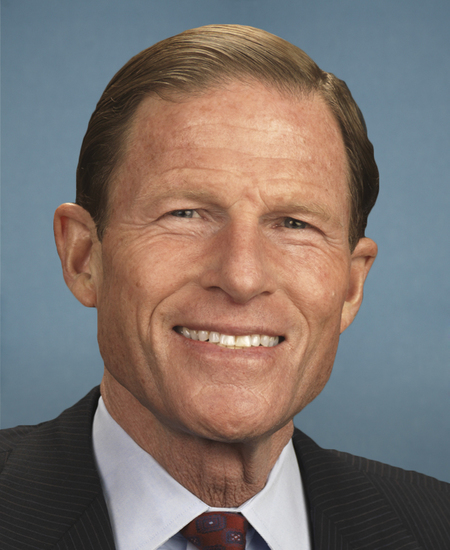
Sen. Richard Blumenthal
Sponsored bills
9/11 Responder and Survivor Health Funding Correction Act This bill increases funding for and otherwise modifies a federal program that provides medical monitoring and treatment to responders and survivors who suffer from health conditions related to the September 11, 2001, attacks on the World Trade Center. Among the changes, the bill allows certain health care providers other than physicians to determine whether an individual's health condition is related to the attacks, and it establishes a research program to study the impacts of the attacks on health and educational outcomes of individuals who were 21 years of age or younger when the attacks occurred.
This resolution expresses support for women who are being unjustly detained around the world for exercising their fundamental rights and calls for their unconditional release.
Disaster Relief Medicaid Act This bill establishes a series of programs and requirements relating to Medicaid coverage of individuals affected by a federally declared major disaster. In particular, the bill provides for specific disaster relief coverage under Medicaid for individuals who meet specified income eligibility standards and, during the seven-day period preceding the disaster, were either residents of the impacted area or were employed in the impacted area (and subsequently lost employment). Coverage is effective for two years after the date of the disaster declaration. State Medicaid programs must provide disaster relief coverage that is at least as comprehensive as the state's Medicaid coverage and the Medicaid coverage of the individual's home state, as applicable. The bill applies a 100% Federal Medical Assistance Percentage (i.e., federal matching rate) to such coverage and related administrative expenses.
This bill directs the National Oceanic and Atmospheric Administration (NOAA) to establish grant programs to support living shoreline projects and research on nature-based infrastructure. NOAA must award grants to state or local governments, nonprofit organizations, and Indian tribes to (1) implement climate-resilient living shoreline projects; and (2) encourage innovation in the use of natural materials to protect coastal communities, habitats, and natural system functions. A grant to carry out a living shoreline project may be used only to carry out the project, including administration, design, permitting, entry into negotiated indirect cost rate agreements, and construction; monitor, collect, and report data on the performance of the project, in accordance with the standard NOAA develops; or incentivize landowners to engage in such projects. NOAA shall award competitive research grants to eligible entities, including U.S. territories, to carry out projects focused on developing and assessing the effectiveness of innovative approaches to nature-based infrastructure for specified climate-related purposes. NOAA shall award grants to such entities for projects that focus on, among other things assessing the effectiveness of installed nature-based infrastructure, or novel approaches to nature-based infrastructure and living shorelines.
Real Emergency Access for Aging and Disability Inclusion for Disasters Act or the REAADI for Disasters Act This bill establishes programs and requirements to assist individuals with disabilities and older adults (age 50 or older) with disaster preparedness. Among other provisions, the bill requires the establishment of an advisory committee that includes disabled individuals and older adults to oversee the use of funds made available by this bill; allows states to contract with Centers for Independent Living to provide services and support to disabled individuals in preparing for hazards; requires the Department of Health and Human Services to award grants to carry out projects of national significance that, among other things, create opportunities for disabled individuals and older adults to directly contribute to disaster preparedness, recovery, and mitigation; modifies and expands the membership of the National Advisory Committee on Individuals with Disabilities and Disasters to ensure that it represents the diversity of the disabled and older adult communities; and establishes the Disability and Disaster Preparedness Advisory Commission to review settlement agreements involving potential violations of the Rehabilitation Act of 1973 and the Americans with Disabilities Act of 1990. The Government Accountability Office must study the compliance of federal agencies with such enactments in expending funds to support disabled individuals and older adults in responding to, recovering from, and mitigating disasters.

September 11 Transparency Act of 2021 This bill requires declassification reviews of certain documents related to investigations into the terrorist attacks on September 11, 2001. The Office of the Director of National Intelligence, the Department of Justice, and the Central Intelligence Agency must complete reviews of certain documents by deadlines specified in the bill.
Preventing Harmful Exposure to Phthalates Act This bill prohibits the use of any phthalate chemical as a food contact substance. (A food contact substance is any substance intended for use as a component of materials used in manufacturing, packing, packaging, transporting, or holding food if such use is not intended to have a technical effect in such food.) The Food and Drug Administration (FDA) must review FDA-regulated products other than food to determine whether use of such products leads to exposure to phthalate chemicals. This review must be publicly available on the website of the Department of Health and Human Services.
Get Toxic Substances Out of Schools Act of 2021 This bill addresses the provision of Environmental Protection Agency (EPA) grants to prevent and eliminate toxic substances, particularly in certain school environments. The EPA is authorized make grants to Indian tribes (in addition to the current authority to provide grants to states) to establish and operate programs to prevent or eliminate unreasonable risks associated with a chemical substance or mixture of which the EPA is unlikely to address during the 24-month period after the grant is made. The bill also authorizes the EPA to partner with the Department of Labor (with respect to enforcement of labor standards) to provide grants to states and Indian tribes to identify, prevent, or eliminate risks associated with the presence of a chemical substance or mixture in eligible facilities (i.e., public school facilities operated by a local educational agency, facilities operated by an early childhood education program, and center-based child care facilities operated by an eligible child care provider). The EPA has permanent authority to provide grants to Indian tribes (in addition to the current authority to provide such grants to states) to (1) provide technical assistance to local educational agencies, early childhood education programs, and eligible child care providers to address environmental concerns in eligible facilities; and (2) develop and implement state and tribal programs to support the remediation of toxic substances in eligible facilities. Under the bill, the EPA must also provide specified outreach and guidelines related to environmental hazards in eligible facilities.
Beyond the Box for Higher Education Act of 2021 This bill requires the Department of Education to issue guidance and recommendations for institutions of higher education to remove criminal and juvenile justice questions from their admission applications.