This resolution recognizes and expresses support for the efforts of democracy and human rights activists in Cuba.
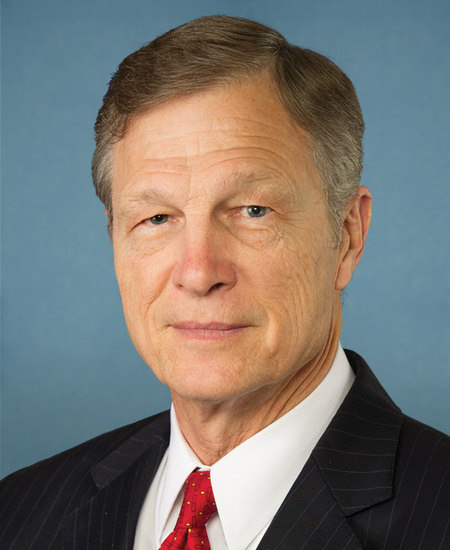
Rep. Brian Babin
Sponsored bills
Department of Energy Science for the Future Act This bill supports specified research and development activities of the Department of Energy (DOE) Office of Science. The bill establishes various programs, including a basic energy sciences research and development program; a program of research and development for the application of advanced computing practices to foundational and emerging research problems in chemistry and materials science; a web-based platform to develop and provide access to a database of computed information on known and predicted materials properties and computational tools to accelerate breakthroughs in materials discovery and design; a biological systems science and climate and environmental science research and development program; research and development activities in biomolecular characterization and imaging science; earth and environmental systems science research; a coastal zone research initiative; an initiative focused on the development of engineered ecosystems; a program to implement a strategy for achieving computing systems with capabilities beyond exascale computing systems; a program of fundamental research and development of energy efficient computing and data center technologies relevant to advanced computing applications; a Quantum User Expansion for Science and Technology program or QUEST program; a collaborative research and development program of fusion energy technologies; a research program in elementary particle physics and advanced technology research and development to improve the understanding of the fundamental properties of the universe, including constituents of matter and energy and the nature of space and time; research activities on the nature of the primary contents of the universe, including the nature of dark energy and dark matter; a research program to discover and understand various forms of nuclear matter; a program across the DOE for the production of isotopes, including the development of techniques to produce isotopes, that the DOE determines are needed for research, medical, industrial, or related purposes; a midscale instrumentation program to enable the development and acquisition of novel, state-of-the-art instruments ranging in cost from $1 million to $20 million each that would significantly accelerate scientific breakthroughs at user facilities; and a high intensity laser research initiative. The DOE Office of Science shall continue to leverage U.S. participation in the Large Hadron Collider and prioritize expanding international partnerships and investments in the Long-Baseline Neutrino Facility and Deep Underground Neutrino Experiment. DOE shall support construction of a Facility for Rare Isotope Beams to advance the understanding of rare nuclear isotopes and the evolution of the cosmos. DOE shall expand opportunities to increase the number, diversity, equity, and inclusion of highly skilled science, technology, engineering, and mathematics (STEM) professionals working in DOE mission-relevant disciplines and broaden the recruitment pool to increase diversity, including expanded partnerships with Historically Black Colleges, Tribal Colleges, Minority Serving Institutions, emerging research institutions, and scientific societies. DOE shall establish within the DOE Office of Science, a cross-cutting research initiative to leverage the federal government's innovative analytical resources and tools, user facilities, and advanced computational and networking capabilities in order to prevent, prepare for, and respond to emerging infectious diseases, including COVID-19. DOE may not carry out gain-of-function research of concern.

National Science Foundation for the Future Act This bill reauthorizes the National Science Foundation (NSF) through FY2026 and authorizes programs and activities at the NSF. The bill establishes requirements for the NSF, including to enter into a contract with the National Academies of Science, Engineering, and Medicine to assess the status and opportunities for Pre-K through 12 science, technology, engineering, and mathematics, including computer science, (STEM) education research; award grants to establish no fewer than three multidisciplinary Centers for Transformative Education Research and Translation to support research and development of STEM education innovations; provide grants for research on programming that engages students in grades Pre-K through 8, including underrepresented and rural students, in STEM in order to prepare such students to pursue degrees or careers in STEM; award grants to support research and development activities to encourage greater collaboration and coordination between institutions of higher education and industry to enhance education, foster hands-on learning experiences, and improve alignment with workforce needs; award grants to establish a network of centers for science and technical education; award grants to advance research on the nature of learning and teaching at community colleges; award grants to establish traineeship programs for graduate students who pursue artificial intelligence-related research leading to a masters or doctorate degree; award grants to carry out research on the cyber workforce; establish a cybersecurity workforce data initiative; carry out a national initiative to facilitate the development of networks and partnerships to broaden participation in STEM studies and careers of groups historically underrepresented in such studies and careers; maintain a Research Security and Policy office to coordinate all research security policy issues across the NSF; award grants to support research to improve our understanding of the climate system and related human and environmental systems; support research to significantly advance our understanding of the food-energy-water system; award grants to advance knowledge of risk assessment and predictability to improve our ability to predict extreme events and natural hazards, including pandemics; and award grants to support basic research that will accelerate innovation to advance critical minerals mining strategies and technologies. The bill also establishes within the NSF a Directorate for Science and Engineering Solutions to advance research and development solutions to address societal and national challenges.
This resolution requires, no later than 60 days after a select commission is established in the legislative branch, and every 30 days afterwards, the chair of the commission to submit to the Clerk of the House a report that, for each line item expense incurred by the commission to carry out the duties of that commission documents the date and amount of each outlay, and includes a copy of the receipt for each outlay. The Clerk shall make such information received with respect to the budget outlays of a select commission available to the public on a government website in a searchable, sortable, and downloadable format as soon as possible after it is received.
Law Enforcement Officer Recreation Pass Act This bill directs the Department of Agriculture and the Department of the Interior to make the National Parks and Federal Recreational Lands Pass available, without charge and for the lifetime of the passholder, to law enforcement officers.
30 x 30 Termination Act This bill limits federal acquisition of land or declaration of a national monument in certain areas and nullifies a provision of an executive order related to conservation. In a state or county where 15% or more of the land is managed by a federal agency (1) federal funds may not be used to acquire nonfederal land unless the agency proposing the acquisition disposes of an equal amount of federal land within the state or county, and (2) a declaration of a national monument shall not apply. The bill prohibits from having the force and effect of law a provision of Executive Order 14008 (86 Fed. Reg. 7619), titled Tackling the Climate Crisis at Home and Abroad , that requires the Department of the Interior to recommend steps to achieve the goal of conserving at least 30% of U.S. lands and waters by 2030. No federal funds may be used to implement, administer, enforce, or carry out any report or program substantially similar to such provision. No federal funds may be used to implement, administer, enforce, or carry out any action on federal land that results in a net-loss of multiple use or any principal or major use, unless such action has been authorized by federal statute.
End Zuckerbucks Act This bill prohibits tax-exempt charitable organizations from providing direct funding to official election organizations.
This resolution calls on the Russian government to immediately release Trevor Reed, a U.S. citizen, and all other political prisoners. It also condemns the Russian government's use of politically motivated imprisonment.
National Statuary Hall Collection Policy Act This bill establishes an additional requirement for the replacement of a statue in National Statuary Hall. Currently, a state's request to replace a statue it has provided for display shall only be considered if (1) the request has been approved by the legislature and the governor of the state, and (2) the statue to be replaced has been displayed in the U.S. Capitol for at least 10 years as of the time the request is made. The bill adds the requirement that at least two-thirds of the Members of Congress who represent a requesting state approve any request to replace a statue in National Statuary Hall.
Rebuilding Communities After Disasters Act This bill requires the Small Business Administration (SBA) to increase the loan limits for the disaster loan program and to communicate certain information about the program following disasters. Specifically, the bill raises from $40,000 to $75,000 the loan amount for repair or replacement of household and personal effects and from $200,000 to $400,000 the loan amount for repair or replacement of a primary residence. Further, the bill requires the SBA to communicate through radio, television, print, and web-based outlets all relevant information needed by disaster loan applicants if a disaster is declared or the SBA declares eligibility for additional disaster assistance. (Currently, the SBA is only required to endeavor to communicate such information.) The SBA must submit a report on the disaster loan program that includes information such as the number and dollar value of program loans and the average estimated dollar value of damage sustained by borrowers.