

Sanctioning Russia Act of 2025 This bill imposes penalties on certain persons (individuals and entities) if the President determines that the Russian government or a person acting at Russia's direction is involved with (1) refusing to negotiate a peace agreement with Ukraine; (2) violating a negotiated peace agreement; (3) initiating another invasion of Ukraine; or (4) overthrowing, dismantling, or seeking to subvert the Ukrainian government. If the President makes such a determination, the bill requires certain actions including the President must impose visa- and property-blocking sanctions on specified persons such as the Russian president, certain Russian military commanders, and any foreign person that knowingly provides defense items to the Russian armed forces; the President must increase the rate of duty on all goods and services imported from Russia into the United States to at least 500% relative to the value of such goods and services; the President must increase the rate of duty on all goods and services imported into the United States from countries that knowingly engage in the exchange of Russian-origin uranium and petroleum products to at least 500% relative to the value of such goods and services; the Department of the Treasury must impose property-blocking sanctions on any financial institution organized under Russian law and owned wholly or partly by Russia, and any financial institution that engages in transactions with those entities; and the Department of Commerce must prohibit the export, reexport, or in-country transfer to or in Russia of any U.S.-produced energy or energy product.
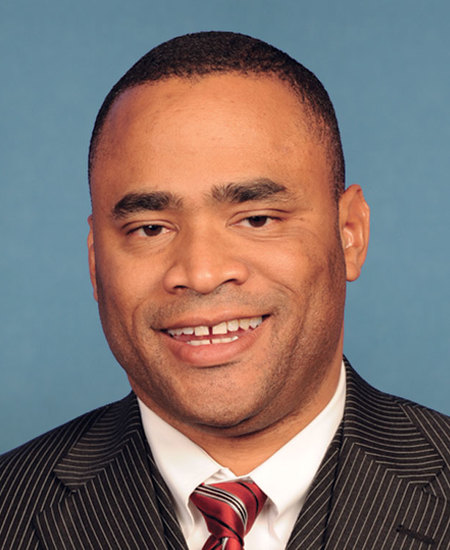
Rep. Marc A. Veasey
Sponsored bills
Maddy summaryThe Nutrition CARE Act of 2025 requires Medicare to cover medical nutrition therapy services for beneficiaries with eating disorders starting January 1, 2026. It directly affects Medicare beneficiaries with eating disorders, including an estimated 1.6 million people on Medicare Part B, with specific focus on underserved groups like 420,500-560,700 Black, Indigenous, and People of Color beneficiaries. The bill mandates coverage through registered dietitians or nutrition professionals, requiring at least 13 hours of services in the first year (including initial assessment) and 4 hours annually thereafter, with referrals from physicians or psychologists. This addresses a current gap where Medicare does not cover medical nutrition therapy for eating disorders at any treatment level. The policy change aims to improve access to a critical treatment pillar for a condition with high mortality rates and significant healthcare costs.
Maddy summaryThis bill directs the U.S. Department of Health and Human Services to launch a national public education campaign about abortion access. The campaign must provide medically accurate information on where to obtain abortion services (including medication abortion), legal rights for out-of-state care, identifying misleading anti-abortion centers, spotting disinformation, and protecting personal health data. It specifically targets underserved communities like people of color, immigrants, LGBTQ+ individuals, rural residents, and those with low incomes, while prohibiting the promotion of misinformation or abstinence-only programs.
Maddy summaryThe Sarah Katz Caffeine Safety Act would require restaurants and retail food establishments with 20 or more locations to label menu items containing 150 milligrams or more of caffeine per serving with a "High caffeine" warning. It would mandate that packaged foods and dietary supplements with more than 10 milligrams of caffeine display the exact caffeine content, whether naturally occurring or added, along with a safety advisory about daily limits (400 milligrams for healthy adults). The bill directs the FDA to review caffeine safety in food and beverages, and the NIH to study caffeine's effects on vulnerable populations including children, pregnant women, and those with heart conditions or mental health conditions. It also requires a public education campaign about caffeine safety and a GAO study on the marketing of caffeinated beverages to children and teens, with reports due within 6 months and 180 days respectively.
Maddy summaryHR 2527, the Early Detection of Vision Impairments for Children Act of 2025, provides federal grants to states, territories, tribes, and urban Indian organizations to establish statewide vision screening and intervention programs for children. The bill requires grantees to implement vision screenings in medical, home, educational, and early learning settings, develop data systems for tracking outcomes, and improve access to care for underserved children in rural and low-income communities. It also authorizes technical assistance grants through the CDC to help develop screening systems, share best practices, and conduct research on vision care programs. The bill allocates $5 million annually for fiscal years 2026-2030 to fund these activities, targeting early detection to prevent vision-related learning and developmental challenges.
Save America's Forgotten Equines Act of 2025 or the SAFE Act of 2025 This bill permanently prohibits the slaughter of equines (e.g., horses and mules) for human consumption. (Current law prohibits the slaughter of dogs and cats for human consumption. This bill extends the prohibition to equines.) Specifically, this bill prohibits a person from knowingly (1) slaughtering an equine for human consumption; or (2) shipping, transporting, possessing, purchasing, selling, or donating an equine to be slaughtered for human consumption or equine parts for human consumption. The bill subjects a violator to a fine. The bill applies to conduct in or affecting interstate or foreign commerce or within the special maritime and territorial jurisdiction of the United States. However, it does not apply to an activity carried out by an Indian for a religious ceremony. As background, in recent years, the appropriations acts have prohibited the Department of Agriculture (USDA) from using federal funds to inspect horses before they are slaughtered for human consumption. Therefore, there are currently no USDA-inspected horse slaughter facilities in the United States.
Maddy summaryHR 2439 authorizes $50 million for fiscal year 2026 and $55 million for 2027 to fund the United Nations Population Fund (UNFPA), directly supporting its global programs. The bill specifies that these funds will help end preventable maternal deaths, address unmet contraceptive needs, combat gender-based violence, and end harmful practices like child marriage and female genital mutilation. UNFPA operates in over 150 countries, primarily aiding women and girls in developing nations and crisis zones, including those affected by conflict or natural disasters. The bill emphasizes UNFPA’s compliance with U.S. restrictions (not funding abortion) and its role in advancing U.S. strategic interests through voluntary family planning and reproductive health services.
Maddy summaryHR 2477, the Portable Ultrasound Reimbursement Equity Act of 2025, would amend Medicare rules to require equal reimbursement for portable ultrasound transportation and setup services as is currently provided for portable X-ray services. This change directly affects Medicare beneficiaries needing portable ultrasound exams and healthcare providers (like mobile clinics) who offer these services. The bill mandates that Medicare pay separately for portable ultrasound transportation and setup in the same way and to the same extent as portable X-ray services, using similar supplier requirements as existing regulations. The policy change would take effect for services provided on or after January 1, 2027.
Maddy summaryThe Safer Skies Act of 2025 requires specific smaller airlines to adopt enhanced security screening protocols currently used by larger carriers. It mandates that "covered air carrier operations" - defined as airlines operating under certain FAA rules, offering individual seats with public schedules, using planes with more than nine passenger seats, and not using TSA checkpoints - to follow the Aircraft Operator Standard Security Program (49 CFR §1544.101(a)) within 360 days of the bill's enactment. The Transportation Security Administration must revise its rules to enforce this requirement. This directly affects regional and private charter airlines that currently skip TSA checkpoint screening but serve the public with scheduled passenger flights.
Maddy summaryThis bill would require federal firearms licensees to prohibit sales of specific high-capacity rifles and shotguns to people under 21. It targets semiautomatic centerfire rifles and shotguns capable of holding more than 5 rounds in their magazines, raising the age limit from 18 to 21 for these weapons. Exceptions apply for active military members and certain government employees authorized to carry firearms. The law directly affects gun retailers and individuals under 21 seeking to purchase these specific firearms. It modifies existing federal gun sale rules without changing age requirements for other firearms.