

Maddy summaryThis bill would eliminate preferences for socially and economically disadvantaged businesses in government contracting by amending multiple federal laws, including the Small Business Act and the Minority Business Development Act. It removes references to "disadvantaged businesses" and repeals provisions requiring agencies to track or prioritize contracts for these businesses. The bill also adds new prohibitions against considering race or ethnicity in contract awards, stating agencies may not take race or ethnicity into account when granting contracts. It would require agencies to remove all references to racial or ethnic considerations from contracting rules within 180 days of enactment. These changes would fundamentally alter government contracting practices by removing specific preferences that have been part of contracting programs for decades.
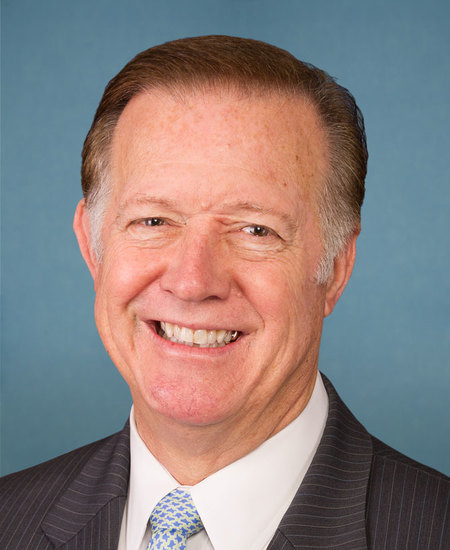
Rep. Randy K. Weber, Sr.
Sponsored bills
Maddy summaryHJRES 225 is a congressional resolution seeking to block an IRS rule that modified the Advanced Manufacturing Production Credit tax incentive. If approved, it would nullify the rule (published October 28, 2024, in the Federal Register), preventing it from taking effect. This directly affects manufacturers that rely on the tax credit for production investments, as they would continue operating under the existing credit rules instead of the proposed changes. The resolution uses a standard procedural mechanism under federal law to disapprove the agency rule.
Maddy summaryThis bill directs the Smithsonian Institution to conduct a two-year study on establishing a Juneteenth museum on Galveston Island, Texas. The study will examine construction and operating costs, potential sites, whether the museum should be part of the National Museum of African American History and Culture, and other relevant factors, with input from Galveston officials and community leaders. It does not fund or create the museum but requires a final report to Congress within 30 days of study completion. The bill directly affects the Smithsonian, Galveston County, and Texas state officials involved in the study process.
Maddy summaryHR 10180 amends the National Marine Sanctuary Act to prevent the Secretary from requiring additional permits for undersea fiber optic cables already authorized by federal or state agencies. It directly affects cable companies operating in national marine sanctuaries who hold existing federal or state permits for installation, operation, or maintenance. The key provision prohibits the National Oceanic and Atmospheric Administration from imposing new authorization requirements for these activities if a valid permit from another agency is already in place. The bill also requires the Secretary to coordinate with other agencies through existing interagency cooperation mechanisms to streamline this process. This change simplifies regulatory requirements for existing cable operations without altering environmental protections.
Maddy summaryThe DOGE Act prohibits federal agencies from awarding duplicate grants for the same purpose, except for institutions of higher education. It requires agencies to use a new electronic tracking system (to be created by OMB within one year) to identify applicants seeking multiple grants for identical or similar projects before funding is awarded. The system will track details like awardee names, project abstracts, and grant periods to prevent overlapping funding. Additionally, the bill mandates a report on using artificial intelligence to detect duplicate applications and potential fraud in grant processes. This primarily affects federal grant applicants and agencies managing grant programs.
Maddy summaryHR 8706, the "Dismantle DEI Act of 2024," would prohibit federal agencies from maintaining diversity, equity, and inclusion (DEI) offices, programs, or training by requiring the closure of existing DEI offices within 90 days and banning federal funding for DEI-related activities. The bill defines "prohibited diversity, equity, and inclusion practices" as those that discriminate based on race, color, ethnicity, religion, biological sex, or national origin, or require training that asserts a particular group is inherently superior or inferior. It would rescind several executive orders related to racial equity and gender inclusion, and prohibit the use of federal funds for DEI-related activities across all federal agencies, contractors, and grant recipients. The bill contains limited exceptions for Equal Employment Opportunity offices and disability rights enforcement offices as historically organized and operated.
Maddy summaryHRES 1578 is a ceremonial resolution honoring the American Jewish Committee (AJC) on its 118th anniversary. It recognizes the AJC’s founding in 1906 and commends its work on human rights advocacy, interfaith dialogue, and promoting Israel’s security. The resolution has no policy impact - it is purely symbolic, expressing congressional support for the AJC’s historical efforts to combat antisemitism and advance democratic values. It directly affects the AJC as an organization, acknowledging its global advocacy without creating new laws or obligations.
Maddy summaryHRES 1577 is a resolution expressing congressional support for National Adoption Day (November 23, 2024) and National Adoption Month (November 2024). It highlights that over 108,000 children in U.S. foster care are waiting for adoption and encourages Americans to consider adoption to help provide safety, permanency, and well-being for children. The resolution does not create new laws but formally recognizes the importance of adoption and urges the public to support efforts to place children in permanent families. It directly affects public awareness and encourages citizen engagement during these designated observances.
Maddy summary# Summary of Proposed Higher Education Act Amendments This document outlines significant proposed amendments to the Higher Education Act of 1965, primarily as part of the "College Cost Reduction Act." The key elements include: ## Accreditation Reform - Major overhaul of accreditation standards, requiring accrediting agencies to demonstrate independence from trade associations - New requirements for accrediting agencies to assess student achievement outcomes, including median value-added earnings relative to median total price charged - Introduction of an "Alternative Quality Assurance Experimental Site Initiative" to test non-accredited institutions - Protections for religious institutions, including a new process for appealing accreditation decisions related to religious mission - Removal of "litmus tests" that would require institutions to support specific political viewpoints ## Student Success Initiatives - Establishment of "Postsecondary Student Success Grants" to increase participation, retention, and completion rates for high-need students - Focus on evidence-based practices, with tiered requirements (tier 1, 2, and 3 reforms) - Mandatory inclusion of high-need student populations (low-income, first-generation, military-connected, etc.) - Requirements for institutions to report on completion rates, retention rates, and student demographics ## Regulatory Changes - Repeal of numerous existing regulations including: * Closed school discharges * Borrower defense to repayment * Pre-dispute arbitration * False certification requirements * Ability-to-benefit rules * Financial responsibility regulations - New restrictions on incentive compensation for recruiters - Changes to third-party servicer definitions and regulations ## Transfer and Credit Policies - New requirement that institutions cannot deny transfer credit based solely on the source of accreditation - Requirements for transparent transfer policies - Changes to reverse transfer policies ## Other Key Provisions - Modifications to the National Advisory Committee on Institutional Quality and Integrity (NACIQI) - New definitions for "total price" and "value-added earnings" - Changes to the process for institutions to change accrediting agencies - New requirements for institutions to report on student outcomes The overall focus of these proposed amendments is to reduce regulatory burden on institutions, promote transparency, improve student outcomes (particularly for high-need students), modernize accreditation processes, and protect religious institutions' rights in accreditation decisions.
Maddy summaryThe Natural Disaster Resilience and Recovery Accountability Act establishes a 15-member Commission within the Office of Management and Budget to review and recommend improvements for federal natural disaster resilience and recovery programs. The Commission, composed of experts from government, emergency services, health, infrastructure, and community organizations, will examine program effectiveness, collect data across agencies, and propose specific reforms to enhance efficiency and accessibility. It must submit interim reports every six months and a final report within two years to congressional committees, including actionable legislative and administrative recommendations based on a comprehensive review of federal programs. The bill requires federal agencies to provide information and consult with the Commission but does not authorize new funding, directing the Commission to use existing agency resources. This bill directly affects federal agencies managing disaster programs by mandating their collaboration with the Commission to improve disaster response and recovery efforts.