

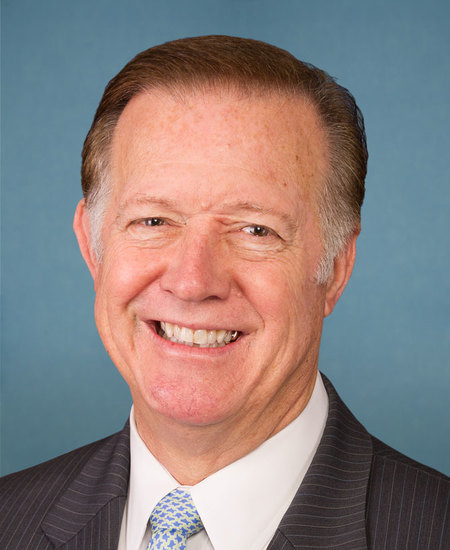
Photo of Randy K. Weber, Sr.
R United States House · District 14 · Texas On the 2026 ballot

Rep. Randy K. Weber, Sr.

Compare
Total votes
2,837
all sessions
Attendance
98%
68 missed
Near the chamber average
With party
92%
of cast votes
Near the chamber average
Bipartisan score
4%
crosses aisle rarely
Near the chamber average
Sponsored
1,847
bills & resolutions
Higher than 84% of chamber peers
Committees
6
assignments
1,847 bills and resolutions

Sponsored bills

Total
1,847
Primary
60
Co-sponsor
1,787
This page
1,847
matching current filters
Co-sponsor HR 1576
In committee · Indiana House · Co-sponsor
Protecting American Agriculture from Foreign Adversaries Act of 2025

Maddy summaryThis bill requires the U.S. Department of Agriculture (USDA) to join the Committee on Foreign Investment in the United States (CFIUS) for reviews of certain transactions involving foreign adversaries. It specifically targets acquisitions of U.S. agricultural land, biotechnology, or agriculture-related infrastructure (like transportation, storage, or processing) by entities from China, North Korea, Russia, or Iran. The USDA must notify CFIUS about reportable transactions, prompting the committee to determine if a full review is needed. The provisions expire for any country removed from the official list of foreign adversaries in federal regulations.

In committee Feb 25, 2025 1 co-sponsor
Co-sponsor HR 1575
In committee · Indiana House · Co-sponsor
No American Land for Communist China Act

Maddy summaryHR 1575, the "No American Land for Communist China Act," prohibits the People's Republic of China government and businesses with 25% or more Chinese government ownership from purchasing real estate adjacent to specific federal lands. The bill directly affects Chinese government agents and Chinese-affiliated businesses seeking to buy property near lands managed by the Departments of Interior, Defense, Agriculture (Forest Service), and Energy, as well as Indian country. Key provisions require the President to take necessary actions to block such purchases, defining "covered Federal lands" broadly to include national parks, military bases, and tribal lands. The law aims to prevent foreign government influence over land near sensitive U.S. properties through a clear purchase restriction.

In committee Feb 25, 2025 1 co-sponsor
Co-sponsor HR 1579
In committee · Indiana House · Co-sponsor
Broadband Buildout Accountability Act

Maddy summaryHR 1579, the Broadband Buildout Accountability Act, would exempt the Broadband Equity, Access, and Deployment Program from Freedom of Information Act (FOIA) requests. This means federal agencies administering the program - funded under the Infrastructure Investment and Jobs Act - would not have to disclose documents like grant applications or project details to the public through FOIA. The bill amends Section 60102(o)(2) of the Infrastructure Investment and Jobs Act to add this exemption. It directly affects transparency around federal broadband funding by limiting public access to program-related information.

In committee Feb 25, 2025 1 co-sponsor
Co-sponsor HR 1548
In committee · Indiana House · Co-sponsor
Leveling the Playing Field 2.0 Act

Maddy summaryHR 1548, the "Leveling the Playing Field 2.0 Act," amends U.S. trade laws to strengthen enforcement of antidumping and countervailing duty regulations. The bill creates new rules for handling multiple investigations on the same merchandise (successive investigations), addresses market distortions in foreign countries that affect production costs, and improves mechanisms to prevent companies from circumventing existing duties. It also establishes procedures for investigating currency undervaluation as a form of subsidy and strengthens requirements for importers to certify compliance with trade laws. These changes primarily affect U.S. importers of foreign goods, foreign exporters, and the Department of Commerce, which administers these trade enforcement mechanisms.

In committee Feb 24, 2025 1 co-sponsor
Co-sponsor HR 1525
In committee · Indiana House · Co-sponsor
Protecting Life from Chemical Abortions Act

Protecting Life from Chemical Abortions Act This bill nullifies certain changes made by the Food and Drug Administration (FDA) to dispensing requirements for mifepristone. (Mifepristone is a drug that is approved to end pregnancies through 10 weeks gestation when used in conjunction with the drug misoprostol. The procedure is often referred to as medication abortion or the abortion pill.) The FDA regulates mifepristone through the Mifepristone Risk Evaluation and Mitigation Strategy (REMS) program. The program requires health care providers to comply with certain requirements in order to prescribe or dispense mifepristone to end a pregnancy; the program previously included an in-person dispensing requirement that required mifepristone to be directly dispensed to patients in clinics, medical offices, or hospitals. During the COVID-19 public health emergency, the FDA stopped enforcing the in-person dispensing requirement, which allowed mail-order pharmacies to fill and dispense mifepristone prescriptions. In January 2023, the FDA modified program requirements so as to (1) remove the in-person dispensing requirement, and (2) require pharmacies to be program-certified in order to dispense mifepristone. The modifications allow certified retail pharmacies to dispense mifepristone pursuant to prescriptions that are written by certified prescribers. The bill nullifies the January 2023 changes and prohibits the FDA from (1) exercising any enforcement discretion with respect to program requirements, or (2) reducing program protections until every state submits certain data regarding abortions to the Centers for Disease Control and Prevention. The bill also generally prohibits the declaration of a public health emergency with respect to abortions.

In committee Feb 24, 2025 1 co-sponsor
Co-sponsor HR 1521
In committee · Indiana House · Co-sponsor
DOC Access Act of 2025

Dentist and Optometric Care Access Act of 2025 or the DOC Access Act of 20 25 This bill prohibits private health insurance plans from setting rates for items and services, except for dental cleanings, provided by a doctor of optometry, of dental surgery, or of dental medicine (or an employer of such a doctor) for which the plan does not pay a substantial amount. Additionally, an agreement between a plan and such a doctor for limited scope dental or vision benefits may last longer than two years only with the prior acceptance of the doctor for each term extension. Plans also may not restrict such a doctor's choice of laboratories or suppliers. Such doctors may elect to waive the application of the payment amount and choice of laboratories provisions of this bill. The bill does not supersede state laws regarding health insurers and dental or vision benefit plans.

In committee Feb 24, 2025 1 co-sponsor
Co-sponsor HR 1502
In committee · Indiana House · Co-sponsor
North Platte Canteen Congressional Gold Medal Act

Maddy summaryHR 1502 authorizes the creation of a Congressional Gold Medal to honor the volunteers and communities (primarily from Nebraska, Colorado, and Kansas) who supported the North Platte Canteen during World War II. The bill directs the Treasury Secretary to design and strike the medal, which will be presented to the individuals who contributed to the canteen’s operations and then permanently displayed at the Lincoln County Historical Museum in North Platte, Nebraska. It also permits the sale of bronze duplicates to cover production costs, with proceeds going to the U.S. Mint. This is a commemorative measure recognizing historical service, not a policy change affecting current laws or programs.

In committee Feb 21, 2025 1 co-sponsor
Co-sponsor HR 1513
In committee · Indiana House · Co-sponsor
Unplug the Electric Vehicle Charging Stations Program Act

Maddy summaryHR 1513, the "Unplug the Electric Vehicle Charging Stations Program Act," terminates two existing federal programs that funded electric vehicle (EV) charging infrastructure. The bill repeals the authorization for grants supporting EV charging stations and eliminates the National Electric Vehicle Infrastructure Formula Program, which distributed funds to states for building charging networks. It also rescinds unobligated funds previously allocated to these programs. This bill directly affects the Department of Transportation's ability to support EV charging infrastructure development through these specific funding mechanisms. The policy change removes federal financial support for expanding public EV charging networks under the Infrastructure Investment and Jobs Act.

In committee Feb 21, 2025 1 co-sponsor
Co-sponsor HR 1492
In committee · Indiana House · Co-sponsor
To amend title XI of the Social Security Act to equalize the negotiation period between small-molecule and biologic candidates under the Drug Price Negotiation Program.

Maddy summaryHR 1492 amends the Social Security Act to extend the negotiation period for standard drug manufacturers under the federal drug pricing program. Specifically, it changes the timeframe from 7 years to 11 years for small-molecule drugs (like traditional pills) to negotiate prices with the government, aligning it with the existing 12-year period for complex biologic drugs (like insulin or monoclonal antibodies). This adjustment directly affects pharmaceutical companies that produce small-molecule drugs, giving them a longer window to negotiate pricing terms. The bill makes this change effective as if it had been part of the 2022 law that established the program.

In committee Feb 21, 2025 1 co-sponsor
Co-sponsor HR 1463
In committee · Indiana House · Co-sponsor
To prohibit the use of Federal funds to implement, administer, or enforce a final rule of the Food and Drug Administration relating to "Medical Devices; Laboratory Developed Tests", and for other purposes.

Maddy summaryHR 1463 prohibits the use of federal funds to implement, administer, or enforce a specific FDA rule about medical devices known as "laboratory developed tests" (LDTs), published in the Federal Register on May 6, 2024 (89 Fed. Reg. 37286). The bill directly affects the Food and Drug Administration (FDA), preventing it from using taxpayer money to carry out this regulation. Its key mechanism is a straightforward funding ban on the specified rule and any substantially similar future rule. This is a procedural restriction focused solely on blocking financial support for the FDA's LDT regulatory approach.

In committee Feb 21, 2025 1 co-sponsor
Showing 341 to 350 of 1,847 bills
Previous 1 … 34 35 36 … 185 Next