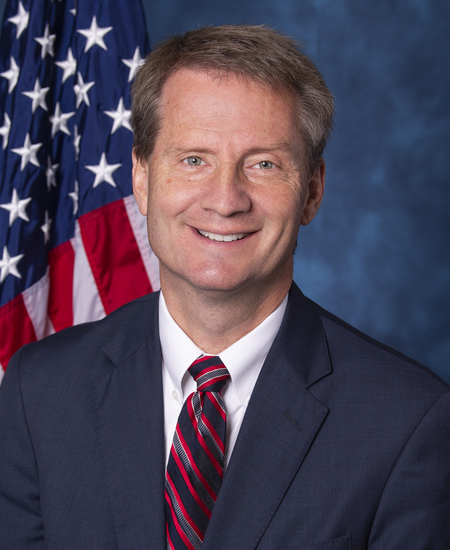
Photo of Tim Burchett
R United States House · District 2 · Tennessee On the 2026 ballot

Rep. Tim Burchett

Compare
Total votes
2,837
all sessions
Attendance
98%
50 missed
Near the chamber average
With party
85%
of cast votes
Lower than 97% of chamber peers
Bipartisan score
8%
crosses aisle rarely
Higher than 96% of chamber peers
Sponsored
749
bills & resolutions
Near the chamber average
Committees
10
assignments
749 bills and resolutions

Sponsored bills

Total
749
Primary
120
Co-sponsor
629
This page
749
matching current filters
Co-sponsor HR 5658
Passed · Indiana House · Co-sponsor
Vote by Mail Tracking Act

Maddy summaryHR 5658, the Vote by Mail Tracking Act, requires that all mail-in ballots for federal elections be sent in envelopes containing a Postal Service barcode for tracking. This applies to every ballot mailed for federal office elections after the bill becomes law. The envelope must also meet Postal Service design standards for ballot envelopes, be machineable, and display the Official Election Mail Logo. The bill directly affects voters using mail-in ballots for federal races and mandates this tracking system to be implemented by the Postal Service.

Passed Nov 19, 2024 1 co-sponsor
Co-sponsor HR 6951
In committee · Indiana House · Co-sponsor
College Cost Reduction Act

Maddy summary# Summary of Proposed Higher Education Act Amendments This document outlines significant proposed amendments to the Higher Education Act of 1965, primarily as part of the "College Cost Reduction Act." The key elements include: ## Accreditation Reform - Major overhaul of accreditation standards, requiring accrediting agencies to demonstrate independence from trade associations - New requirements for accrediting agencies to assess student achievement outcomes, including median value-added earnings relative to median total price charged - Introduction of an "Alternative Quality Assurance Experimental Site Initiative" to test non-accredited institutions - Protections for religious institutions, including a new process for appealing accreditation decisions related to religious mission - Removal of "litmus tests" that would require institutions to support specific political viewpoints ## Student Success Initiatives - Establishment of "Postsecondary Student Success Grants" to increase participation, retention, and completion rates for high-need students - Focus on evidence-based practices, with tiered requirements (tier 1, 2, and 3 reforms) - Mandatory inclusion of high-need student populations (low-income, first-generation, military-connected, etc.) - Requirements for institutions to report on completion rates, retention rates, and student demographics ## Regulatory Changes - Repeal of numerous existing regulations including: * Closed school discharges * Borrower defense to repayment * Pre-dispute arbitration * False certification requirements * Ability-to-benefit rules * Financial responsibility regulations - New restrictions on incentive compensation for recruiters - Changes to third-party servicer definitions and regulations ## Transfer and Credit Policies - New requirement that institutions cannot deny transfer credit based solely on the source of accreditation - Requirements for transparent transfer policies - Changes to reverse transfer policies ## Other Key Provisions - Modifications to the National Advisory Committee on Institutional Quality and Integrity (NACIQI) - New definitions for "total price" and "value-added earnings" - Changes to the process for institutions to change accrediting agencies - New requirements for institutions to report on student outcomes The overall focus of these proposed amendments is to reduce regulatory burden on institutions, promote transparency, improve student outcomes (particularly for high-need students), modernize accreditation processes, and protect religious institutions' rights in accreditation decisions.


In committee Nov 18, 2024 1 co-sponsor
Co-sponsor HR 1279
In committee · Indiana House · Co-sponsor
Sunshine Protection Act of 2023

Maddy summaryThe Sunshine Protection Act of 2023 would end the practice of changing clocks twice a year for daylight saving time (DST) by making DST permanent nationwide, unless a state chooses to remain on standard time. It repeals the requirement to switch clocks back to standard time in the fall, directly affecting all U.S. states and territories that currently observe DST. The bill allows states that previously opted out of DST under the Uniform Time Act (like Arizona and Hawaii) to maintain their current time zone choices without further action. Key provisions include adjusting time zone offset language in existing law and granting states the authority to select either permanent DST or standard time based on their current arrangements. This change would eliminate seasonal time changes for most Americans, though states could still choose to stay on standard time if they prefer.

In committee Nov 14, 2024 1 co-sponsor
Primary HR 10111
In committee · Indiana House · Lead sponsor
UAP Whistleblower Protection Act

Maddy summaryHR 10111, the UAP Whistleblower Protection Act, expands federal whistleblower protections to cover disclosures about the use of taxpayer funds for researching unidentified anomalous phenomena (UAP). It amends existing laws to explicitly include "the use of Federal taxpayer funds to evaluate or research unidentified anomalous phenomena material" as a protected disclosure category. This applies to federal civilian employees, FBI personnel, Department of Defense personnel, DOD contractors, federal civilian contractors, and intelligence community workers. The bill ensures these individuals cannot face retaliation for reporting misuse of public funds related to UAP research, without altering how UAP investigations are conducted.

In committee Nov 12, 2024 0 co-sponsors
Primary HR 9955
In committee · Indiana House · Lead sponsor
Safeguarding Our Stockpiles Act

Maddy summaryThe Safeguarding Our Stockpiles Act modifies the President's authority to rapidly deploy military aid without prior congressional approval. It restricts emergency drawdowns to a 20-day window after notifying Congress of an unforeseen emergency, caps annual emergency aid at $100 million, and requires Congress to approve larger requests through a specific joint resolution process. The resolution must name a single recipient country, follow strict formatting rules, and undergo expedited consideration with limited debate time. This bill directly affects how the President requests emergency military assistance and how Congress reviews those requests. It does not change who receives aid but adds procedural safeguards for congressional oversight of emergency military stockpile use.

In committee Oct 11, 2024 0 co-sponsors
Co-sponsor HR 9927
In committee · Indiana House · Co-sponsor
To terminate the Shelter and Services Program of the Federal Emergency Management Agency, and for other purposes.

Maddy summaryThis bill terminates all federal funding for FEMA's Shelter and Services Program effective upon enactment. It prohibits new appropriations for this program or any similar successor program. Any remaining funds from the program as of the enactment date will be transferred to support disaster relief efforts under the Robert T. Stafford Disaster Relief Act. The change directly affects FEMA's budget operations but redirects existing resources to broader disaster assistance.

In committee Oct 5, 2024 1 co-sponsor
Co-sponsor HRES 1469
Passed · Indiana House · Co-sponsor
Ensuring accountability for key officials in the Biden-Harris administration responsible for decisionmaking and execution failures throughout the withdrawal from Afghanistan.

Maddy summaryHRES 1469 is a formal House resolution condemning 15 specific officials in the Biden-Harris administration for their roles in the 2021 Afghanistan withdrawal. It alleges failures including inadequate planning for evacuations, disregarding warnings about Taliban actions, and misleading the public - leading to the Abbey Gate terrorist attack that killed 13 U.S. service members. The resolution does not create new legal requirements but formally condemns these individuals for "decisionmaking and execution failures" during the withdrawal. It directly addresses President Biden, Vice President Harris, National Security Advisor Jake Sullivan, Secretary of State Antony Blinken, and other senior officials named in the resolution. This is a symbolic statement of congressional disapproval, not a binding policy change.

Passed Sep 25, 2024 1 co-sponsor
Co-sponsor HR 9841
In committee · Indiana House · Co-sponsor
Prison to Proprietorship for the Formerly Incarcerated Act

Maddy summaryThis bill requires the Service Corps of Retired Executives (SCORE) to provide nationwide entrepreneurship counseling and training to people recently released from federal prisons. It mandates mentoring, business planning assistance, and help accessing capital to help them start or grow small businesses. Annual reports to Congress will track participation, demographics, and program effectiveness. The law directly affects formerly incarcerated individuals in federal custody, not state prisons.

In committee Sep 25, 2024 1 co-sponsor
Co-sponsor HR 9828
In committee · Indiana House · Co-sponsor
End the Vaccine Carveout Act

Maddy summaryThis bill removes legal immunity for vaccine manufacturers by allowing individuals injured by vaccines to sue them directly in court after filing a claim with the federal vaccine injury compensation program (VICP). It eliminates time limits for filing VICP claims (previously 24-36 months) and explicitly excludes COVID-19 vaccines from the program's coverage. The changes affect people seeking compensation for vaccine injuries and vaccine manufacturers, who will no longer automatically avoid lawsuits. The bill also repeals provisions that previously restricted legal action after VICP claims.

In committee Sep 25, 2024 1 co-sponsor
Co-sponsor HR 3433
Passed · Indiana House · Co-sponsor
Give Kids a Chance Act of 2024

Maddy summaryHR 3433, the "Give Kids a Chance Act of 2024," requires pharmaceutical companies developing certain cancer drugs to conduct pediatric studies if the drugs target molecular pathways relevant to childhood cancers. It directly affects drug manufacturers submitting new applications for cancer treatments, particularly those combining previously approved adult cancer drugs or containing a single new active ingredient. The bill amends FDA regulations to mandate these pediatric investigations only when specific conditions are met, such as when a drug's molecular target is relevant to pediatric cancer growth. The FDA must issue implementing guidance within 12 months, and reports to Congress will track implementation and effectiveness starting 2 years after enactment.

Passed Sep 24, 2024 1 co-sponsor
Showing 301 to 310 of 749 bills
Previous 1 … 30 31 32 … 75 Next