

Future in Logging Careers Act This bill allows individuals who are 16 or 17 years old to work at certain timber harvesting operations that are owned or operated by at least one parent or a person standing in place of a parent. The bill, therefore, exempts such employees from child labor laws.
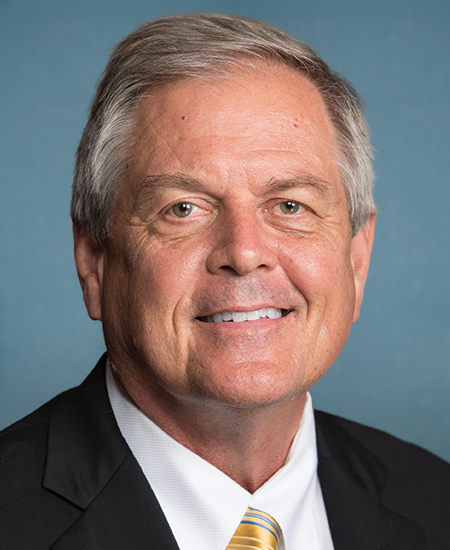
Rep. Ralph Norman
Sponsored bills
Natural Gas Export Expansion Act This bill revises requirements regarding natural gas imports or exports to expand the expedited application and approval process to any nation, even if not a party to a free trade agreement with the United States, that is not specifically excluded by this bill. The bill excludes any nation subject to sanctions or trade restrictions imposed by the United States or excluded by the President or Congress for national security reasons.
American Workforce Empowerment Act This bill allows tax-preferred college savings plans (529 plans) to fund certain postsecondary certificate programs and apprenticeship programs.
American Heritage Protection Act of 2021 This bill prohibits the Department of the Interior from changing the name of or altering in any way the Lincoln Memorial, the Jefferson Memorial, the Franklin Delano Roosevelt Memorial, the Dwight D. Eisenhower Memorial, the Theodore Roosevelt Island, or the Washington Monument; or moving, or altering in any way, any statue located on federal land related to the War of 1812, the Civil War, or the Revolutionary War.
This resolution recognizes the men and women of U.S. Customs and Border Protection for their work to defend American sovereignty, uphold law and order, and mitigate the threat at the southern border.
This resolution expresses the sense of the House of Representatives that (1) clean water is a national priority, and (2) the 2020 final rule titled The Navigable Waters Protection Rule: Definition of "Waters of the United States" should not be withdrawn or vacated.
A Fast-Tracked Executive Rescission Review (AFTER) of Appropriations Act of 2021 This bill establishes expedited legislative procedures for congressional consideration of proposals by the President to rescind funding, cancel a new item of direct spending, or cancel a limited tax benefit.
Accelerate Long-term Investment Growth Now Act or the ALIGN Act This bill makes permanent the expensing of certain new business equipment. Expensing allows the deduction of the full amount of an expense item in the same taxable year.
Paris Transparency and Accountability Act This bill restricts the President's authority to unilaterally establish or revise actions the United States plans to take to meet its obligations under the Paris Agreement (a climate change treaty adopted in 2015) and increases congressional oversight of those actions. The bill also prohibits any legal cause of action in U.S. courts pursuant to the Paris Agreement. Specifically, the President must report to Congress before proposing new or revised actions under the agreement. The report must describe the proposed actions, including their impact on global emissions, and outline a detailed plan to address economic effects and related considerations of the actions. If a proposed action results in increased energy or manufacturing costs, the report must include specific policy measures (and timelines for implementing the measures) to prevent (1) job displacement, (2) reduced global competitiveness of U.S. goods, and (3) leaked emissions that may occur as a result of the proposed action. After the President submits a report, the bill provides Congress with a 60-day period to review it. During the review period, Congress may block the actions proposed in the report by enacting a joint resolution of disapproval. The bill also outlines procedures for the introduction and consideration of this type of joint resolution.
Haulers of Agriculture and Livestock Safety Act of 2021 or the HAULS Act of 202 1 This bill modifies exemptions with respect to commercial motor vehicle safety regulations involving the transportation of agricultural commodities and farm supplies. The bill allows the federal hours-of-service rules exemption regarding maximum driving and on-duty time for drivers transporting agricultural commodities and farm supplies to apply year-round. Current law provides an exception from the federal hours-of-service rules for the transportation of agricultural commodities within a 150 air-mile radius of the normal work reporting location only during planting and harvest periods which are determined by each state. Additionally, the Department of Transportation must revise the definition of agricultural commodity to include specific commodities that are covered by the federal hours-of-service rules exception.