Life at Conception Act This bill declares that the right to life guaranteed by the Constitution is vested in each human being at all stages of life, including the moment of fertilization, cloning, or other moment at which an individual comes into being. Nothing in this bill shall be construed to authorize the prosecution of any woman for the death of her unborn child.
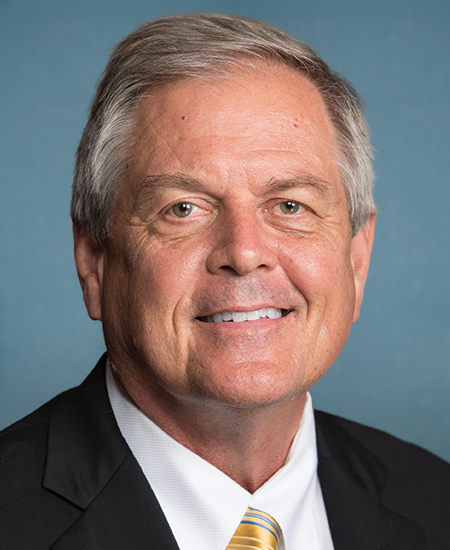
Rep. Ralph Norman
Sponsored bills
Protect Our Military Families' 2nd Amendment Rights Act This bill broadens the scope of allowable firearms transactions involving active duty service members and their spouses. Specifically, the bill allows a licensed gun dealer, importer, or manufacturer to sell or ship a firearm or ammunition to the spouse of a member of the Armed Forces on active duty outside the United States. Current law already allows a licensed dealer, importer, or manufacturer to sell or ship a firearm or ammunition to a member of the Armed Forces on active duty outside the United States. The bill also specifies that, for purposes of federal firearms laws, a member of the Armed Forces on active duty, or his or her spouse, is a resident of the state in which (1) the member or spouse maintains legal residence, (2) the permanent duty station of the member is located, and (3) the member maintains a home from which he or she commutes to the permanent duty station.

One Subject at a Time Act This bill requires each bill or joint resolution to include no more than one subject and the subject to be clearly and descriptively expressed in the measure's title. An appropriations bill may not contain any general legislation or change to existing law that is not germane to the subject of such bill. The bill voids measures or provisions noncompliant with these requirements, including appropriation provisions outside the relevant subcommittee's jurisdiction.
Sanctity of Human Life Act This bill defines the beginning of human life for purposes of legal and constitutional attributes and privileges of personhood. Specifically, it declares that the right to life guaranteed by the Constitution is vested in each human and is a person's most fundamental right; each human life begins with fertilization, cloning, or its equivalent; and Congress, each state, the District of Columbia, and each U.S. territory have the authority to protect all human lives.
No Taxpayer Funding for Abortion and Abortion Insurance Full Disclosure Act of 2021 This bill modifies provisions relating to federal funding for, and health insurance coverage of, abortions. Specifically, the bill prohibits the use of federal funds for abortions or for health coverage that includes abortions. Such restrictions extend to the use of funds in the budget of the District of Columbia. Additionally, abortions may not be provided in a federal health care facility or by a federal employee. Historically, language has been included in annual appropriations bills for the Department of Health and Human Services (HHS) that prohibits the use of federal funds for abortions—such language is commonly referred to as the Hyde Amendment. Similar language is also frequently included in appropriations bills for other federal agencies and the District of Columbia. The bill makes these restrictions permanent and extends the restrictions to all federal funds (rather than specific agencies). The bill's restrictions regarding the use of federal funds do not apply in cases of rape, incest, or where a physical disorder, injury, or illness endangers a woman's life unless an abortion is performed. The Hyde Amendment provides the same exceptions. The bill also prohibits qualified health plans from including coverage for abortions. Currently, qualified health plans may cover abortion, but the portion of the premium attributable to abortion coverage is not eligible for subsidies.
Empower our Girls Act This bill allows certain grants authorized under the Violence Against Women Act to be used to support victims of female genital mutilation. Such grants already support victims of domestic violence, sexual assault, dating violence, and stalking. The bill also requires the Federal Bureau of Investigation (FBI) to classify female genital mutilation as a Part II crime (i.e., a less serious offense) in the Uniform Crime Reports. (The FBI compiles and periodically publishes crime statistics through the Uniform Crime Reporting Program. Currently, the FBI does not compile and publish information about female genital mutilation.)
Health Freedom and Flexibility Act This bill revises provisions relating to health savings accounts (HSAs), including to eliminate the requirement that a participant in an HSA be enrolled in a high deductible health plan; repeal certain limitations on deductions for contributions to HSAs; repeal rules relating to eligible individuals who participate in HSAs; repeal the limitation on use of HSAs to purchase health insurance; include certain medical items as medical expenses for HSA purposes, including menstrual care products, over-the-counter medicines, and medically necessary items; include as HSA-eligible medical expenses, direct primary care, exercise equipment, and dental care items; and prohibit the use of HSAs to pay for abortions or for insurance that includes coverage for abortions.
Official Time Reporting Act This bill requires the Office of Personnel Management (OPM) to report annually to Congress on the use of official time by federal employees. Official time is paid time off from assigned duties to perform labor-management relations activities. Among other things, the OPM must report on the following: the total amount of official time granted to employees, the specific types of activities for which official time was granted, and the total amount of compensation provided to employees in connection with official time activities.
This bill directs the President to withdraw the United States from the United Nations Framework Convention on Climate Change (the entity tasked with supporting the global response to climate change), and it prohibits the use of funds to carry out U.S. obligations under the framework following this withdrawal.
Finish the Wall Act This bill requires the Department of Homeland Security (DHS) to resume activities related to the construction of a barrier system along the U.S.-Mexico border and addresses other border-related issues. DHS must resume all such construction activities that were planned or underway prior to January 20, 2021. DHS must also expend all funds appropriated or explicitly obligated since October 1, 2016, for construction of this barrier system. DHS may not cancel contracts for activities related to such construction entered into on or before January 20, 2021. Furthermore, within 14 days of this bill's enactment, DHS must certify to Congress that U.S. Customs and Border Protection facilities that process adults taken into custody at the border are fully compliant with certain laws related to the collection of DNA. (Among other things, these laws allow for the collection of DNA samples from non-U.S. persons detained under U.S. authority.)