

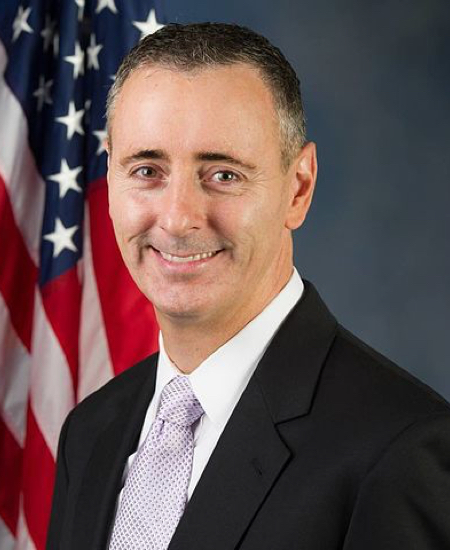
Photo of Brian K. Fitzpatrick
R United States House · District 1 · Pennsylvania On the 2026 ballot

Rep. Brian K. Fitzpatrick

Compare
Total votes
2,837
all sessions
Attendance
100%
9 missed
Higher than 75% of chamber peers
With party
76%
of cast votes
Lower than 98% of chamber peers
Bipartisan score
12%
some cross-party votes
Higher than 97% of chamber peers
Sponsored
4,052
bills & resolutions
Higher than 99% of chamber peers
Committees
6
assignments
4,052 bills and resolutions

Sponsored bills

Total
4,052
Primary
180
Co-sponsor
3,872
This page
4,052
matching current filters
Co-sponsor HRES 920
In committee · Indiana House · Co-sponsor
Celebrating the 50th anniversary of the Individuals with Disabilities Education Act on November 29, 2025, and recognizing its transformative impact on the education of children with disabilities.

Maddy summaryHRES 920 is a ceremonial resolution celebrating the 50th anniversary of the Individuals with Disabilities Education Act (IDEA) on November 29, 2025. It recognizes IDEA’s historical impact - establishing the right to free, appropriate public education in the least restrictive environment for children with disabilities - and notes how it transformed access to education after over 1 million children were previously excluded from schools. The resolution does not create new policy or funding; it solely commemorates IDEA’s legacy, honors the students and families it has served, and acknowledges educators and advocates who advanced its implementation. This is a symbolic gesture with no direct effect on current law or services.

In committee Dec 2, 2025 1 co-sponsor
Co-sponsor HRES 919
In committee · Indiana House · Co-sponsor
Commemorating and supporting the goals of World AIDS Day.

Maddy summaryHRES 919 is a non-binding resolution commemorating World AIDS Day (December 1) and supporting global efforts to end the HIV/AIDS epidemic. It encourages achieving "zero new HIV transmissions, zero discrimination, and zero AIDS-related deaths" by 2030, promotes awareness of U=U (Undetectable=Untransmittable) treatment, and urges continued U.S. funding for HIV prevention, treatment, and research programs domestically and globally. The resolution does not create new laws but symbolically affirms support for existing initiatives like PEPFAR and the Ryan White CARE Act, while highlighting disparities affecting communities of color, transgender individuals, and people in the Southern U.S.

In committee Dec 2, 2025 1 co-sponsor
Co-sponsor HR 6358
In committee · Indiana House · Co-sponsor
Veteran Education Empowerment Act

Maddy summaryHR 6358, the Veteran Education Empowerment Act, creates a federal grant program to help colleges establish or improve dedicated Student Veteran Centers. These centers provide veterans, active-duty service members, and their families with lounge space, benefits counseling, academic support, and mental health services. Institutions must serve significant numbers of veterans and have sustainability plans to qualify for grants, with funding capped at $500,000 per institution over four years. The bill directly affects colleges serving veterans and aims to address challenges like isolation and transition difficulties through centralized campus support.

In committee Dec 2, 2025 1 co-sponsor
Co-sponsor HR 5858
In committee · Indiana House · Co-sponsor
CATCH IT Act

Maddy summaryThe CATCH IT Act (HR 5858) increases federal funding for rural health facilities by raising the federal share of costs for preventative health care equipment by 25 percentage points under the Community Facilities Grant Program. It specifically covers equipment like advanced breast imaging, mobile cancer screening units, cancer screening lab tools, colorectal screening devices, CT scanners, and diagnostic ultrasound equipment. This applies to facilities developing new projects or upgrading existing ones to include these technologies, aiming to improve access to preventative care in rural areas. The policy change takes effect in the first federal fiscal year after the bill is enacted.

In committee Dec 2, 2025 1 co-sponsor
Co-sponsor HR 4549
Passed · Indiana House · Co-sponsor
Office of Rural Affairs Enhancement Act

Maddy summaryHR 4549, the Office of Rural Affairs Enhancement Act, amends the Small Business Administration's structure to better serve rural small businesses. It requires the Office's Assistant Administrator to have specific rural business expertise and mandates new outreach activities, including regional webinars and events for rural small business owners. The bill also adds annual reporting requirements for the SBA, detailing the Office's budget, staff, outreach events, and analysis of lending programs targeting rural businesses. These changes directly affect rural small business concerns (defined as those in rural areas per SBA rules) and the SBA's operational approach to their support. The legislation focuses on strengthening the Office's capacity to connect rural businesses with federal resources.

Passed Dec 2, 2025 1 co-sponsor
Co-sponsor HR 1262
Passed · Indiana House · Co-sponsor
Mikaela Naylon Give Kids a Chance Act

Give Kids a Chance Act of 2025 This bill expands the Food and Drug Administration’s (FDA’s) authority with respect to research on rare pediatric diseases, including by permitting the FDA to take enforcement action against drug sponsors that fail to satisfy pediatric study requirements and by reauthorizing programs that support pediatric research.  Specifically, the bill modifies requirements relating to molecularly targeted pediatric cancer investigations to permit research on new drugs in combination with active ingredients that have already been approved, provided certain conditions are met; permits the FDA to take enforcement action against drug sponsors that fail to comply with pediatric study requirements, if such sponsors demonstrated a lack of due diligence in satisfying the requirement; renews the FDA’s authority to award priority review vouchers to sponsors of new products intended to treat rare pediatric diseases through September 30, 2029; and reauthorizes through FY2027 certain funding for the National Institutes of Health to support priority pediatric research.  The bill also provides statutory authority for the FDA’s interpretation of the orphan drug exclusivity period. The bill specifies, consistent with FDA regulations, that the seven-year market exclusivity period for drugs for rare diseases or conditions (i.e., orphan drugs) prohibits the approval of the same drug for the same approved use or indication with respect to the disease or condition. (In Catalyst Pharmaceuticals, Inc. v. Becerra , a court rejected the FDA’s interpretation and held that orphan drug exclusivity extends to all uses or indications for the disease or condition.)

Passed Dec 2, 2025 1 co-sponsor
Co-sponsor HR 6340
In committee · Indiana House · Co-sponsor
Save the Green to Gold Program Act

Maddy summaryThe Save the Green to Gold Program Act amends U.S. military law to adjust how enlisted service time is counted for officers who completed the SROTC program. It allows these officers to count their service in the Selected Reserve from either August 1, 1979, or the date the bill becomes law, regardless of which military branch they served in. This change directly affects current and future officers who served in the Selected Reserve before becoming commissioned, potentially extending their counted service time for promotion and retirement. The bill updates section 2106(c) of Title 10, U.S. Code, to provide this new option for computing service length.

In committee Dec 1, 2025 1 co-sponsor
Co-sponsor HR 5661
In committee · Indiana House · Co-sponsor
Water Preservation and Affordability Act of 2025

Maddy summaryThe Water Preservation and Affordability Act of 2025 amends the Clean Water Act to require federal water infrastructure funding recipients to prioritize "resource preservation techniques," defined as water efficiency (reuse, conservation), energy efficiency, stormwater mitigation, sustainable design, and environmental innovation. It mandates that projects receiving loans for treatment works repairs or expansions must evaluate and use these techniques to the maximum extent practicable. The bill increases annual funding for the Clean Water Infrastructure Resiliency Program from $25 million to $50 million (2026-2031) and authorizes $40 million yearly for a wastewater efficiency pilot program (2026-2031). These changes directly affect municipal water systems and wastewater treatment facilities receiving federal grants or loans under the Clean Water Act.

In committee Dec 1, 2025 1 co-sponsor
Co-sponsor HR 5566
In committee · Indiana House · Co-sponsor
Water Infrastructure Resilience and Sustainability Act

Maddy summaryHR 5566, the Water Infrastructure Resilience and Sustainability Act, extends deadlines for three existing federal water infrastructure programs by five years. It amends the Clean Water Act to extend the deadline for the Clean Water Infrastructure Resiliency and Sustainability Program from 2026 to 2031, and updates the Safe Drinking Water Act to extend deadlines for both the general Drinking Water System Infrastructure Program and the Midsize/Large Drinking Water System Program from 2026 to 2031. These changes directly affect state and local governments administering these programs, giving them more time to complete eligible projects. The bill makes no new funding commitments or policy changes - only adjusts the timeline for existing program requirements.

In committee Dec 1, 2025 1 co-sponsor
Co-sponsor HR 4733
In committee · Indiana House · Co-sponsor
Low-Income Household Water Assistance Program Establishment Act

Maddy summaryThis bill establishes a federal program to help low-income households pay for drinking water and wastewater services. It provides $500 million annually (2026-2030) in grants to states and tribes that already administer energy assistance programs, allowing them to cover past-due bills or other costs for households meeting specific income criteria (e.g., receiving certain federal benefits or earning ≤150% of the poverty level). The program prohibits using these funds to replace existing assistance and requires technical help to streamline eligibility. It directly affects low-income households in participating states and tribes, particularly those facing water affordability challenges.

In committee Dec 1, 2025 1 co-sponsor
Showing 451 to 460 of 4,052 bills
Previous 1 … 45 46 47 … 406 Next