

Maddy summaryHRES 335 is a symbolic resolution condemning two mass shootings in Louisville, Kentucky: one at the Old National Bank on April 10, 2023 (killing 5 people), and another at Chickasaw Park on April 15, 2023 (killing 2 people). It honors the victims' memories, expresses condolences to their families and the affected community, and reaffirms the House's commitment to supporting all gun violence victims. The resolution does not propose new laws or policies but serves as a formal statement of condemnation and solidarity. It directly affects the victims' families, Louisville residents, and the broader community impacted by these tragedies.
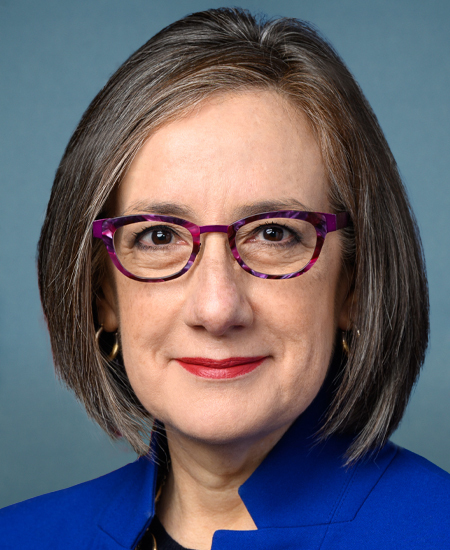
Rep. Andrea Salinas
Sponsored bills
Maddy summaryThe Election Mail Act (HR 2987) establishes new requirements for handling mail-in ballots in federal elections to improve reliability and accessibility. It requires the Postal Service to process absentee ballots on the same day received, place postmarks indicating mailing dates on ballot envelopes, and treat election mail as first-class mail with free postage for completed ballots. The bill also mandates states to use intelligent mail barcodes on return envelopes, affix specific tags for ballot visibility, and adopt a uniform 7-day deadline for accepting mailed ballots postmarked on or before election day. These changes apply to federal elections, with most provisions taking effect for the 2024 election cycle. The bill includes additional provisions for the Postal Service to consult with Indian Tribes about voting barriers on tribal lands.
Maddy summaryThe Child Care for Working Families Act establishes a federal entitlement program providing subsidized child care for working families with children under age 6 who are not yet in kindergarten. It creates a sliding fee scale where families at or below 85% of State median income pay no copayment, while higher-income families pay up to 7% of their income based on income thresholds. The bill requires states to develop quality rating systems for child care providers and ensures providers receive sufficient funding to meet quality standards, including wages equivalent to elementary educators. It prioritizes access for underserved populations including children with disabilities, infants and toddlers, children experiencing homelessness, and families in low-income communities. The program is funded with $20 billion for fiscal year 2024 and subsequent years through 2029.
Forced Arbitration Injustice Repeal Act of 2023 or the FAIR Act of 2023 This bill prohibits a predispute arbitration agreement from being valid or enforceable if it requires arbitration of an employment, consumer, antitrust, or civil rights dispute.
Performing Artist Tax Parity Act of 2023 This bill modifies the above-the-line tax deduction for the expenses of performing artists (including commissions paid to managers or agents) to provide for a phaseout of such deduction for taxpayers whose adjusted gross income exceeds $100,000 ($200,000 for joint return filers). The $100,000 phaseout threshold is adjusted for inflation annually for taxable years beginning after 2023.
Maddy summaryThe Flight Education Access Act increases federal student loan limits for students enrolled in eligible flight education programs, which prepare students for commercial pilot certification. It sets specific annual and aggregate loan limits based on a student's year of study (e.g., dependent students can borrow up to $111,000 total), and requires programs to meet a 70% completion rate after three years to maintain eligibility. The bill also creates a new $40 million annual grant program to support partnerships between educational institutions and aviation industry partners to diversify the pilot workforce and increase interest in aviation careers. It requires data collection on program completion rates and demographic information, with reports to Congress on the program's effectiveness.
Raise the Age Act of 2023 This bill establishes new restrictions on the sale or transfer of certain semiautomatic firearms to individuals under 21 years of age. Specifically, this bill makes it unlawful for a licensed gun dealer, importer, manufacturer, or collector to sell or deliver a semiautomatic center-fire rifle or semiautomatic center-fire shotgun that has (or has the capacity to accept) an ammunition feeding device with a capacity of more than five rounds to an individual who the licensee knows or has reasonable cause to believe is under age 21. The prohibition does not apply if the individual under age 21 is a full-time law enforcement officer or active-duty member of the Armed Forces. The bill also requires the Federal Bureau of Investigation to report on the operation of its public access line, including a description of information sharing protocols and recommendations for improving such protocols.
Maddy summaryHRES 324 is a non-binding House resolution expressing support for library staff across public, school, academic, and special libraries. It recognizes these workers as essential community resources providing access to information, internet services, and social support - especially for underserved populations - and highlights their expanded roles during crises like the opioid epidemic and pandemic. The resolution calls for adequate funding, protects staff from threats while performing their duties, supports their right to unionize, and upholds the public’s right to free access to library resources. It does not create new laws or funding but formally acknowledges these priorities during National Library Week.
Maddy summaryThe Family Building FEHB Fairness Act (HR 2828) amends the Federal Employees Health Benefits (FEHB) program to add assisted reproductive treatment as a covered benefit for federal employees and their families. It specifically defines these treatments to include procedures like in vitro fertilization, intrauterine insemination, and the preservation of eggs, sperm, or embryos. The bill requires the Office of Personnel Management to include these services under FEHB coverage, expanding access to reproductive care for eligible federal workers. The change would take effect one year after the bill's enactment, directly affecting federal employees enrolled in the FEHB program seeking fertility-related medical services.
Maddy summaryThe Child Labor Exploitation Accountability Act requires U.S. Department of Agriculture (USDA) contractors to annually disclose if they or their subcontractors faced serious labor violations - including child labor violations under the Fair Labor Standards Act - in the past three years. Contractors with such violations must report corrective steps, and those failing to address issues or repeating violations face a five-year ban from USDA contracts (including the year of listing and the next four years). The law mandates annual reports to Congress tracking the number of contractors on the ineligible list and the program's effectiveness. This policy directly affects agricultural businesses and suppliers contracting with the USDA, aiming to enforce labor compliance through financial consequences.