

Maddy summaryHR 4299, the "There are Two Sexes Act of 2023," prohibits the use of federal funds for creating or distributing any required federal form that offers gender options beyond "Male" or "Female." It directly affects federal agencies and programs that require individuals to provide gender information on official forms, such as benefit applications or enrollment documents. The bill bans federal funding for any such form starting October 1, 2024, ensuring only binary gender options are used on federally mandated paperwork. This policy change restricts how federal entities collect gender data but does not alter personal identification or state-level policies.
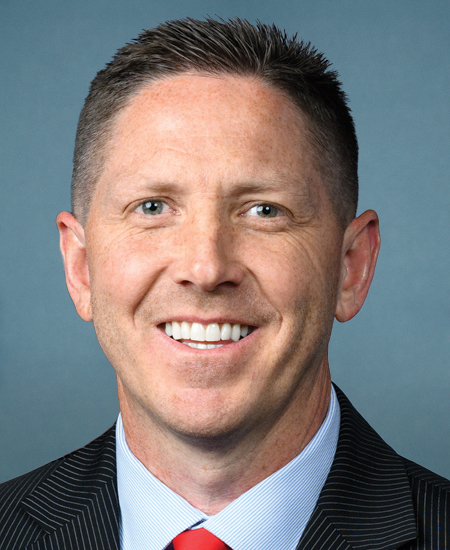
Rep. Josh Brecheen
Sponsored bills
Maddy summaryHR 4294 would require the President to annually designate one month as "Fidelity Month," focused on promoting values like faith, family, and patriotism. The bill directs the President to use this observance to encourage Americans to reaffirm these values, based on the bill's findings about their perceived decline. This is a procedural resolution with no new funding or regulations; it only mandates a presidential designation. The bill directly affects the President's authority and indirectly invites public participation in a national observance.
Maddy summaryHJRES 45 is a congressional disapproval resolution targeting a specific Department of Education rule about federal student loans. It seeks to block the rule implementing "One-Time Federal Student Loan Debt Relief" (including modifications to Perkins, FFEL, and Direct Loan programs) by invoking the Congressional Review Act. If passed, this resolution would nullify the rule, preventing the Department of Education from using it to modify or waive student loan obligations. The bill directly affects borrowers who might have qualified for debt relief under the targeted rule.
Maddy summaryHR 277 would require Congress to approve major federal regulations before they take effect. Major rules are defined as those with significant economic impact ($100 million+ annually), major cost increases for consumers or industries, or significant adverse effects on competition, employment, or innovation. Agencies must submit detailed information about these rules to Congress, including cost-benefit analyses, before they can take effect. Congress would have 70 session days to approve the rule with a joint resolution; if they don't act within that timeframe, the rule would not take effect. This would increase congressional oversight of federal regulations and require more detailed information about proposed rules before they become law.
Maddy summaryHR 288, the Separation of Powers Restoration Act of 2023, amends federal law to change how courts review agency actions. It requires federal courts to decide de novo (anew) all legal questions - including interpretations of laws and the Constitution - when reviewing agency decisions, rather than deferring to agency interpretations. This applies to all judicial reviews of agency actions under existing law, unless a specific law explicitly exempts such cases. The bill directly affects federal courts, agencies, and parties involved in litigation over agency rules or enforcement. It aims to shift interpretive authority from agencies to courts in administrative law cases.
Maddy summaryHR 4038, the POPP Act, blocks the Environmental Protection Agency (EPA) from finalizing, implementing, or enforcing a specific proposed rule about greenhouse gas emissions from power plants. This rule, published in May 2023, aimed to set new standards for emissions from fossil fuel-fired power plants and replace an earlier rule. The bill prohibits the EPA from moving forward with this rule or any substantially similar rule, directly affecting the EPA's regulatory authority and power plant operators who would have been subject to the proposed standards. The bill bases this prohibition on arguments that the proposed rule violates the Clean Air Act by not demonstrating that required emission reduction technologies are commercially viable and cost-effective.
Stop Government Overreach in Ranching Act This bill repeals the guidance that was issued by the Food and Drug Administration (FDA) on June 11, 2021, relating to over-the-counter (OTC) antimicrobial drugs for animals. The guidance provides information for sponsors of medically important antimicrobial new animal drug products who wish to change the status of these drugs from OTC to veterinary prescription, in accordance with the FDA's recommendation that these drugs be administered with veterinary oversight to reduce the possibility of antimicrobial resistance.
Maddy summaryHRES 482 is a ceremonial resolution commending Raul L. Ortiz upon his retirement after 32 years of service with the U.S. Border Patrol. It formally recognizes his career, including his role as the 25th Chief of the Border Patrol (appointed August 2021), and acknowledges his leadership during his tenure. The resolution contains no policy changes or new laws; it is solely a gesture of appreciation from the House of Representatives. It does not affect any individuals or policies beyond expressing formal recognition of Ortiz’s service.
Maddy summaryHR 3924, the Passport Sanity Act, requires the U.S. Department of State to issue passports, passport cards, and Consular Reports of Birth Abroad only with "male" or "female" gender designations, prohibiting the use of the "X" (unspecified) option. This bill directly affects individuals who currently apply for or hold U.S. passports with an "X" gender marker. The key provision mandates that all new applications and documents must use only the binary gender options, eliminating the existing "X" designation. The bill does not alter eligibility for passports but changes the gender marker options available on these specific travel documents.
This resolution requires the Clerk of the House of Representatives to place in the House Chamber a real-time display of the outstanding national debt.