

Maddy summaryThe LET'S Protect Workers Act increases civil penalties for employers who violate labor and workplace safety laws. It significantly raises fines for child labor violations (up to $700,000 for serious injuries/deaths), wage and hour violations (up to $50,000 per violation for repeated/willful violations), and workplace safety violations (up to $800,000). The bill also increases penalties for farmworker protections (to $30,000), mine safety violations, and unfair labor practices (up to $100,000). New provisions require employers to pay penalties, with withdrawal orders for mines that fail to pay fines. These changes apply to violations occurring on or after January 1, 2025, with some provisions taking effect immediately.
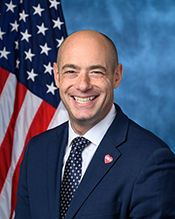
Rep. Greg Landsman
Sponsored bills
Maddy summaryH.J. Res. 193 proposes a constitutional amendment to eliminate legal immunity for federal officials, including the President, from criminal prosecution for actions taken while performing official duties. It also prohibits the President from granting a pardon to themselves. The amendment would apply to all federal officers (such as the President, Vice President, and members of Congress) except for Congress members acting in their legislative role as defined in the Constitution. If ratified by 38 states, this change would become part of the U.S. Constitution, requiring no further congressional action.
Maddy summaryHRES 1382 is a non-binding resolution expressing the House of Representatives' view that Americans should resolve political disagreements without threats or violence, citing recent incidents like the 2011 shooting of Rep. Giffords and increased threats against election officials. It calls on political leaders of all parties to consistently and often condemn political violence, including after the recent assassination attempt on former President Trump. The resolution does not create new laws but formally states the House's position on this issue.
Maddy summaryHRES 1364 is a procedural resolution that sets the rules for considering H.R. 82 in the House of Representatives. It waives objections to the bill, limits debate to one hour equally divided between the sponsor and an opponent, and allows the bill to proceed directly to a final vote without further amendments. This resolution does not change Social Security policy itself but streamlines the process for evaluating H.R. 82, which would repeal the Government pension offset and windfall elimination provisions. The resolution affects House procedure and the timing of consideration for H.R. 82.
Maddy summaryThis bill amends a section of law governing Department of Veterans Affairs (VA) employee compensation to clarify that disputes over whether an employee received the correct pay amount under existing rules are not considered "adjustment of compensation" under the statute. It specifically excludes grievances challenging pay accuracy from the definition of "establishment, determination, or adjustment of employee compensation." The change directly affects VA employees covered under Section 7421(b) who might file such pay-related grievances. The bill makes a technical clarification to streamline how these disputes are categorized within VA's compensation process.
Maddy summaryHR 7914, the Accountability for Terrorist Perpetrators of October 7th Act, imposes U.S. sanctions on the Popular Resistance Committees (PRC) and associated individuals or groups, including blocking property transactions and denying visas to members. The bill requires the President to enforce these sanctions 90 days after enactment, with exceptions for United Nations operations and national security activities, and allows temporary 180-day waivers for national security reasons. It also mandates a 90-day report to Congress on whether the PRC and the group "Lion's Den" meet criteria for designation as terrorist organizations under existing laws. Ongoing reports every two years will track new entities linked to the PRC.
Maddy summaryHRES 1355 is a non-binding resolution supporting the designation of July 10 as Journeyman Lineworkers Recognition Day. It honors lineworkers who maintain electrical infrastructure under hazardous conditions, including during disasters, and commemorates Henry Miller, the first president of the International Brotherhood of Electrical Workers, who died on July 10, 1896, while troubleshooting an electrical outage. The resolution encourages public recognition of these workers' contributions but does not create new laws or policies.
Maddy summaryHR 8992, the Stop Fentanyl at the Border Act, allocates $5.8 billion in federal funding to enhance border security efforts focused on intercepting fentanyl and other illegal drugs. The bill provides $3.4 billion for U.S. Customs and Border Protection (CBP) staffing, including hiring bonuses, mental health support, and processing coordinators, and $1.09 billion for advanced scanning technology and drug interdiction capabilities at land borders. Additional funds target disrupting fentanyl trafficking networks ($223 million for ICE), outbound firearm/currency inspections ($285 million), and law enforcement coordination (DEA, DOJ, U.S. Marshals). These provisions directly affect CBP officers, ICE agents, and border ports of entry by expanding personnel, technology, and interdiction strategies. The bill requires annual reports to Congress on the effectiveness of new staffing, scanning systems, and outbound inspection programs.
Maddy summaryThis bill removes a prohibition that previously blocked federal housing assistance for college students. It creates a new waiver allowing housing authorities to provide tenant-based housing assistance to students in foster care or court-emancipated minors living in on-campus housing at eligible colleges. The assistance won't count as income for financial aid, work-study programs, or child support calculations, directly supporting vulnerable students facing housing costs.
Maddy summaryThis bill (HR 2365, Public Law 118-66) directs the U.S. Department of Health and Human Services (HHS) to establish the National Parkinson’s Project. It requires HHS to create and update a coordinated national plan for preventing, diagnosing, treating, and researching Parkinson’s disease and related disorders (including multiple system atrophy and progressive supranuclear palsy), while coordinating federal research and care efforts across agencies like the NIH, CDC, and VA. The law mandates annual progress assessments, an advisory council with patient advocates and diverse experts, and annual reports to Congress on federal Parkinson’s programs and recommendations for improvement. It affects federal agencies managing Parkinson’s-related programs and aims to improve care coordination and research efficiency for patients and caregivers, with the law sunsetting in 2035.