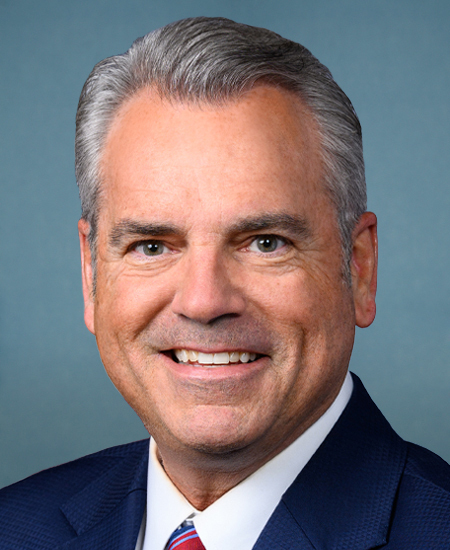
Photo of Mark Alford
R United States House · District 4 · Missouri On the 2026 ballot

Rep. Mark Alford

Compare
Total votes
1,879
all sessions
Attendance
99%
18 missed
Near the chamber average
With party
96%
of cast votes
Near the chamber average
Bipartisan score
3%
crosses aisle rarely
Near the chamber average
Sponsored
443
bills & resolutions
Near the chamber average
Committees
8
assignments
443 bills and resolutions

Sponsored bills

Total
443
Primary
53
Co-sponsor
390
This page
443
matching current filters
Co-sponsor HJRES 12
In committee · Indiana House · Co-sponsor
Proposing an amendment to the Constitution of the United States to limit the number of terms that a Member of Congress may serve.

Maddy summaryThis proposed constitutional amendment would limit Members of Congress to serving a maximum of three terms in the House of Representatives or two terms in the Senate. It directly affects current and future members by preventing those who have already served the maximum terms from seeking re-election. Key provisions include counting vacancies filled for more than a year (House) or three years (Senate) as a full term toward the limit, while excluding terms served before ratification from the count. As a constitutional amendment proposal, it requires approval by three-fourths of state legislatures to become law.

In committee Jan 6, 2025 1 co-sponsor
Co-sponsor HR 82
Signed into law · Indiana House · Co-sponsor
Social Security Fairness Act of 2023

Maddy summaryHR 82, the Social Security Fairness Act of 2023, repeals two provisions that reduce Social Security benefits for certain government workers. It eliminates the Government Pension Offset (GPO), which cuts spousal or survivor benefits for people with pensions from jobs not covered by Social Security (like federal or state government roles), and the Windfall Elimination Provision (WEP), which lowers retirement benefits for those with similar pensions. The law takes effect for benefits paid after December 2023, requiring the Social Security Administration to adjust benefit calculations to remove these reductions. This change directly affects public-sector employees who previously had their Social Security benefits reduced due to their government pensions.

Signed into law Jan 5, 2025 1 co-sponsor
Co-sponsor HR 4563
In committee · Indiana House · Co-sponsor
ACE Act

Maddy summary# Summary of Proposed Legislation This comprehensive legislative proposal contains multiple sections addressing election integrity, campaign finance reform, cybersecurity, census operations, and related government functions. Key provisions include: 1. **Campaign Finance Reforms**: - Increased thresholds for political committee reporting requirements - Repeal of requirements for political committees to report donor identification - Exemption of uncompensated internet communications from contribution/expenditure treatment - Protection of donor privacy for tax-exempt organizations through the "Speech Privacy Act of 2023" 2. **Election Security**: - Establishment of a process for testing and monitoring cybersecurity vulnerabilities in election equipment - Requirements for the Secretary of Homeland Security to notify state officials about election cybersecurity incidents - Exclusive authority for the Election Assistance Commission regarding guidelines for voting system certification 3. **Census and Redistricting**: - Establishment of a permanent Census Monitoring Board with bipartisan composition to review census operations - Clarification of state authority over congressional redistricting maps - Provisions regarding the Speaker of the House's authority to join civil actions related to apportionment 4. **Other Key Provisions**: - Termination of the Disinformation Governance Board and prohibition on funding similar entities - Amendments to the Federal Election Campaign Act to increase reporting thresholds and exempt certain communications - Various technical corrections to existing campaign finance law The legislation appears to focus on enhancing election security, reducing regulatory burdens on political organizations, protecting donor privacy, and strengthening oversight of census operations while maintaining constitutional boundaries between federal and state authority.


In committee Jan 3, 2025 1 co-sponsor
Co-sponsor HR 45
In committee · Indiana House · Co-sponsor
FIND Act

Maddy summaryHR 45 (FIND Act) requires federal government contractors to certify they do not discriminate against firearm businesses (including manufacturers, dealers, and trade associations) in their policies or practices. The bill mandates that contractors and subcontractors (for contracts over 10% of the prime contract value) certify they have no discriminatory policies and will not adopt them during the contract term. Violations could lead to contract termination and potential debarment. This applies to all federal procurement contracts awarded after the bill's enactment, excluding sole-source contracts. The law aims to ensure firearm businesses are treated equally in government contracting without restricting legitimate business criteria like creditworthiness or legal compliance.

In committee Jan 3, 2025 1 co-sponsor
Co-sponsor HR 1097
Signed into law · Indiana House · Co-sponsor
Everett Alvarez, Jr. Congressional Gold Medal Act of 2023

Maddy summaryThis bill, HR 1097 (Everett Alvarez, Jr. Congressional Gold Medal Act of 2023), authorizes the award of a Congressional Gold Medal to Everett Alvarez, Jr., in recognition of his service as a U.S. Navy pilot and Vietnam War prisoner of war. It directly honors Alvarez, who was the first U.S. pilot shot down in the Vietnam War, spent over 8.5 years in captivity, and later served in the Peace Corps and Veterans Administration. The bill’s key mechanism is directing the U.S. Mint to strike a gold medal bearing his name and image, with bronze duplicates available for sale to cover costs. It does not create new policies or affect any group beyond the honoree.

Signed into law Dec 23, 2024 1 co-sponsor
Co-sponsor HR 10514
In committee · Indiana House · Co-sponsor
Conservation Reinvestment Act

Maddy summaryThe Conservation Reinvestment Act provides $1.45 billion in 2025 for economic loss coverage to farmers, plus $1 billion for sales-based crops and $450 million for flat-rate crop payments, all funded through the Commodity Credit Corporation. It increases annual conservation funding under the Food Security Act to $700 million by 2031, requiring at least 30% of these funds to support practices that improve soil carbon or reduce emissions. The bill also allocates $10 million for dairy processing cost reporting, establishes a $7 billion contingency fund for 2028, and allows schools to serve organic or non-organic whole milk under lunch programs. These changes directly affect farmers, conservation programs, and school nutrition providers through specific funding mechanisms and updated eligibility rules.

In committee Dec 19, 2024 1 co-sponsor
Co-sponsor HR 2367
In committee · Indiana House · Co-sponsor
Truck Parking Safety Improvement Act

Maddy summaryHR 2367, the Truck Parking Safety Improvement Act, creates a federal grant program to address commercial truck parking shortages on highways. It provides competitive grants (totaling $175M-$320M over three years) for projects like building new rest areas, expanding parking at ports or truck stops, or improving safety at existing facilities. The program requires all funded parking to be free, publicly accessible to all truck drivers, and maintained without user fees. This directly affects commercial truck drivers, motor carriers, and highway safety by aiming to improve parking access, reduce traffic congestion, and enhance safety on federal-aid highways.

In committee Dec 19, 2024 1 co-sponsor
Co-sponsor HR 10494
In committee · Indiana House · Co-sponsor
Grown in America Act of 2024

Maddy summaryThe Grown in America Act of 2024 creates a new tax credit for businesses that use predominantly domestically produced agricultural inputs in food manufacturing. It reduces tax liability for eligible food processors and manufacturers whose domestic input costs (expenses for U.S.-grown farm products used in food production) meet a minimum threshold, starting at 50% in 2025 and rising to 85% by 2032. The credit is capped at $100 million annually per taxpayer and requires a 3-year average of domestic input costs relative to total input costs. Cooperative businesses may elect to distribute the credit to their patrons based on business volume. The credit applies to taxable years beginning after the bill's enactment date.

In committee Dec 18, 2024 1 co-sponsor
Co-sponsor HR 10453
In committee · Indiana House · Co-sponsor
To prohibit the Secretary of Defense from entering into information technology contracts with entities that provide certain services to China, and for other purposes.

Maddy summaryThis bill prohibits the U.S. Secretary of Defense from entering, renewing, or extending information technology contracts with companies that have specific ties to China. It bans contracts with entities that own or fund AI research facilities in China, provide military or dual-use software to Chinese government-linked companies, enable access to U.S. government software source code for China, or operate data centers in China (including through subsidiaries). The law applies only to Defense Department IT contracts signed within three years of enactment and includes a waiver option for national security reasons. It directly affects defense contractors and their subsidiaries with these China connections.

In committee Dec 17, 2024 1 co-sponsor
Co-sponsor HR 8331
In committee · Indiana House · Co-sponsor
Essential Caregivers Act of 2024

Maddy summaryThe Essential Caregivers Act of 2024 requires nursing homes and similar facilities to allow residents to designate essential caregivers who provide emotional support or assistance with daily activities. During emergencies when regular visitation is restricted, facilities must permit at least one essential caregiver access to residents daily and cannot deny access without following specific procedures. Facilities may deny access for a maximum of 7 days during emergencies (or 14 days with state approval), and must provide a written explanation and appeal process if access is denied. The bill establishes a 48-hour appeal process for residents and caregivers to challenge denials, with facilities required to prove violations during appeals. This law applies to Medicare skilled nursing facilities, Medicaid nursing facilities, intermediate care facilities, and certain inpatient rehabilitation facilities.

In committee Dec 17, 2024 1 co-sponsor
Showing 221 to 230 of 443 bills
Previous 1 … 22 23 24 … 45 Next