

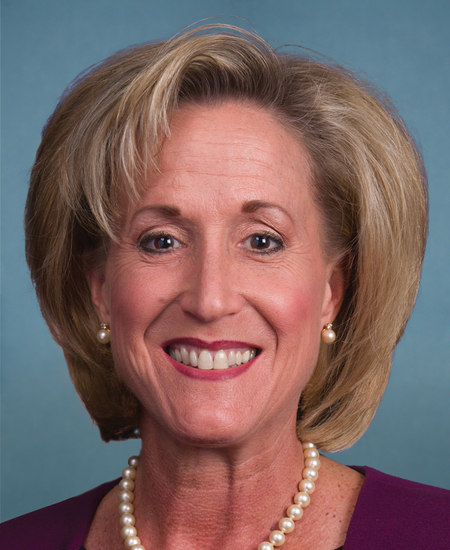
Photo of Ann Wagner
R United States House · District 2 · Missouri On the 2026 ballot

Rep. Ann Wagner

Compare
Total votes
2,837
all sessions
Attendance
98%
55 missed
Near the chamber average
With party
93%
of cast votes
Near the chamber average
Bipartisan score
4%
crosses aisle rarely
Near the chamber average
Sponsored
668
bills & resolutions
Lower than 81% of chamber peers
Committees
6
assignments
668 bills and resolutions

Sponsored bills

Total
668
Primary
62
Co-sponsor
606
This page
668
matching current filters
Co-sponsor HR 7450
In committee · Indiana House · Co-sponsor
Protecting Privacy in Purchases Act

Maddy summaryHR 7450, the Protecting Privacy in Purchases Act, prohibits payment card networks and covered entities (like payment processors) from requiring or assigning merchant category codes that specifically identify firearms retailers as different from general stores or sporting goods retailers. This directly affects firearms retailers and payment networks by preventing them from using business classification codes that could flag firearm sales. The bill establishes an enforcement process where the Attorney General investigates complaints, issues remediation notices, and can seek court injunctions for non-compliance, while preempting state or local laws on this issue. It does not create private lawsuits for individuals.

In committee Feb 23, 2024 1 co-sponsor
Co-sponsor HR 7380
In committee · Indiana House · Co-sponsor
PURR Act of 2024

Maddy summaryThe PURR Act of 2024 establishes a uniform federal regulatory framework for pet food in the U.S., replacing inconsistent state-level rules and separating pet food regulation from livestock feed. It preempts state laws on pet food labeling and marketing, creates a standardized process for reviewing new pet food ingredients (requiring FDA action within 90 days), and allows certain marketing claims like "natural" or "hairball control" without premarket approval if truthful and substantiated. The bill defines key terms (e.g., "companion animal" as dogs/cats), sets ingredient listing rules, and mandates FDA guidance on topics like nutritional adequacy and calorie claims. This directly affects pet food manufacturers, the FDA’s Center for Veterinary Medicine, and pet owners by creating clearer safety standards and labeling consistency nationwide.

In committee Feb 16, 2024 1 co-sponsor
Co-sponsor HR 7382
In committee · Indiana House · Co-sponsor
Empowering Law Enforcement To Fight Sex Trafficking Demand Act of 2024

Maddy summaryHR 7382 amends existing law to allow law enforcement agencies using Byrne JAG funds (a federal grant program) to specifically fund programs aimed at reducing demand for commercial sex trafficking. This change directly affects state and local law enforcement agencies that receive Byrne JAG grants, enabling them to allocate these funds toward demand reduction initiatives like public awareness campaigns or victim services. The key mechanism is adding "programs to reduce the demand for trafficked persons" as an explicitly authorized use of Byrne JAG funds under the 1968 Crime Control Act. This policy change expands the scope of existing federal funding to target the demand side of sex trafficking, without creating new programs or altering other funding categories.

In committee Feb 15, 2024 1 co-sponsor
Co-sponsor HR 443
Passed · Indiana House · Co-sponsor
Enhancing Detection of Human Trafficking Act

Maddy summaryHR 443, the Enhancing Detection of Human Trafficking Act, requires the Department of Labor to train its employees on identifying human trafficking during their work. The training must be tailored to specific job locations and environments, cover current detection methods, and include clear steps for referring suspected cases to law enforcement. Employees must complete this training within 180 days of the bill's enactment, and the Department must report annually to Congress on training participation, effectiveness, and the number of cases referred to the Justice Department. This bill directly affects Department of Labor staff who interact with workers or workplaces, aiming to improve early detection through structured employee training and reporting.

Passed Feb 6, 2024 1 co-sponsor
Co-sponsor HR 7035
In committee · Indiana House · Co-sponsor
Death Tax Repeal Act

Maddy summaryThe Death Tax Repeal Act would eliminate the federal estate tax and generation-skipping transfer tax for estates of people who die on or after the bill's enactment date, and for generation-skipping transfers made after that date. It would also establish a new $10 million lifetime gift tax exemption (adjusted annually for inflation) and replace the existing gift tax rate schedule with a revised structure. These changes would primarily affect high-net-worth individuals and their heirs, as the estate tax and gift tax typically apply to large estates or gifts exceeding the new exemption threshold. The bill's provisions would take effect on the date of enactment, with transitional rules for the year the bill is signed into law.

In committee Jan 18, 2024 1 co-sponsor
Co-sponsor HR 7030
In committee · Indiana House · Co-sponsor
REG Act of 2024

Maddy summaryThis bill requires the Securities and Exchange Commission (SEC) to review its final rules every five years to determine if revisions (including rescission) are needed to promote capital formation, maintain fair markets, and protect investors. It mandates the SEC to consider how each rule interacts with other existing regulations cumulatively, not just individually. The SEC must submit annual reports to Congress detailing its review plan and biennial reports identifying reviewed rules, findings, and any missed deadlines. This applies specifically to SEC rules under the Securities Act of 1933, Securities Exchange Act of 1934, and related investment laws.

In committee Jan 18, 2024 1 co-sponsor
Co-sponsor HR 6962
In committee · Indiana House · Co-sponsor
Financial Stability Oversight Council Reform Act

Financial Stability Oversight Council Reform Act This bill subjects the budgets of the Financial Stability Oversight Council (FSOC) and the Office of Financial Research (OFR) to the annual appropriations process and establishes requirements for reports and a public notice and comment period. The budgets of the FSOC and the OFR are funded by assessments on financial institutions which are deposited into the Financial Research Fund and, under current law, are immediately available to be spent. This bill requires the funding from the Financial Research Fund to be made available by appropriations acts. The OFR must submit quarterly reports to Congress regarding its finances; workforce; and actions taken to achieve the goals, objectives, and performance measures of the office. The OFR must provide a public notice and comment period of at least 90 days before issuing any proposed report, rule, or regulation. The bill expands the duties of the OFR to include publishing an annual work plan; consulting with other federal departments and agencies with relevant expertise prior to preparing any public report with respect to a specified entity, class of entities, or financial product or service; and developing and implementing a cybersecurity plan. The Government Accountability Office must annually audit the cybersecurity plan and its implementation.

In committee Jan 11, 2024 1 co-sponsor
Co-sponsor HR 6789
In committee · Indiana House · Co-sponsor
Rectifying UDAAP Act

Maddy summaryThis bill clarifies the Consumer Financial Protection Bureau's (CFPB) authority to enforce rules against "unfair, deceptive, or abusive acts or practices" (UDAAP) affecting consumers. It defines "abusive" acts as those intentionally interfering with consumer understanding or taking unreasonable advantage of consumer vulnerabilities, requiring the CFPB to provide a clear definition within 180 days. Financial institutions must now receive written notice and 180 days to correct potential violations before penalties are imposed, and the CFPB must conduct cost-benefit analyses for new rules. The bill also prohibits the CFPB from treating discrimination as part of UDAAP enforcement and limits penalties for past conduct to the most recent compliance rating period.

In committee Dec 14, 2023 1 co-sponsor
Co-sponsor HR 6760
In committee · Indiana House · Co-sponsor
No Tax Dollars for the United Nations Climate Agenda Act

Maddy summaryHR 6760 prohibits U.S. federal agencies from using tax dollars to fund contributions to three specific United Nations climate programs: the Intergovernmental Panel on Climate Change (IPCC), the United Nations Framework Convention on Climate Change (UNFCCC), and the Green Climate Fund. The bill directly affects all federal departments and agencies that manage U.S. contributions to international climate initiatives. Its key mechanism is a strict ban on using any appropriated funds - whether for mandatory or voluntary payments - to support these organizations. This policy change would prevent the U.S. government from providing financial support to these entities through federal budgets.

In committee Dec 13, 2023 1 co-sponsor
Primary HR 2627
In committee · Indiana House · Lead sponsor
Increasing Investor Opportunities Act

Maddy summaryHR 2627, the "Increasing Investor Opportunities Act," removes restrictions preventing closed-end investment companies (like mutual funds) and business development companies from investing all their assets in private funds. The bill amends the Investment Company Act of 1940 and Securities Exchange Act to clarify that the SEC cannot block such investments solely because the funds are private, and ensures stock exchanges cannot prohibit listing securities based on this investment strategy. It defines "private fund" consistently across securities laws to eliminate regulatory ambiguity. This directly affects investment companies seeking greater flexibility in their portfolio choices without requiring new regulatory approvals.

In committee Dec 12, 2023 0 co-sponsors
Showing 261 to 270 of 668 bills
Previous 1 … 26 27 28 … 67 Next