

Maddy summary# Summary of Proposed Election Reform Legislation This document outlines a comprehensive federal election reform bill with multiple titles addressing various aspects of voting rights, election administration, and election integrity. ## Key Provisions: ### 1. Democracy Restoration (Title I) - Restores voting rights to citizens with felony convictions who are not serving a felony sentence in a correctional institution - Requires states to notify individuals of restored voting rights upon release from prison, completion of probation, or sentencing - Prohibits states from conditioning voting rights on payment of fines or fees - Requires states to provide notification of voting rights to citizens with criminal convictions ### 2. Voter Identification Requirements (Title II) - Establishes a broad definition of acceptable identification documents (including utility bills, bank statements, student IDs, etc.) - Requires states to provide free identification to voters who lack one - Authorizes $5 million annually for 5 years to cover costs of providing identification - Sets procedures for provisional voting when identification is not presented ### 3. Voter List Maintenance (Title III) - Prohibits "voter caging" (using undeliverable mail to challenge voter registration) - Bans use of unverified match lists to remove voters from registration lists - Sets strict conditions for removing voters from registration lists - Requires states to provide notice to voters removed from registration lists ### 4. Election Integrity Measures (Title V) - Prohibits hindering or interfering with voter registration (Section 2001) - Restricts removal of local election administrators (Section 3001) - Prohibits harassment of election workers (Section 3101) - Bans deceptive practices in elections (Section 3201), including false statements about voting locations, eligibility, or endorsements ### 5. Additional Provisions - Requires states to provide notice of voting rights restoration to citizens - Establishes private rights of action for violations of the law - Sets criminal penalties for violations (up to $100,000 fines and 5 years imprisonment) - Includes provisions for federal funding to be contingent on compliance with voting rights restoration This legislation represents a significant overhaul of voting rights and election administration procedures across the United States, with a focus on expanding voting access, protecting voter rights, and ensuring fair election administration.
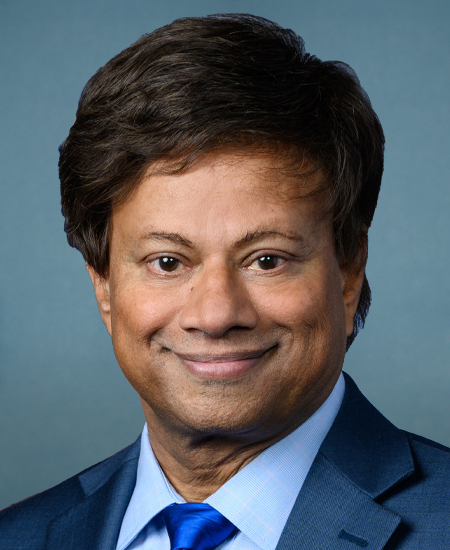
Rep. Shri Thanedar
Sponsored bills
Maddy summaryHR 549, the Metastatic Breast Cancer Access to Care Act, removes waiting periods for disability and Medicare coverage for people diagnosed with metastatic breast cancer. Specifically, it amends Social Security Act sections to allow immediate eligibility for disability insurance benefits (eliminating the standard waiting period) and immediate Medicare coverage (waiving the 24-month waiting period) for these patients. The bill directly affects individuals with metastatic breast cancer who would otherwise face delays in accessing critical benefits. These changes apply to applications filed or benefits beginning after the bill's enactment date. The law makes no other policy changes beyond these specific eligibility adjustments.
Maddy summaryThe EACH Act of 2023 would require federal health programs - including Medicaid, Medicare, the Indian Health Service, and TRICARE - to cover abortion services without restrictions. It repeals a provision in the Affordable Care Act that allowed states to limit abortion coverage in health insurance plans sold through state marketplaces. The bill also prohibits the federal government from restricting abortion coverage in private health insurance plans. This would directly affect millions of people, particularly low-income individuals and people of color, who are disproportionately enrolled in Medicaid and currently face barriers to abortion care due to coverage restrictions.
Maddy summaryThe RRLEF Act of 2024 (HR 10384) requires law enforcement agencies seeking Edward Byrne Justice Assistance Grants to certify they do not transfer or purchase firearms from licensed dealers listed as "covered" by the ATF. A "covered" dealer is one with 25+ firearms traced to criminal use within three years in two of the past three years, per ATF data. The bill mandates the ATF publish this list annually and removes restrictions on public access to firearm tracing data. This directly affects local and state law enforcement agencies applying for Byrne grants, requiring them to avoid transactions with dealers on the public list.
Maddy summaryHR 1584, the Plum Island National Monument Act, establishes Plum Island, New York, as a national monument to protect its natural ecosystems, historical sites, and cultural heritage. The bill designates the Secretary of the Interior as the managing agency, requiring coordination with other federal departments through written agreements for lands within the monument area. It mandates the development of a management plan within three years of funding, which must then be submitted to specific congressional committees. This act directly affects the federal management of Plum Island and sets the framework for conservation and public access to the site.
Maddy summaryHR 7438 directs the U.S. Treasury to mint commemorative coins for the 2026 FIFA World Cup, including 100,000 $5 gold coins, 500,000 $1 silver coins, and 750,000 half-dollar coins. The coins will be sold to the public at face value plus surcharges ($35, $10, and $5 per coin, respectively), with all surcharge revenue paid to FWC2026 US, Inc. for U.S. soccer programs. These funds must support soccer initiatives, particularly in underserved communities and youth development, as specified in the bill. The coins are legal tender but will only be issued during 2026, with no net cost to the U.S. government.
Maddy summaryHR 5799, the James R. Dominguez Memorial Act of 2023, designates a U.S. Border Patrol checkpoint on U.S. Highway 90 West in Uvalde County, Texas, as the "James R. Dominguez Border Patrol Checkpoint" to honor Agent James R. Dominguez, who died in 2012 while clearing road debris. The bill updates all federal references - such as laws, maps, and documents - to use this new name for the checkpoint. It does not change border patrol operations or policies, only the official designation of the location. This memorial act directly affects the checkpoint's identity and all federal records referencing it.
Maddy summaryThe Community Parks Revitalization Act authorizes the Secretary of Housing and Urban Development to provide grants and secured loans to local governments for improving urban parks and recreational facilities. It establishes three grant types: rehabilitation grants for physical improvements to parks, innovation grants for programs targeting veterans/military families and at-risk youth, and recovery action grants for planning local park system improvements. Local governments must submit detailed recovery plans, meet matching requirements (3/7 of grant amount for most grants), and prioritize projects addressing recreation deficiencies for minority and low-income residents. The bill also authorizes secured loans with specific terms (max 49% of project costs, 35-year maturity) for larger infrastructure projects requiring creditworthiness and dedicated revenue sources.
Maddy summaryHR 6751 authorizes the U.S. Mint to produce commemorative coins honoring Roberto Clemente, a Hall of Fame baseball player and humanitarian, including 50,000 $5 gold coins, 400,000 $1 silver coins, and 750,000 half-dollar coins. The coins must feature Clemente's image and inscriptions like "Roberto Clemente" and "2027," with all sales including a surcharge ($5-$35 per coin) paid to the Roberto Clemente Foundation. The foundation, which supports youth sports, education, and disaster relief programs, will use these funds for its mission, while the U.S. Treasury must recover all production costs. The coins will be sold exclusively in 2027, with no net cost to the government.
Maddy summaryThis bill amends the Robert T. Stafford Disaster Relief Act to explicitly include substance use disorder and alcohol use disorder treatment in federal disaster relief funding. It expands access to addiction services for disaster survivors by requiring that mental health and counseling assistance programs funded under the Act cover these specific needs. Key provisions revise existing language to add "substance use disorder" and "alcohol use disorder" throughout the law, ensuring these services are directly eligible for disaster-related funding. The bill also mandates a federal report within 180 days to update application forms and guidance documents to reflect these changes, ensuring implementation aligns with the new provisions.