

Maddy summaryHRES 1601 is a symbolic resolution designating November 8, 2024, as "National First-Generation College Celebration Day." It urges all Americans to celebrate this day, recognize first-generation college students' contributions to the workforce, and honor the 1965 Higher Education Act and its programs (like Pell Grants and TRIO) that support these students. The resolution does not create new laws or funding but highlights the challenges faced by first-generation students - such as higher employment rates during studies and household responsibilities - while acknowledging their growing presence in U.S. higher education (54% of undergrads identify as first-generation). This is a non-binding gesture of recognition, not a policy change.
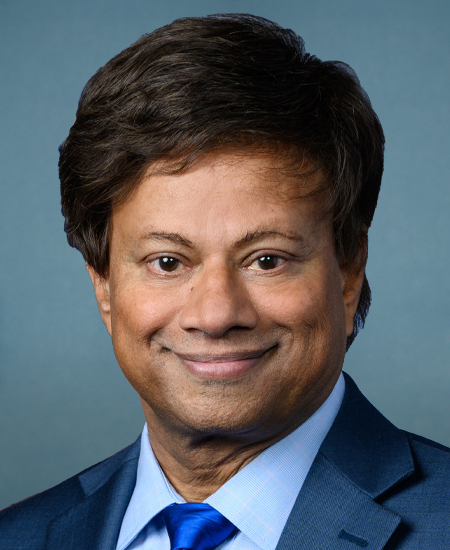
Rep. Shri Thanedar
Sponsored bills
Maddy summaryThe Working Dog Commemorative Coin Act (HR 807) directs the U.S. Treasury to mint three types of commemorative coins honoring working dogs' service: $5 gold coins, $1 silver coins, and half-dollar coins with specific weight and composition requirements. Each coin will carry a surcharge ($35 for $5 coins, $10 for $1 coins, $5 for half-dollars) that will be paid directly to America's VetDogs to support their programs providing service dogs for veterans, the disabled, and others. The coins will be issued in 2027 with designs reflecting working dogs' roles in military, detection, therapy, and assistance work. The legislation specifies that all surcharge revenue must fund America's VetDogs' operations without creating new government programs. This is a commemorative measure focused on honoring working dogs' contributions through coin sales, with all surcharge funds going to a specific nonprofit organization.
Maddy summaryThe Minority Diabetes Initiative Act (HR 10193) creates a federal grant program to improve diabetes care in minority communities. It authorizes the Secretary of Health and Human Services to fund public and nonprofit health providers - including community health centers, tribal health departments, and community organizations - to deliver specific diabetes services. These grants must cover routine care, prevention education, eye/foot care, and treatment for complications like kidney disease, while requiring services to be culturally appropriate and offered in accessible languages. The program is funded through annual appropriations for fiscal years 2025-2030. This bill directly affects minority communities with high diabetes rates by expanding access to comprehensive, culturally responsive care through eligible health providers.
Maddy summaryHRES 1588 is a House resolution supporting Transgender Day of Remembrance (TDoR) by recognizing the epidemic of violence against transgender people and memorializing those killed between October 1, 2023, and September 30, 2024. It specifically honors 38 transgender or gender-nonconforming individuals whose lives were lost to violence during that period, highlighting that transgender women of color face disproportionate risks. The resolution acknowledges systemic issues like underreporting, barriers to healthcare, and higher rates of homelessness and suicide within the community. It calls for the U.S. government to prioritize solutions to this violence while affirming transgender people's right to dignity and safety. As a symbolic resolution, it does not create new laws or policies but formally recognizes these issues for congressional record.
Maddy summaryHRES 837 is a non-binding resolution passed by the U.S. House of Representatives on November 1, 2023, reaffirming U.S. commitment to the Philippines. It specifically calls for invoking the U.S.-Philippines Mutual Defense Treaty if Philippine assets (including Coast Guard vessels) are attacked in the South China Sea, urges joint U.S.-Philippines patrols in the region, and objects to China's disputed territorial claims. The resolution does not create new laws or funding but expresses congressional support for existing defense agreements and diplomatic positions. It directly addresses U.S. foreign policy toward the Philippines and the South China Sea disputes.
Maddy summaryThis bill creates a federal commission to address racial and gender biases in school discipline and improve mental health support for students of color. The commission will develop guidelines for tracking restorative practices, define key terms like "restorative justice," create training materials for school staff on culturally competent approaches, and recommend student-to-counselor ratios for schools receiving federal funds. The commission, composed of 13 members including federal agency representatives, advocates, and students of color, will report annually for five years on progress, including how training reduced disproportionate discipline. The bill directly affects elementary and secondary schools, school personnel, and students of color by establishing a structured process for implementing equitable practices.
Maddy summaryThis bill prohibits Medicaid from covering conversion therapy for any enrollee. It amends federal law to block Medicaid payments for any therapy aimed at changing a person's sexual orientation or gender identity (defined as "conversion therapy" in the bill), starting in the first full quarter after the law takes effect. The prohibition applies to all Medicaid providers who offer such therapy for compensation, but explicitly excludes support for gender transition, acceptance-based care, and interventions focused on safety or unlawful conduct. It directly affects Medicaid recipients seeking therapy and providers who previously billed for conversion therapy services.
Maddy summaryThe Critical Minerals Security Act of 2024 requires the U.S. Secretary of the Interior to submit regular reports to Congress assessing global critical mineral and rare earth element resources. These reports must detail which resources are controlled by foreign entities of concern (like adversarial nations), owned by U.S. allies, or underutilized, including mine output, ownership structures, and reasons for lack of commercial mining. The bill also establishes a process for U.S. persons to notify the government of planned divestments in foreign mining operations and seek non-adversarial buyers, while mandating a strategy to collaborate with allied nations on advanced mining and processing technologies. It directly affects federal agencies, U.S. entities operating in foreign mineral sectors, and U.S. government oversight of critical supply chains.
Maddy summaryThe Half-Century Update for Water Access and Affordability Act establishes a federal program to provide financial assistance to low-income households struggling to pay water bills. It requires states and water utilities to implement programs that offer direct bill discounts, debt relief, water efficiency upgrades, and crisis assistance to households earning up to 200% of the poverty level or 80% of local median income. The bill prohibits disconnections for non-payment, allows automatic enrollment for households already receiving other federal assistance, and mandates data collection to track program impacts on water service access. The legislation authorizes $20 billion annually from 2025-2035 to fund this assistance, with specific requirements to ensure universal access and prevent discrimination in program implementation.
Maddy summaryHRES 1563 is a non-binding resolution expressing Congress's commitment to climate restoration for future generations. It declares that the U.S. should prioritize restoring atmospheric CO2 levels to pre-industrial concentrations (below 300 ppm) alongside achieving net-zero emissions, calling for the executive branch to take action through international climate efforts. The resolution specifically urges the President, Secretary of State, and U.S. Ambassador to the UN to advance climate restoration, including removing 1 trillion tons of CO2 from the atmosphere by 2050. It does not create new laws or funding but formally recognizes the obligation to future generations, referencing scientific goals and prior resolutions like H.Res. 975.