

Maddy summaryHR 7921, the Countering Antisemitism Act, establishes a National Coordinator to Counter Antisemitism within the Executive Office of the President and creates an Interagency Task Force to coordinate federal efforts against antisemitism across multiple agencies. The bill requires federal agencies to report on implementing the U.S. National Strategy to Counter Antisemitism, mandates annual threat assessments of antisemitic violent extremism from the FBI, DHS, and National Counterterrorism Center, and addresses antisemitic discrimination in higher education through a designated Office for Civil Rights Designee. It also includes provisions for a study on Holocaust education by the U.S. Holocaust Memorial Museum, a study on online antisemitism with recommendations for Congress, and amendments to the Nonprofit Security Grant Program to require public reporting on grant applications and awards.
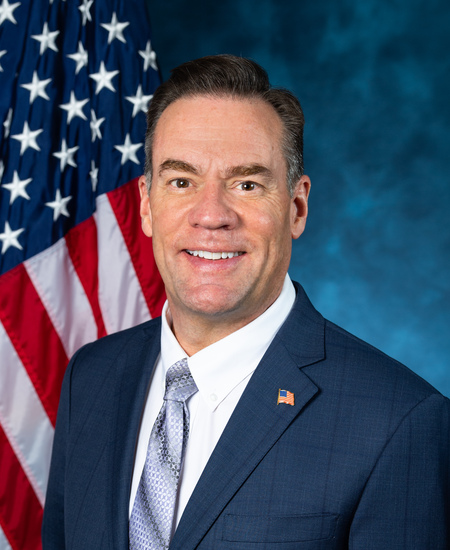
Rep. Russ Fulcher
Sponsored bills
Maddy summaryH.J.Res. 116 seeks to block a Department of Labor rule finalized on January 10, 2024, which aimed to clarify how businesses classify workers as employees or independent contractors under the Fair Labor Standards Act (FLSA). If passed, this resolution would prevent the rule from taking effect, directly affecting businesses that use independent contractors and their workers, who rely on FLSA protections for minimum wage and overtime pay. The bill uses a specific congressional process (under Chapter 8 of Title 5, U.S. Code) to disapprove the rule, rather than creating new policy. This action would maintain the existing classification standards until a new rule is established.
Maddy summaryThis bill freezes new energy efficiency standards for distribution transformers. It prohibits the Energy Secretary from proposing or implementing any rules different from the 2013 standards (published April 18, 2013) for five years after the bill's enactment. The law directly affects the Department of Energy and transformer manufacturers by maintaining existing efficiency requirements. It ensures no changes to the 2013 rule during this five-year period.
Maddy summaryThis bill amends U.S. immigration law to change eligibility criteria for tribal members crossing the U.S.-Canada border. It replaces the previous requirement of "at least 50% blood quantum" with recognition of membership in federally recognized U.S. tribes or Canadian First Nations with Indian Act status. Specifically, it allows members or eligible members of U.S. tribes, or Canadian First Nations members with Indian Act registration, to cross the border under the same provisions. Individuals admitted under this change receive the status of "alien lawfully admitted for permanent residence," providing clearer legal standing. The bill directly affects tribal members and Canadian First Nations citizens who cross the U.S.-Canada border for travel or residence.
Maddy summaryThe Department of Energy Experienced Worker Program Act creates a new initiative allowing the Department of Energy (DOE) to fund nonprofit organizations that recruit workers aged 55 or older (who are not currently employed by DOE) to provide technical, professional, and administrative support for DOE missions. Nonprofits would receive grants or multiyear agreements to connect these older workers with DOE needs, using existing frameworks from the Older Americans Act. The bill includes strict safeguards to prevent displacement of current DOE employees, avoid using the program for laid-off positions, maintain existing service contracts, and prohibit converting program participants into DOE employees. This directly affects DOE’s operational support structure, nonprofit organizations eligible under the Older Americans Act, and older workers seeking part-time or project-based opportunities.
Maddy summaryHR 7514, the WAIVER Act, waives a requirement that materials used in veterans home construction must be made in the U.S. for specific state veterans home projects. It applies only to projects that had applications submitted by April 15, 2022, and were included in the VA's FY 2023 State Home Construction Grants Priority List. The waiver allows these projects to use foreign-made materials for construction instead of complying with the standard "Buy American" rule. This directly affects state governments and contractors working on qualifying veterans home construction projects already approved under the VA's 2023 priority list. The change is limited to these specific projects and does not alter the general domestic procurement requirement for future projects.
Maddy summaryHRES 987 is a symbolic resolution introduced in the U.S. House of Representatives on January 31, 2024, by multiple Republican members. It formally denounces the Biden administration’s energy policies as "harmful" and "anti-American," citing specific actions like canceling the Keystone XL pipeline, restricting federal land leasing for oil and gas, blocking LNG exports, and implementing mineral extraction rules. The resolution does not create new laws or affect any group directly; it serves only as a formal expression of disapproval by the House. It has no legal effect and is intended to convey political opposition to the administration’s approach to energy development.
Maddy summaryThis bill establishes new eligibility rules for women's and girls' amateur sports by defining "female" and "male" based on biological sex at birth. It prohibits individuals designated as male under these definitions from participating in athletic competitions designated for females, women, or girls. The law amends existing U.S. Code provisions to add this requirement, directly affecting athletes and organizations managing female-designated teams. The key change is a clear ban on male-identified participants in female sports, replacing previous eligibility standards with biological sex criteria.
Maddy summaryHR 3385, the DiasporaLink Act, requires the Commerce Secretary to produce a report within one year assessing the value, cost, and feasibility of building a trans-Atlantic submarine fiber optic cable connecting the contiguous U.S., U.S. Virgin Islands, Ghana, and Nigeria. The report must evaluate security, economic opportunities, current telecommunications infrastructure reliability, and potential digital sovereignty benefits of such a cable. It also mandates analysis of developing a secure data center in the U.S. Virgin Islands for military communications. This procedural bill directs a federal assessment but does not authorize construction or funding. The report will inform Congress about the project's potential without advancing any policy position.
Let Injured Americans Be Legally Empowered Act or the LIABLE Act This bill prohibits COVID-19 vaccine manufacturers from being immune under federal law from lawsuits relating to their vaccines. Specifically, the bill prohibits any federal law from providing immunity for COVID-19 vaccine manufacturers from civil suits or liability, or limiting liability, with respect to the administration or use of their vaccines. Additionally, individuals may not be precluded from bringing a civil suit against a COVID-19 vaccine manufacturer because the individual sought or received compensation through specified federal vaccine injury compensation programs, nor does the bill preclude individuals from seeking compensation through these programs. The bill applies to vaccine administrations that occur before, on, or after the bill's date of enactment.