

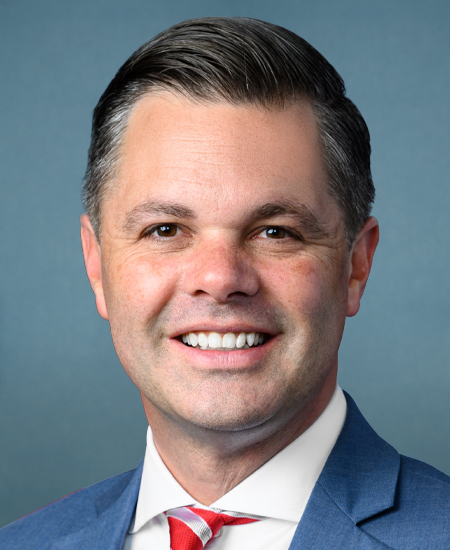
Photo of Zachary Nunn
R United States House · District 3 · Iowa On the 2026 ballot

Rep. Zachary Nunn

Compare
Total votes
1,879
all sessions
Attendance
96%
66 missed
Lower than 79% of chamber peers
With party
90%
of cast votes
Near the chamber average
Bipartisan score
5%
crosses aisle rarely
Near the chamber average
Sponsored
996
bills & resolutions
Higher than 80% of chamber peers
Committees
7
assignments
996 bills and resolutions

Sponsored bills

Total
996
Primary
115
Co-sponsor
881
This page
996
matching current filters
Co-sponsor HR 5543
In committee · Indiana House · Co-sponsor
Baltic Security Assessment Act of 2025

Maddy summaryHR 5543, the Baltic Security Assessment Act of 2025, requires the U.S. State and Defense Departments to submit a report within 180 days of enactment. The report will assess emerging military, cyber, hybrid, and political threats to Estonia, Latvia, and Lithuania, including the roles of Russia, Belarus, China, Iran, and other actors. It will also evaluate U.S. and NATO military presence in the region, opportunities for defense cooperation, and recommendations to strengthen deterrence, cybersecurity, and democratic resilience in the Baltic countries. This bill directly affects U.S. foreign policy and defense planning regarding the Baltics, but does not create new programs or funding.

In committee Apr 22, 2026 1 co-sponsor
Primary HR 8383
In committee · Indiana House · Lead sponsor
Protecting Americans’ Savings Act

Maddy summaryThe Protecting Americans’ Savings Act aims to change how certain investment votes are made by amending federal securities law. It directs the Securities and Exchange Commission (SEC) to create rules prohibiting "robovoting," which is defined as automatically casting votes based on a proxy advisory firm's recommendations without independent review. The bill also prevents institutional investors, such as pension funds, from outsourcing their proxy voting decisions to anyone other than registered investment advisers or broker-dealers who have a fiduciary duty to them. Additionally, it clarifies that no person is required to cast proxy votes unless obligated by a fiduciary duty or an existing SEC rule.

In committee Apr 20, 2026 0 co-sponsors
Co-sponsor HR 8313
In committee · Indiana House · Co-sponsor
Trump Accounts for All Generations Act

Maddy summaryThis bill, titled the Trump Accounts for All Generations Act, makes a specific program related to "Trump accounts" permanent and adjusts its contribution limits. It directly affects individuals who contribute to these accounts by altering their long-term availability and value. The legislation permanently extends the "Trump accounts" contribution program by removing its scheduled expiration date of January 1, 2029. Furthermore, it introduces an annual inflation adjustment for the program's $1,000 contribution amount, beginning in taxable years after 2028. The bill also removes the word "pilot" from the program's title and related sections of the tax code, formally establishing it as an ongoing program.

In committee Apr 15, 2026 1 co-sponsor
Co-sponsor HR 7688
In committee · Indiana House · Co-sponsor
DPA Modernization Act of 2026

Maddy summaryThe DPA Modernization Act of 2026 updates the Defense Production Act of 1950 to strengthen national defense manufacturing and supply chain resilience. It creates a Defense Production Act Committee with specific roles, establishes a Defense Production Act Fund with a new Fund manager, and adds new provisions for critical minerals resilience. The bill increases funding limits for certain programs (e.g., raising caps from $10,000 to $100,000) and requires new reporting requirements to improve transparency. It also creates a Defense Production Act Dashboard for tracking activities and adds fraud risk management requirements. The bill affects Federal agencies that use the Defense Production Act authorities to support national defense manufacturing and supply chains.

In committee Apr 15, 2026 1 co-sponsor
Co-sponsor HR 5877
In committee · Indiana House · Co-sponsor
Combatting Money Laundering in Cyber Crime Act of 2025

Maddy summaryThis bill expands the U.S. Secret Service's authority to investigate money laundering and cybercrime by explicitly adding these offenses to their existing mandate. It extends the period for sharing financial data with law enforcement from 5 to 10 years under FinCEN rules and increases reporting requirements for international financial institutions from 6 to 10 years. The bill also requires the Government Accountability Office to report on law enforcement's ability to identify and stop money laundering in cybercrime within one year of enactment. These changes directly affect federal law enforcement agencies, financial institutions, and cybersecurity investigators by strengthening investigative tools and data access.

In committee Apr 15, 2026 1 co-sponsor
Co-sponsor HR 8134
In committee · Indiana House · Co-sponsor
Strengthen Taxpayer Rights Act of 2026

Maddy summaryThe Strengthen Taxpayer Rights Act of 2026 limits which IRS employees can participate in appeals conferences without taxpayer permission. Specifically, it prohibits IRS staff from attending these conferences unless the taxpayer explicitly agrees to their presence. This change directly affects individuals requesting appeals through the IRS Independent Office of Appeals. The provision aims to give taxpayers more control over who represents the government during their appeal hearings. It applies to all conferences held after the law is enacted.

In committee Mar 27, 2026 1 co-sponsor
Co-sponsor HR 8137
In committee · Indiana House · Co-sponsor
To amend the Internal Revenue Code of 1986 to establish tax credits for the production of, and investment in, certain renewable materials.

Maddy summaryThis bill creates two new tax incentives to encourage the production and investment in renewable materials derived from biomass. The first provision offers a production credit of 10 cents per pound for qualified renewable materials sold or used in business, while the second provides an investment credit equal to 30 percent of qualified property costs used in renewable material facilities. Both credits are limited to facilities located in the United States or its possessions and exclude products intended for fuel, heat, electricity, food, or feed. The bill also allows these tax credits to be transferred to other taxpayers and requires the Treasury Department to issue implementing regulations within 180 days of enactment.

In committee Mar 27, 2026 1 co-sponsor
Co-sponsor HR 8110
In committee · Indiana House · Co-sponsor
Cyber Ready Workforce Act

Maddy summaryThis bill establishes a grant program within the Department of Labor to help create and expand registered apprenticeship programs focused on cybersecurity training. The program would provide funding to workforce intermediaries, which can be partnerships involving businesses, educational institutions, and community organizations, to develop apprenticeships that lead to specific cybersecurity careers. Grant recipients must use at least 85 percent of funds for program development, employer partnerships, and support services like mentorship and transportation assistance for apprentices, while up to 15 percent can be used for outreach and marketing. The apprenticeships would cover technical instruction and industry-recognized certifications in areas such as network security, ethical hacking, and system administration, targeting occupations like cybersecurity technicians and computer systems analysts.

In committee Mar 26, 2026 1 co-sponsor
Primary HR 8119
In committee · Indiana House · Lead sponsor
HOPE with Fertility Services Act

Maddy summaryThis bill requires group health plans and health insurers that cover obstetrical services to also cover infertility and iatrogenic infertility treatments, including procedures like in vitro fertilization and egg freezing. It defines infertility as the inability to achieve pregnancy after 12 months of unprotected intercourse or after standard medical treatment, and iatrogenic infertility as fertility damage caused by medical procedures such as chemotherapy or radiation therapy. The legislation establishes coverage standards that cannot be more restrictive than those applied to other medical benefits, prohibits penalties against providers for offering these services, and requires annual compliance reporting to the federal government.

In committee Mar 26, 2026 0 co-sponsors
Co-sponsor HR 8124
In committee · Indiana House · Co-sponsor
STOP Suicide Act

Maddy summaryThe STOP Suicide Act establishes a new grant program to fund stabilization services for individuals experiencing acute suicidal thoughts. These grants will be awarded competitively to eligible entities such as community health centers, crisis centers, schools, and tribal organizations to support evidence-based interventions that reduce immediate suicide risk. The program authorizes up to $30 million annually from 2027 to 2031 and requires recipients to submit plans for sustaining services after grant funding ends. Grants may support outpatient care, virtual services, and peer support in the least restrictive settings appropriate for each individual's needs.

In committee Mar 26, 2026 1 co-sponsor
Showing 71 to 80 of 996 bills
Previous 1 … 7 8 9 … 100 Next