

Maddy summaryThis bill, known as the No Tax on Drill Pay Act, would exclude certain military compensation from federal income tax. It directly affects members of the U.S. military who receive pay for inactive-duty training, which includes weekend drills and other training activities outside of regular duty. The legislation amends the Internal Revenue Code to add inactive-duty training compensation to the list of qualified military benefits that are not subject to taxation. This change applies to any compensation received after the bill becomes law, meaning it would affect future training pay rather than past earnings.
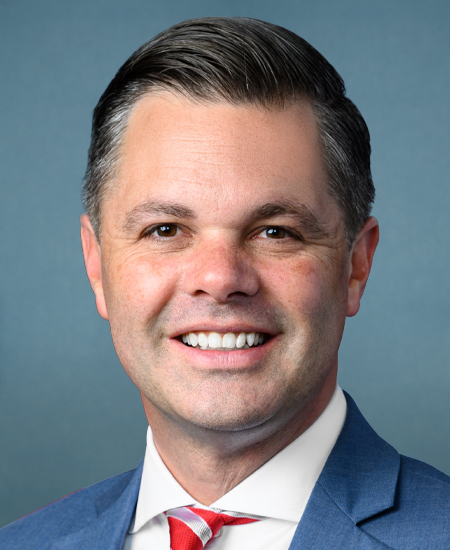
Rep. Zachary Nunn
Sponsored bills
This bill reauthorizes through FY2031 the Young Fishermen’s Development Grant Program, which supports local and regional training, education, outreach, and technical assistance initiatives for young fishermen.
Maddy summaryHR 7771, the ARSENAL Act of 2026, requires the Defense Production Act Committee to create and maintain a real-time, centralized database tracking priority ratings, allocations, and assistance under the Defense Production Act. This database must be accessible to all Committee members and allow for live updates, while adhering to security and classification rules set by the Chairperson. The bill directly affects the Defense Production Act Committee by standardizing how they manage and share critical logistics data. It does not change defense policy or impact the public; it solely improves internal data coordination for the Committee’s existing responsibilities.
Maddy summaryThis bill renames two existing Department of Veterans Affairs clinics in Iowa to honor fallen Iowa National Guard members. The Des Moines VA clinic (1211 East Army Post Road) will be named the "Staff Sergeant Edgar Torres-Tovar VA Clinic," and the Marshalltown VA clinic (201 East Merle Hibbs Boulevard) will be named the "Staff Sergeant William Nathaniel Howard VA Clinic." The bill changes official references in all federal documents to these new names after enactment. It does not create new policies or services, only formally commemorates these service members' legacies through facility naming.
Maddy summaryThe TIER Act of 2025 adjusts financial regulatory thresholds to account for economic growth. It raises key asset thresholds for large banks and financial institutions - from $250 billion to $370 billion in most cases (e.g., in the Federal Reserve Act and Financial Stability Act). The bill also establishes a new mechanism requiring periodic, automatic adjustments to these thresholds every five years based on U.S. GDP growth, starting in 2031. These changes directly affect large bank holding companies and financial firms subject to federal oversight under current regulations. The adjustments aim to keep regulatory standards aligned with the evolving size of the economy.
Maddy summaryHR 6554, the Community Bank Representation Act, creates a new "Community Bank Member" position on the Federal Reserve Board of Governors. This member must have primary experience in community banking and is tasked with developing policy recommendations and overseeing regulation for banks with less than $17 billion in assets. The bill also requires the Federal Reserve to annually adjust this $17 billion threshold using changes in nominal U.S. GDP. The new member must report semi-annually to relevant congressional committees on the Federal Reserve's regulatory efforts for community banks.
Maddy summaryHRES 1073 is a non-binding resolution designating February 21-28, 2026, as "National FFA Week" to recognize the National Future Farmers of America (FFA) Organization’s role in developing agricultural education leaders and to celebrate the 50th anniversary of Alaska’s State FFA Association. It does not create new laws or affect any specific groups or policies; instead, it formally expresses the House’s support for this commemorative week. The resolution highlights FFA’s mission to prepare students for leadership and careers in agriculture, food, and natural resources. As a symbolic gesture, it has no direct legislative or financial impact on constituents.
Maddy summaryThe SCAM Act requires online platforms that display paid advertisements (like social media sites) to verify advertiser identities, implement scam detection systems, and remove fraudulent ads within 24 hours of confirmation. It directly affects platforms that accept payment for ads, targeting scams such as fake giveaways, romance scams, and AI impersonations that cost consumers $195 billion in 2024 (per FTC data). Key mechanisms include mandatory identity checks for advertisers, active monitoring systems, and a 72-hour investigation window for reported scams. The law aims to reduce fraud by shifting responsibility to platforms, with enforcement by the FTC and state attorneys general.
Maddy summaryHR 7516, the "No Funds for Forced Labor Act," requires the U.S. Treasury to direct American representatives at international financial institutions (like the World Bank) to oppose loans for projects that use or risk using forced labor, particularly those involving state-run entities in Xinjiang. It mandates these institutions to vet projects for forced labor risks, explain their vetting process, and detail mitigation steps before funding. The bill directly affects international financial institutions and the projects they fund, especially those linked to Xinjiang. It does not ban all loans but targets projects with documented forced labor concerns, requiring annual reports to Congress on implementation. The law focuses on policy changes to prevent U.S.-aligned financial support for forced labor practices.
Maddy summaryThis bill amends the process for the Financial Stability Oversight Council (FSOC) when considering actions against U.S. nonbank financial companies. It requires the FSOC to first determine that alternative solutions - such as new regulatory standards, agency actions, or a company's written plan - are not possible or insufficient to protect financial stability before voting on a formal determination. The change directly affects the FSOC and large nonbank financial companies that could face regulatory scrutiny. The key provision adds a new step to ensure the Council explores other options before taking significant action. (Procedural bill; summary limited to 3 sentences as specified.)