

Maddy summaryThis bill amends the Servicemembers Civil Relief Act (SCRA) to improve access to existing financial protections for active-duty service members, reservists, and their dependents. It requires military financial literacy training to include SCRA consumer protections (like interest rate limits), mandates notifications about these benefits at key service milestones (e.g., when entering service or being mobilized), and clarifies that creditors must apply the SCRA interest rate cap to *all* pre-service debts, not just specified ones. Creditors must also provide multiple submission methods (online, mail, fax) for servicemembers to submit required documents. These changes aim to make SCRA benefits easier to understand and utilize without creating new financial obligations.
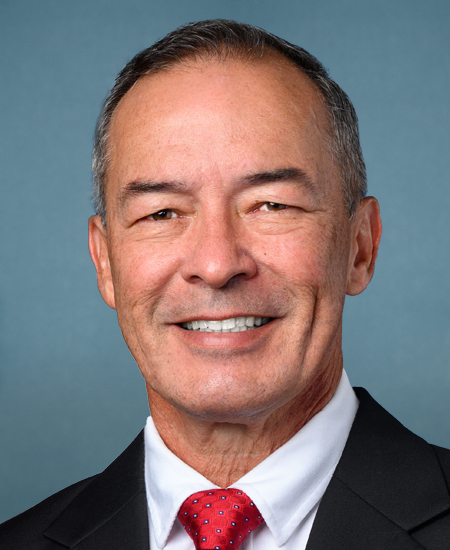
Rep. James C. Moylan
Sponsored bills
Maddy summaryThe Energy Parity Act requires that any reduction in capacity fees for wind and solar energy projects must be matched by an equivalent reduction in royalty rates for oil and natural gas leases. It lowers the minimum royalty rate for onshore oil and gas leases from 16.67% to 12.5% and adjusts minimum bid and rental rates (e.g., reducing the minimum bid from $10 to $2 per acre for two years). The bill also directs the Bureau of Land Management to reissue a proposed rule on renewable energy leasing within 120 days of enactment. These changes directly affect federal leaseholders for oil, gas, and renewable energy projects.
Maddy summaryThis bill requires the U.S. Army Corps of Engineers to prioritize water supply and conservation as a core mission when planning, building, and managing all water projects. It directly affects the Corps' project decisions, mandating they consider these factors alongside existing priorities like flood control and navigation. Key provisions explicitly state that this change does not alter the Corps' current authorities, pending permit processes, or state water management rights. The bill focuses on operational priorities within the Corps' existing framework, without creating new federal water regulations or overriding state water laws.
Maddy summaryThe provided context does not include sufficient details about HR 7060's specific provisions or policy changes. While the bill's title ("Military Spouse Job Continuity Act") suggests it relates to military spouses' employment, the context only lists a procedural amendment to 37 U.S.C. § 453(g) (striking a paragraph and redesignating another) without explaining the substance of the change. Without the actual bill text or a substantive summary describing how this amendment affects military spouses or job continuity, a factual summary cannot be generated. For accurate information, consult the full bill text or official legislative summaries from Congress.
Maddy summaryThe LAKES Act (HR 6906) allows local governments and nonprofit organizations to collect and retain user fees for managing lakes and recreation facilities under Army Corps of Engineers projects. It requires that at least 80% of fees collected at a specific site be used for that site's maintenance, while permitting entities to keep up to 100% of fees for related operations. The bill modifies existing laws to ensure these fees supplement, not replace, regular federal funding for recreation facilities. It directly affects local public entities and nonprofits managing Corps-managed water resources. The key change is enabling these groups to retain and use user fees they collect, improving local funding for facility upkeep.
Maddy summaryThe PREPARE Act of 2023 establishes an Interagency Council composed of senior officials from 25 federal agencies to coordinate extreme weather resilience efforts across the government. The law requires each federal agency to develop and update comprehensive extreme weather plans that integrate climate considerations into agency operations, with plans submitted annually to the Office of Management and Budget. The Council will create a public website to share resources, best practices, and progress updates, and will issue annual reports to Congress detailing implementation and effectiveness. This legislation directly affects all federal agencies by mandating they incorporate extreme weather planning into their operations and budgeting processes. The Act aims to improve government coordination on climate resilience without creating new regulatory requirements or duplicating existing federal programs.
Maddy summaryThe Death Tax Repeal Act would eliminate the federal estate tax and generation-skipping transfer tax for estates of people who die on or after the bill's enactment date, and for generation-skipping transfers made after that date. It would also establish a new $10 million lifetime gift tax exemption (adjusted annually for inflation) and replace the existing gift tax rate schedule with a revised structure. These changes would primarily affect high-net-worth individuals and their heirs, as the estate tax and gift tax typically apply to large estates or gifts exceeding the new exemption threshold. The bill's provisions would take effect on the date of enactment, with transitional rules for the year the bill is signed into law.
Maddy summaryThis bill modifies Guam's relationship with citizens of the Freely Associated States (Federated States of Micronesia, Marshall Islands, and Palau). It requires individuals from these nations seeking temporary work or study status in Guam to provide proof of employment or enrollment in education within 10 business days of arrival, plus proof of residence. It also mandates that federal prisons, not state/local facilities, house FAS citizens convicted of felonies in the U.S., with the Bureau of Prisons reimbursing prior incarceration costs. Additionally, it extends federal grant authorizations for Guam's compensation program until 2043. The bill directly affects FAS citizens residing or traveling to Guam under Compact agreements.
Maddy summaryThis bill creates a new program to provide financial assistance to struggling rural health care facilities, including hospitals, clinics, and long-term care centers in designated rural areas. Facilities may use existing USDA funds to refinance loans, upgrade telehealth technology or equipment, or cover operating costs and reserves - provided the aid preserves local health services and improves the facility's financial health. It includes a waiver allowing facilities in persistent poverty areas (20%+ poverty for 30+ years) or distressed communities to bypass standard eligibility requirements. The program applies to rural areas defined as having ≤50,000 residents not adjacent to larger cities.
Maddy summaryHR 3925 establishes a federal grant program to fund youth fishing projects in coastal and Great Lakes areas. The bill authorizes $2 million annually (2024-2028) for grants to eligible entities like nonprofits, schools, state/local governments, or Tribal organizations to cover equipment, transportation, licenses, and educational components for youth. Priority is given to projects serving underserved communities, defined as groups facing systemic barriers due to race, disability, poverty, or inequality. Recipients must report annually on grant usage and participant numbers to Congress.