

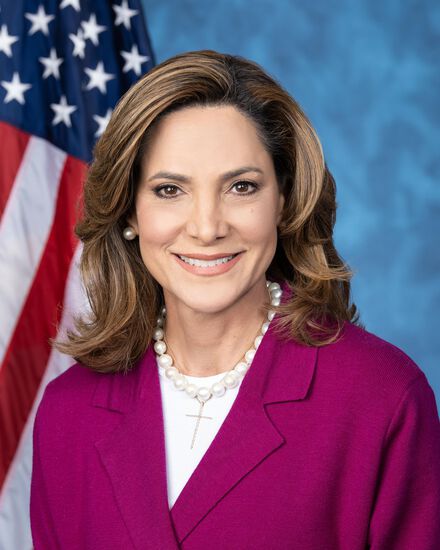
Photo of Maria Elvira Salazar
R United States House · District 27 · Florida On the 2026 ballot

Rep. Maria Elvira Salazar

Compare
Total votes
2,831
all sessions
Attendance
92%
221 missed
Lower than 95% of chamber peers
With party
90%
of cast votes
Near the chamber average
Bipartisan score
5%
crosses aisle rarely
Near the chamber average
Sponsored
1,439
bills & resolutions
Near the chamber average
Committees
7
assignments
1,439 bills and resolutions

Sponsored bills

Total
1,439
Primary
73
Co-sponsor
1,366
This page
1,439
matching current filters
Co-sponsor HR 867
In committee · Indiana House · Co-sponsor
IGO Anti-Boycott Act

Maddy summaryThis bill expands the Anti-Boycott Act of 2018 to cover boycotts promoted or enforced by international governmental organizations (IGOs), not just foreign countries. It adds "international governmental organization" to key definitions in the law and requires the President to annually report to Congress on foreign countries and IGOs that foster or impose such boycotts. The law directly affects U.S. businesses and entities subject to boycotts by IGOs, like the United Nations or World Trade Organization. The changes are technical amendments to existing definitions and reporting requirements.

In committee Jan 31, 2025 1 co-sponsor
Co-sponsor HR 879
In committee · Indiana House · Co-sponsor
Medicare Patient Access and Practice Stabilization Act of 2025

Medicare Patient Access and Practice Stabilization Act of 2025 This bill increases certain payment adjustments under the Medicare physician fee schedule for services furnished between April 1, 2025, and January 1, 2026.

In committee Jan 31, 2025 1 co-sponsor
Co-sponsor HR 833
In committee · Indiana House · Co-sponsor
Educational Choice for Children Act of 2025

Maddy summaryHR 833 creates a federal tax credit for individuals and corporations that contribute to scholarship granting organizations (SGOs) providing scholarships for elementary and secondary education. The credit allows taxpayers to deduct up to 10% of their adjusted gross income or $5,000 (whichever is less) for contributions to SGOs serving students from households with income up to 300% of the area median income. The bill establishes a $10 billion annual cap on the tax credit program, requires SGOs to verify student eligibility and maintain separate accounts, and prohibits government control over SGOs or private schools. It ensures scholarships can be used at public, private, or religious schools without discrimination based on religious character. The tax credit would be available for contributions made after December 31, 2025, with annual volume cap increases based on usage.

In committee Jan 31, 2025 1 co-sponsor
Co-sponsor HCONRES 4
In committee · Indiana House · Co-sponsor
Expressing the sense of Congress that tax-exempt fraternal benefit societies have historically provided and continue to provide critical benefits to the people and communities of the United States.

Maddy summaryHCONRES 4 is a symbolic resolution expressing Congress's support for tax-exempt fraternal benefit societies (like mutual aid organizations). It recognizes these groups, which have over 7 million members nationwide, as historically and currently providing critical community benefits - including life/health insurance, charitable work, and volunteer services - valued at over $3.8 billion annually. The resolution affirms that their tax-exempt status under Section 501(c)(8) of the Internal Revenue Code remains beneficial and should continue to be promoted. This is a non-binding expression of congressional sentiment, not a policy change.

In committee Jan 28, 2025 1 co-sponsor
Co-sponsor HRES 70
In committee · Indiana House · Co-sponsor
Expressing the sense of the House of Representatives that Congress should take all appropriate measures to ensure that the United States Postal Service remains an independent establishment of the Federal Government and is not subject to privatization.

Maddy summaryThis resolution expresses the House of Representatives' position that Congress should take steps to prevent the privatization of the United States Postal Service (USPS), ensuring it remains a federal independent agency. It highlights USPS’s constitutional role, self-sustaining nature (relying on service revenue, not taxpayer funds), and critical functions - serving 168 million addresses daily, supporting rural communities, and underpinning e-commerce. The resolution opposes privatization, noting it would raise prices, reduce services, and harm the $1.9 trillion mailing industry. As a non-binding resolution, it reflects the House’s stance but does not create new law or policy.

In committee Jan 28, 2025 1 co-sponsor
Co-sponsor HR 768
In committee · Indiana House · Co-sponsor
Holocaust Education and Antisemitism Lessons Act

Maddy summaryHR 768, the Holocaust Education and Antisemitism Lessons Act, requires the U.S. Holocaust Memorial Museum Director to study how states and school districts currently teach about the Holocaust and antisemitism in K-12 schools. The study will examine curriculum requirements, teacher training, educational materials used, and assessment methods across all states and a representative sample of school districts and schools. It specifically aims to identify gaps, resources needed, and how schools address antisemitism and genocide prevention in their teaching. The Museum must submit a report to Congress within three years of the bill's enactment, detailing findings on current practices and challenges. This bill does not mandate new teaching requirements but seeks to understand existing approaches to Holocaust education.

In committee Jan 28, 2025 1 co-sponsor
Co-sponsor HR 817
In committee · Indiana House · Co-sponsor
To amend the Internal Revenue Code of 1986 to allow a credit against tax for charitable donations to nonprofit organizations providing education scholarships to qualified elementary and secondary students.

Maddy summaryHR 817, the Educational Choice for Children Act of 2025, creates a new tax credit allowing individuals to claim up to 10% of their adjusted gross income (capped at $5,000) for charitable contributions to scholarship granting organizations. These organizations provide education scholarships to eligible students from households with income not exceeding 300% of the area median gross income, covering qualified expenses like tuition, curriculum materials, and educational therapies. The bill establishes strict requirements for scholarship organizations, including verifying household income, conducting annual audits, and distributing scholarships to multiple students without government control. It also prohibits government entities from mandating or controlling scholarship organizations or excluding private or religious schools from receiving scholarship funds, while exempting scholarship amounts from taxable income for recipients. The tax credit is limited to $5 billion annually for 2025-2028, allocated on a first-come, first-serve basis.

In committee Jan 28, 2025 1 co-sponsor
Co-sponsor HR 21
Passed · Indiana House · Co-sponsor
Born-Alive Abortion Survivors Protection Act

Maddy summaryHR 21, the Born-Alive Abortion Survivors Protection Act, requires medical staff at abortion facilities to provide the same immediate care and hospital admission to any infant born alive during an abortion as they would for any newborn. It mandates reporting failures to provide this care to law enforcement and imposes penalties of up to 5 years in prison for violations, with harsher penalties for intentional killing. The bill also allows women who undergo abortions to sue for civil damages, including triple the abortion cost, and provides for attorney fees. It defines "abortion" to exclude procedures performed after viability to preserve a live birth. This law directly affects healthcare providers at abortion facilities and creates new federal legal obligations for them.

Passed Jan 24, 2025 1 co-sponsor
Co-sponsor HR 703
In committee · Indiana House · Co-sponsor
Main Street Tax Certainty Act

Maddy summaryHR 703, the Main Street Tax Certainty Act, makes a key tax deduction permanent for small business owners. It removes the temporary sunset provision (subsection (i)) from Section 199A of the tax code, ensuring the qualified business income deduction remains available for eligible small businesses. This change directly affects pass-through business owners (like S-corps, partnerships, and sole proprietorships) who currently qualify for this deduction. The permanent change takes effect for tax years starting after December 31, 2025.

In committee Jan 23, 2025 1 co-sponsor
Co-sponsor HJRES 28
In committee · Indiana House · Co-sponsor
Proposing an amendment to the Constitution of the United States to require that the Supreme Court of the United States be composed of nine justices.

Maddy summaryHJRES 28 proposes a constitutional amendment to permanently fix the number of justices on the U.S. Supreme Court at nine. This would require ratification by 38 state legislatures (three-fourths of states) within seven years to become part of the Constitution. The amendment directly affects the structure of the Supreme Court, which has had nine justices since 1869 but could otherwise be altered by future congressional action. It does not change current court operations or create new laws, but instead seeks to make the nine-justice composition a permanent constitutional requirement.

In committee Jan 22, 2025 1 co-sponsor
Showing 381 to 390 of 1,439 bills
Previous 1 … 38 39 40 … 144 Next