

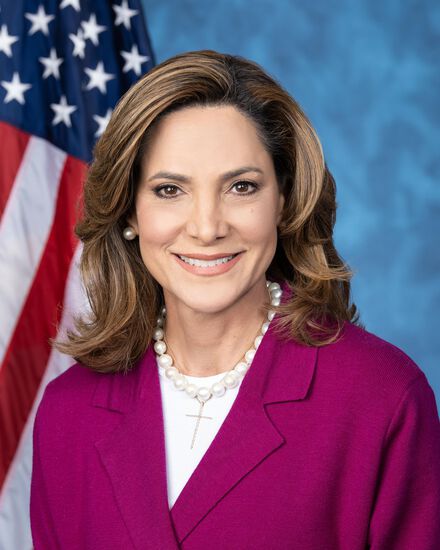
Photo of Maria Elvira Salazar
R United States House · District 27 · Florida On the 2026 ballot

Rep. Maria Elvira Salazar

Compare
Total votes
2,831
all sessions
Attendance
92%
221 missed
Lower than 95% of chamber peers
With party
90%
of cast votes
Near the chamber average
Bipartisan score
5%
crosses aisle rarely
Near the chamber average
Sponsored
1,439
bills & resolutions
Near the chamber average
Committees
7
assignments
1,439 bills and resolutions

Sponsored bills

Total
1,439
Primary
73
Co-sponsor
1,366
This page
1,439
matching current filters
Co-sponsor HR 1192
In committee · Indiana House · Co-sponsor
To ensure that Big Cypress National Preserve may not be designated as wilderness or as a component of the National Wilderness Preservation System, and for other purposes.

This bill prohibits the Big Cypress National Preserve in Florida from being designated as wilderness or as a component of the National Wilderness Preservation System. The National Park Service currently manages Big Cypress National Preserve, which is a freshwater swamp ecosystem of 729,000 acres.  In general, development activities, commercial activities, permanent structures, and roads are prohibited in wilderness areas. In contrast, natural preserves typically allow some development activities, such as hunting or oil and gas exploration.

In committee Feb 11, 2025 1 co-sponsor
Co-sponsor HR 1189
In committee · Indiana House · Co-sponsor
National Plan for Epilepsy Act

Maddy summaryHR 1189, the National Plan for Epilepsy Act, creates a coordinated federal strategy to address epilepsy through a National Plan for Epilepsy. The plan requires the Secretary of Health and Human Services to establish an annual assessment, maintain a diverse Advisory Council (including people with epilepsy, caregivers, and experts), and coordinate research and care across federal agencies. Key provisions include annual progress reports to Congress, data sharing between agencies, and recommendations to improve diagnosis, treatment access, and reduce epilepsy-related disparities. The plan expires December 31, 2035, and directly affects the estimated 3.4 million people in the U.S. living with epilepsy and their caregivers.

In committee Feb 11, 2025 1 co-sponsor
Co-sponsor HR 1197
In committee · Indiana House · Co-sponsor
PREEMIE Reauthorization Act of 2025

Maddy summaryThe PREEMIE Reauthorization Act of 2025 extends federal research funding for preterm birth prevention and care through fiscal years 2025-2029, replacing the prior 2019-2023 period. It requires the HHS Secretary to establish an interagency working group within 18 months and mandates a National Academies study on preterm birth costs, risk factors, and prevention strategies. The study must assess neonatal intensive care costs, long-term family expenses, and opportunities for early detection and support. It also analyzes targeted research for at-risk pregnancies, state program best practices, and precision medicine approaches starting in pregnancy. This bill directly affects preterm infants, their families, and federal health agencies through these research and coordination mechanisms.

In committee Feb 11, 2025 1 co-sponsor
Co-sponsor HR 736
Passed · Indiana House · Co-sponsor
Protect Small Businesses from Excessive Paperwork Act of 2025

Maddy summaryThis bill extends the deadline for small businesses to file certain financial reports from a variable timeline tied to regulatory dates to a fixed date of January 1, 2026. It modifies Section 5336(b)(1)(B) of Title 31, U.S. Code, directly affecting small businesses already required to submit specific financial disclosures under existing law. The key change simplifies compliance by replacing flexible regulatory deadlines with a single, clear cutoff date. This adjustment provides additional time for affected businesses without altering the underlying reporting requirements.

Passed Feb 11, 2025 1 co-sponsor
Co-sponsor HR 1138
In committee · Indiana House · Co-sponsor
Payment Choice Act of 2025

Maddy summaryHR 1138, the Payment Choice Act of 2025, requires most retail businesses to accept cash for in-person purchases up to $500 per transaction and prohibits charging higher prices for cash payments compared to other methods. Businesses may temporarily refuse cash only due to system failures, insufficient change, or if they offer a prepaid card conversion device meeting strict conditions (no fees, no minimum deposit, no expiration). The bill allows businesses a 5-year period to phase in accepting $50 bills or larger, after which the Treasury Secretary must mandate acceptance of $1-$20 bills. Consumers can send a 45-day notice to businesses for violations before pursuing legal action, with potential damages of at least $250 per violation. The law does not override stricter state cash acceptance protections.

In committee Feb 7, 2025 1 co-sponsor
Co-sponsor HR 71
In committee · Indiana House · Co-sponsor
Veterans Health Care Freedom Act

Maddy summaryHR 71, the Veterans Health Care Freedom Act, allows eligible veterans enrolled in VA healthcare to choose from a broader network of providers, including non-VA facilities, without geographic restrictions. The bill creates a 3-year pilot program in four diverse locations (rural and urban) where veterans can select primary care and specialty providers within a defined "covered care system" (VA facilities and approved community providers), with VA coordinating care through a primary provider. After the pilot, the law permanently requires the VA to offer this same choice of providers to all enrolled veterans, removing current barriers that limited access to non-VA care outside a veteran’s local VA network. The program uses existing VA funding and mandates regular reports to Congress on implementation and results.

In committee Feb 6, 2025 1 co-sponsor
Co-sponsor HR 942
In committee · Indiana House · Co-sponsor
Banning SPR Oil Exports to Foreign Adversaries Act

Maddy summaryHR 942, the "Banning SPR Oil Exports to Foreign Adversaries Act," prohibits the export of petroleum products drawn from the U.S. Strategic Petroleum Reserve to China, North Korea, Russia, Iran, and any entity owned or controlled by these countries or the Chinese Communist Party. The Secretary of Energy may grant a waiver for such exports if certified as serving U.S. national security interests, but must issue implementing rules within 60 days of enactment. This policy directly affects U.S. energy exports and entities seeking to purchase SPR oil from the listed adversaries.

In committee Feb 4, 2025 1 co-sponsor
Co-sponsor HR 933
In committee · Indiana House · Co-sponsor
Defending Domestic Orange Juice Production Act of 2025

Defending Domestic Orange Juice Production Act of 2025 This bill requires finished pasteurized orange juice to contain at least 10% by weight of orange juice soluble solids, exclusive of the solids of any added optional sweetening ingredients. (Current regulations require at least 10.5% by weight of orange juice soluble solids.)

In committee Feb 4, 2025 1 co-sponsor
Co-sponsor HR 929
In committee · Indiana House · Co-sponsor
Dr. Lorna Breen Health Care Provider Protection Reauthorization Act

Maddy summaryThis bill reauthorizes the Dr. Lorna Breen Health Care Provider Protection Act, extending mental health support programs for healthcare professionals through 2030 (previously ending in 2024). It requires funded programs to specifically address reducing administrative burdens on healthcare workers while continuing to promote access to mental health and substance use disorder services. The legislation directly affects healthcare providers across the U.S. who may access these federally supported resources. Key provisions include extending funding periods and mandating that grant recipients focus on easing workplace administrative tasks, alongside maintaining existing awareness initiatives. The bill does not create new programs but continues and refines existing mental health support for the healthcare workforce.

In committee Feb 4, 2025 1 co-sponsor
Co-sponsor HR 830
In committee · Indiana House · Co-sponsor
SAFE Act

Maddy summaryThe SAFE Act creates a new category of "fentanyl-related substances" that would automatically be controlled under Schedule I of the Controlled Substances Act based on specific chemical modifications to fentanyl. This affects anyone involved in the production, distribution, or use of substances meeting this broad definition. The bill establishes a process for removing or rescheduling these substances if they're determined to have less potential for abuse than Schedule I substances, and allows courts to review past convictions involving substances that have since been removed from this category. It also creates new research procedures for Schedule I substances and requires a GAO report analyzing the law's implementation and impact within four years.

In committee Jan 31, 2025 1 co-sponsor
Showing 371 to 380 of 1,439 bills
Previous 1 … 37 38 39 … 144 Next