

Maddy summaryHR 5815, the District of Columbia Medicaid Fairness Act, adjusts federal Medicaid funding for Washington D.C. by setting a specific Federal Medical Assistance Percentage (FMAP) for the district. It directly affects D.C. residents enrolled in Medicaid by guaranteeing a minimum federal funding share: 70% for fiscal years before 2027, gradually decreasing to 55% by 2029. For fiscal years 2030 and beyond, D.C. will receive the standard FMAP rate calculated under the Social Security Act, without the special adjustment. This change ensures D.C. receives a higher federal share than it would under the standard formula until 2029, after which it aligns with other states. The bill modifies Section 1905 of the Social Security Act to implement these funding adjustments.
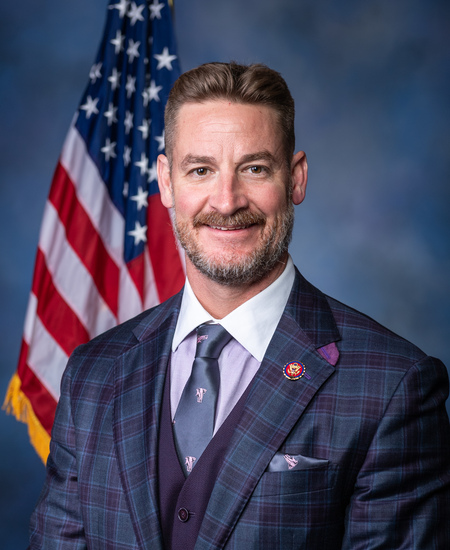
Rep. W. Gregory Steube
Sponsored bills
Maddy summaryThis bill ensures Medicare covers and pays for skin substitute products (used in wound care) by creating a new payment system starting in 2026. It establishes a payment rate based on a volume-weighted average of past payment data, adjusted annually for inflation, and requires a new billing code for these products by January 2026. The bill also adds program integrity measures: identifying the top 3% of providers by payment volume (outliers) for extra review, and requiring prior authorization for their claims starting in 2027. Additionally, it mandates coverage for these products in 2026 unless unsafe, and prohibits denying coverage solely based on clinical evidence analysis.
Maddy summaryThis bill, HR 5789 (the Donald J. Trump Congressional Gold Medal Act), authorizes Congress to award a gold medal to former President Donald J. Trump. It recognizes his "extraordinary peacemaking efforts" as described in the bill's findings, including a fictional 2025 Israel-Hamas peace agreement and other alleged diplomatic achievements. The key provision directs the Treasury Secretary to design and strike the medal, with bronze duplicates available for sale to cover costs. The bill does not create new laws or affect any policies; it is a ceremonial honor for Trump, with no direct impact on constituents or legislation.
Maddy summaryThis bill adds Medicare coverage for multi-cancer early detection screening tests (blood or biological tests analyzing cell-free DNA) starting January 1, 2028. It directly affects Medicare beneficiaries aged 68 and older (starting in 2028, with the age limit increasing by 1 year annually), requiring tests to be FDA-cleared and deemed reasonable/necessary by the Secretary for early cancer detection across multiple organ sites. Payment will initially match current stool DNA test rates before 2031, then shift to a lower rate or new payment system after 2031, with limits preventing more than one test per year. The bill explicitly states it does not alter coverage for existing cancer screenings like breast, colorectal, or prostate cancer tests.
Maddy summaryThis bill would require all states to recognize valid concealed carry permits issued by other states, allowing permit holders to carry concealed handguns (excluding machine guns) in any state that either issues such permits or doesn't prohibit concealed carry. It directly affects law-abiding gun owners with valid permits from their home state, ensuring they can carry in states with similar permit systems or no prohibitions. Key provisions include treating valid permit documents as proof of legal carry (reducing officer stops), shifting the burden of proof to prosecutors if challenged, and allowing civil lawsuits for violations with attorney's fee awards. The bill does not override state laws restricting firearms on private property or government land, nor does it affect federal gun restrictions like those in section 922(q).
Maddy summaryHR 5608 removes a restriction preventing private insurance companies participating in the "Write Your Own" program from selling competing private flood insurance policies alongside National Flood Insurance Program (NFIP) products. The bill amends federal law to prohibit the FEMA Administrator from requiring these companies to agree not to offer private flood insurance as a condition of participating in the NFIP program. This change directly affects private insurers currently in the Write Your Own program, allowing them to sell both NFIP-backed and standalone private flood insurance without contractual restrictions. The key provision eliminates non-compete clauses in agreements between FEMA and these insurers, enabling greater market competition for flood insurance products.
Maddy summaryHR 5607, the Flood Insurance Transparency Act of 2025, requires the National Flood Insurance Program (NFIP) to publicly share specific flood risk and claims data. It mandates the Administrator to make available, through an open-source system, property-level information (like loss ratios, claim amounts, and flood risk assessments) and community-level data (including flood hazard area statistics and multiple-loss property counts), while protecting personally identifiable information. This affects researchers, developers, and communities using NFIP data for flood risk analysis, but does not change insurance premiums or coverage. The bill establishes a searchable database for communities participating in the NFIP, detailing compliance status, flood hazard area construction dates, and historical claims data.
Maddy summaryThis bill bans the import, export, and sale of donkey skins and ejiao products (a gelatin made from donkey skin) in U.S. commerce. It directly affects U.S. businesses importing or selling ejiao, which currently accounts for $12 million in annual U.S. imports. The law prohibits trading in donkey skins for ejiao production or any product containing ejiao, with civil penalties up to $10,000 per violation or criminal charges for larger offenses. Enforcement will be handled by U.S. Customs and Border Protection, targeting the U.S. market for a product driving global donkey population declines.
Maddy summaryThis bill allows local governments to use "Construction Manager at Risk" procurement methods (a simpler process where contractors help plan and build projects) for disaster recovery work under the Stafford Act. It also raises the spending threshold from $1 million to $3 million for projects that can use simplified procurement procedures. These changes directly affect local governments managing FEMA-funded disaster recovery projects, making it easier to acquire goods and services quickly. The bill requires FEMA to issue regulations within 180 days to implement these changes.
Maddy summaryH.J.Res. 127 proposes a constitutional amendment to establish parental rights regarding children's upbringing, education, and care as a fundamental right. It would guarantee parents the right to choose private, religious, or home schooling instead of public school, or make reasonable choices within public schools for their children. The amendment would require the government to demonstrate a "highest order" interest to limit these rights, and explicitly prohibits denying these rights based on disability. This proposal, if ratified by 38 states, would amend the U.S. Constitution but is not yet law.