

Maddy summaryHRES 719 is a House resolution honoring Charles "Charlie" James Kirk, the founder of Turning Point USA who was assassinated on September 10, 2025. The resolution condemns his assassination and all political violence, extends condolences to his family, and calls on Americans to reject violence while promoting civil discourse. It specifically recognizes Kirk's legacy as a defender of constitutional principles and his role in inspiring youth through free speech and faith-based civic engagement. As a commemorative resolution, it does not enact policy changes but formally expresses the House's stance on honoring his life and legacy.
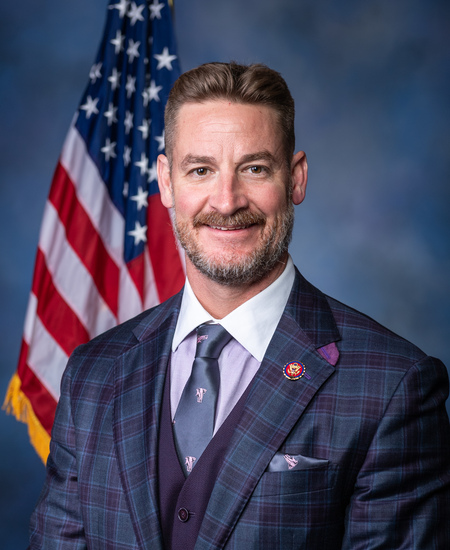
Rep. W. Gregory Steube
Sponsored bills
Maddy summaryThis bill authorizes the posthumous presentation of a Congressional Gold Medal to Welles Remy Crowther, a volunteer firefighter and equities trader who died saving others during the September 11, 2001, attacks. The medal, designed by the Treasury Secretary, will be given to Crowther’s mother, Alison Crowther, following a formal presentation by congressional leaders. The bill also permits the U.S. Mint to sell bronze duplicates of the medal at cost to cover production expenses. It is a purely commemorative measure with no legislative or regulatory impact.
Maddy summaryThis bill requires health plans and insurers to create a clear, timely process for patients or doctors to request exceptions when step therapy protocols (which force patients to try cheaper drugs first) might harm them. It mandates approval for exceptions in six specific cases, such as when prior treatments failed, delaying care risks severe harm, or the required drug causes adverse reactions. Plans must respond within 72 hours (24 hours for emergencies) and cover the requested drug for at least one year if approved. Additionally, health plans must report annual data on exception requests, approvals, denials, and reasons to the government for transparency.
Maddy summaryThe Make America's Youth Healthy Again Act of 2025 establishes a new President’s Council on Sports, Fitness, and Nutrition to advise the President on youth health initiatives. The Council, appointed by the President with up to 30 members serving two-year terms, will recommend strategies to reinstate the Presidential Fitness Test, develop school-based physical education programs, expand community sports access, and address childhood obesity as a national security concern. Key provisions include advising on fitness goals for American youth, promoting partnerships with sports organizations, and emphasizing active lifestyles and nutrition. The Council will terminate two years after enactment unless extended by the President. This bill directly affects federal policy coordination for youth fitness programs but does not create new funding or mandate changes to existing laws.
Maddy summaryThe Choice Arrangement Act creates a new type of employer-provided health benefit called a "CHOICE arrangement" that allows employees to use employer funds to pay for health care expenses. These arrangements must meet specific requirements including nondiscrimination rules, enrollment verification, and proper notice to employees. Employers offering CHOICE arrangements can claim a tax credit of $100 per month for the first year and $50 per month for the second year for each employee enrolled. Employees in CHOICE arrangements remain eligible to purchase health insurance through the marketplace. The changes apply to plan years beginning after December 31, 2025.
Maddy summaryHR 5483, the Chloe Cole Act, prohibits health care professionals, hospitals, or clinics from providing certain gender-affirming treatments to minors under 18 that aim to alter their body to align with a gender identity different from their sex assigned at birth. This includes puberty blockers, sex hormones, and specific surgeries, unless the treatment falls under narrow exceptions like medically necessary care for disorders of sexual development, injuries, or detransition. The bill creates a private right for affected minors or their guardians to sue providers for damages in federal court, with strict liability for violations. It applies when interstate commerce is involved (e.g., payments, travel, communications) and sets a 25-year statute of limitations from the minor’s 18th birthday.
Maddy summaryHRES 727 is a symbolic resolution designating October 14, 2025, as a "National Day of Remembrance for Charlie Kirk." It does not create new law but formally honors Charlie Kirk, founder of Turning Point USA and a prominent advocate for free speech and civic education, who died by assassination on September 10, 2025. The resolution encourages educational institutions and citizens to observe the day with activities promoting civic engagement, liberty, and democracy. It directly affects no specific group through policy changes, as it is a commemorative gesture without binding requirements.
Maddy summaryHRES 702 is a symbolic resolution condemning the September 10, 2025, assassination of Charlie Kirk, founder of Turning Point USA and a conservative political activist. It expresses condolences to his family, praises first responders, and reaffirms the right to peaceful assembly. As a non-binding resolution, it does not create new laws or policies but serves as a formal statement of condemnation. The resolution directly addresses the House of Representatives' stance on this event, with no direct impact on constituents or legislation.
Maddy summaryThe RESULTS Act (HR 5269) changes how Medicare calculates payment rates for clinical diagnostic laboratory tests. It requires Medicare to collect data on private payor rates for widely available non-Advanced Diagnostic Laboratory Tests (non-ADLTs) from a qualifying independent claims data entity (a national nonprofit organization meeting specific criteria) rather than relying on data reported directly by laboratories. For tests where data is unavailable, the bill establishes default payment rates based on previous years' rates adjusted for inflation. The law also requires Medicare to publicly explain payment rates with supporting data, affecting Medicare beneficiaries, clinical laboratories, and private payors that provide services covered by Medicare.
Maddy summaryThe FIREARM Act (HR 3770) changes how federal firearm licensees (like dealers) handle violations of firearms laws. It requires the Attorney General to give licensees 30 business days to correct minor, self-reported violations - such as clerical errors - with assistance and training, instead of automatically revoking licenses. The bill also adds a 15-day window for licensees to challenge revocations in federal court, where courts must review the case anew and only uphold revocations if the licensee willfully violated the law. Additionally, it applies retroactively to licensees whose licenses were revoked under a 2021 enforcement policy, allowing them to reapply if they meet compliance requirements.