Multiple Firearm Sales Reporting Modernization Act of 2022 This bill expands reporting requirements with respect to sales or dispositions of multiple firearms. Currently, a federal firearms licensee (e.g., a gun dealer) must report multiple sales or dispositions of pistols or revolvers to the same person within five business days. This bill requires a federal firearms licensee to report multiple sales or dispositions of any firearms to the same person within five business days.
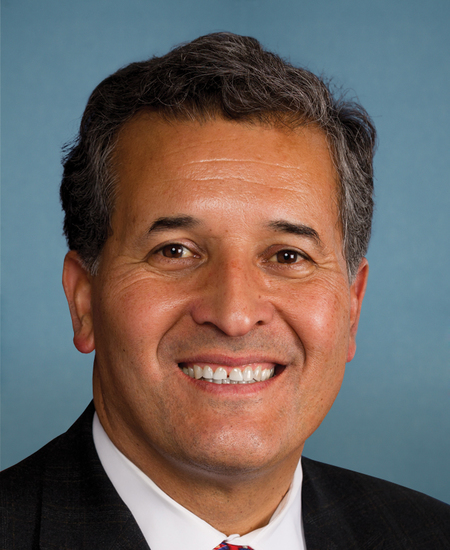
Rep. Juan Vargas
Sponsored bills
Latonya Reeves Freedom Act of 2022 This bill prohibits government entities and insurance providers from denying community-based services to individuals with disabilities that require long-term service or support that would enable such individuals to live in the community and lead an independent life. Specifically, these entities may not discriminate against such individuals in the provision of community-based services by such actions as imposing prohibited eligibility criteria, cost caps, or waiting lists or failing to provide a specific community-based service. Additionally, community-based services must be offered to individuals with such disabilities prior to institutionalization. Institutionalized individuals must be notified regularly of community-based alternatives. The bill requires the Department of Justice to issue regulations requiring government entities and insurance providers to offer community-based long-term services to individuals with such disabilities who would otherwise qualify for institutional placement. Government entities must ensure sufficient availability of affordable, accessible, and integrated housing that is not a disability-specific residential setting or a setting where services are tied to tenancy. Regulations shall also (1) require government entities and insurance providers to perform self-evaluation on current services, policies, and practices and concerning compliance with requirements of this bill; and (2) require government entities to submit a transition plan. The bill provides funds for FY2022 for the Department of Health and Human Services to provide technical assistance with respect to transition plans. The bill allows civil actions by individuals subjected to, or about to be subjected to, a violation of its requirements.

Election Worker and Polling Place Protection Act This bill addresses certain protections for election workers and polling places. In particular, the bill prohibits, with enhanced penalties for certain types of threats and harms (1) intimidation of poll watchers, election officials, and election agents, vendors, and contractors involving violence or threats of harm; and (2) physical damage to or threats to physically damage a polling place, tabulation center, or other election infrastructure.
Russian Travel Sanctions for a Democratic Ukraine Act This bill imposes visa-blocking sanctions on certain citizens of Russia. Specifically, the President must impose such sanctions on citizens of Russia who are (1) Russian oligarchs, (2) employees of Russia's government, or (3) employees of companies that are owned by or receive funding from Russia's government. The President must also impose the sanctions on family members of such individuals. The President must coordinate with allies, including NATO member states, on the imposition of such sanctions. The President may waive the application of such sanctions in certain instances.
This bill authorizes the President to impose asset- and visa-blocking sanctions on any member of Russia's parliament who voted on February 15, 2022, to appeal to Russian President Vladimir Putin to recognize the Donetsk and Luhansk regions of Ukraine as one or more independent states.
Strengthening Citizenship Services for Veterans Act This bill directs U.S. Citizenship and Immigration Services (USCIS) to ensure that various naturalization-related services are available at a U.S. port of entry, embassy, or consulate that is accessible to noncitizen veterans. Specifically, USCIS must ensure that naturalization examinations, biometric collections, and naturalization ceremonies are available at such locations for noncitizen veterans. Such services must be available to a noncitizen veteran who has been removed from the United States or is inadmissible.
Fresh Start Act of 2022 This bill establishes a federal statutory process to expunge records related to certain nonviolent criminal offenses. The bill defines the nonviolent offenses eligible for expungement; it establishes qualifications for an eligible offender; and it sets forth procedures for filing an expungement petition.
Private Prison Information Act of 2021 This bill specifies that a record related to a nonfederal prison, correctional, or detention facility must be considered a federal agency record for purposes of the Freedom of Information Act (FOIA). A nonfederal prison, correctional, or detention facility must disclose information under FOIA unless the information is exempt from disclosure or the disclosure is prohibited by law. The term nonfederal prison, correctional, or detention facility means (1) a private prison, correctional, or detention facility; or (2) a state or local prison, jail, or other correctional or detention facility.
Fair Adjudications for Immigrants Act This bill narrows the scope of certain crime-based grounds for barring or removing an alien from the United States. (Generally, a conviction for certain crimes, such as a crime that carries a term of incarceration of a certain length, may constitute grounds for denying an individual certain immigration benefits.) The bill redefines the term conviction to exclude convictions that have been dismissed, expunged, deferred, annulled, invalidated, withheld, vacated, or pardoned. The term must also exclude adjudications where a court issued a recommendation against removal, an order of probation without entry of judgment, or a similar disposition. In addition, any reference to a term of imprisonment or sentence must, unless otherwise provided (1) only consider the period of incarceration ordered by a court, and (2) exclude any suspended portion of a sentence. Currently, for immigration purposes, a term of incarceration includes any part of the sentence that was suspended. These provisions pertaining to the definition of conviction and terms of imprisonment shall apply to convictions and judgments entered either before or after this bill's enactment. Furthermore, certain crime-based grounds for barring or removing an alien shall not apply if the sentencing court issues a recommendation that the alien not be removed on the basis of the conviction.
Reduce Financial Barriers to Immigration and Citizenship Act of 2021 This bill prohibits the Department of Homeland Security (DHS) from charging fees for certain immigration applications (or petitions), requires DHS to provide fee waivers to certain applicants, and addresses related issues. DHS may not impose fees for certain applications for or related to (1) asylum or refugee status, (2) special immigrant juvenile status, (3) U or T non-immigrant visas (victims of certain crimes such as human trafficking), (4) the Violence Against Women Act, (5) special immigrant status for Afghan or Iraqi nationals employed by the U.S. government, or (6) immigration-related fee waivers. DHS must also waive immigration-related application fees for an applicant who receives a means-tested benefit or meets certain conditions related to financial hardship. However, DHS is not required to provide fee waivers for applications for certain employment-based immigration benefits. Receipt of a fee waiver may not be used as a factor (1) for determining whether an alien should be considered a public charge, or (2) when considering an affidavit of support filed by a sponsor. The bill also requires all collected immigration-related adjudication fees to be used only to fund the adjudication and administration of immigration benefits and naturalization.