

Reduced Costs and Continued Cures Act This bill establishes and alters several programs and requirements relating to the prices of prescription drugs. For example, the bill establishes and alters several requirements under Medicare and Medicaid, including requiring drug manufacturers to issue rebates to the Centers for Medicare & Medicaid Services for covered drugs under Medicare that cost $100 or more and for which the average manufacturer price increases faster than inflation, capping annual out-of-pocket spending under the Medicare prescription drug benefit, and increasing the maximum rebate amount under the Medicaid Drug Rebate Program. The bill also makes changes relating to market exclusivities and manufacturer price concessions for prescription drugs, including authorizing the Federal Trade Commission to initiate proceedings against parties to settlements of patent infringement claims that have anticompetitive effects with respect to drugs or biologics, limiting in certain instances the number of patents that the manufacturer of a biologic can assert in a lawsuit against a company seeking to sell a biosimilar version, and nullifying regulations relating to the treatment of certain Medicare prescription drug benefit rebates from drug manufacturers for purposes of federal anti-kickback laws.
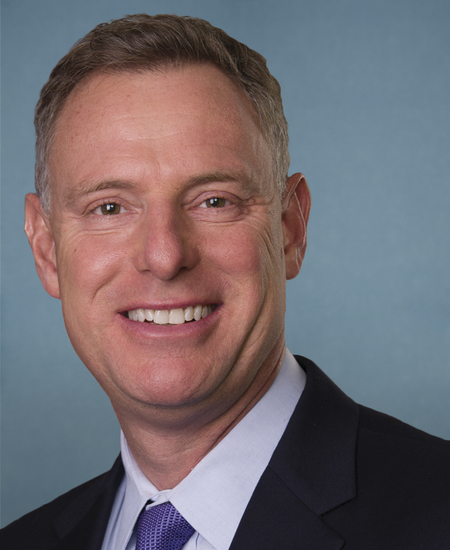
Rep. Scott H. Peters
Sponsored bills
Lifting Immigrant Families Through Benefits Access Restoration Act of 2021 or the LIFT the BAR Act of 2021 This bill repeals certain limits on the eligibility of noncitizens who lawfully reside in the United States for federal means-tested programs, including Medicaid, the Children's Health Insurance Program (CHIP), programs funded through Temporary Assistance for Needy Families (TANF) grants, Supplemental Security Income (SSI), and certain nutrition and housing programs.
Reduced Costs and Continued Cures Act of 2021 This bill establishes and alters several programs and requirements relating to the prices of prescription drugs. For example, the bill establishes and alters several requirements under Medicare and Medicaid, including requiring drug manufacturers to issue rebates to the Centers for Medicare & Medicaid Services for covered drugs under Medicare that cost $100 or more and for which the average manufacturer price increases faster than inflation, capping annual out-of-pocket spending under the Medicare prescription drug benefit, and increasing the maximum rebate amount under the Medicaid Drug Rebate Program. The bill also makes changes relating to market exclusivities and manufacturer price concessions for prescription drugs, including authorizing the Federal Trade Commission to initiate proceedings against parties to settlements of patent infringement claims that have anticompetitive effects with respect to drugs or biologics, limiting in certain instances the number of patents that the manufacturer of a biologic can assert in a lawsuit against a company seeking to sell a biosimilar version, and nullifying regulations relating to the treatment of certain Medicare prescription drug benefit rebates from drug manufacturers for purposes of federal anti-kickback laws.
Frederick Douglass Trafficking Victims Prevention and Protection Reauthorization Act of 2021 This bill reauthorizes through FY2026 and revises programs and activities to support survivors of human trafficking and prevent such trafficking domestically and abroad. The bill expands and authorizes programs for survivors, including a program to prevent re-exploitation. It also extends through FY2026 a special assessment on certain persons convicted of a human trafficking offense, which funds programs for human-trafficking survivors. Additionally, the bill provides privacy and other protections for survivors, including specified financial protections and protections against retaliation for survivors who pursue civil claims against a perpetrator. The bill also allows courts to reduce sentences for certain individuals who commit human trafficking crimes as minors. To prevent trafficking domestically, federal departments must incorporate anti-trafficking efforts into contracting activities and personnel policies, and the bill supports private sector efforts to address human trafficking in its policies and services. Furthermore, the bill supports the identification, investigation, and prosecution of human trafficking crimes, with an expanded focus on forced labor. To prevent trafficking globally, the bill prohibits access to a trade program for developing countries and otherwise restricts development assistance for countries that fail to meet minimum standards for eliminating trafficking. It also changes the criteria for determining whether a country has met applicable standards. In addition, the bill authorizes sanctions on persons convicted of severe forms of trafficking and requires integration of counter-trafficking activities into foreign assistance programs. The bill also requires reporting by the Government Accountability Office, federal agencies, and states concerning human trafficking.
Welcoming Evacuees Coming from Overseas to Mitigate Effects of Displacement Act of 2021 or the WELCOMED Act of 2021 This bill makes certain individuals from Afghanistan eligible for any benefit that is available to a refugee, such as resettlement assistance. Specifically, this bill shall apply to a national of Afghanistan (or an individual with no nationality who last habitually resided in Afghanistan) who is temporarily paroled into the United States for urgent humanitarian reasons or significant public benefit during the four-year period beginning on July 1, 2021.
Frank Harrison, Elizabeth Peratrovich, and Miguel Trujillo Native American Voting Rights Act of 2021 This bill addresses the voting rights of Native American and Alaska Native voters and voting access on tribal lands. The bill includes provisions expanding the types of facilities that can be used as voter registration agencies; increasing polling site accessibility, including by expanding early in-person voting and providing ballot drop boxes; providing enforcement power to citizens and attorneys general; requiring approval for actions like moving a polling place; validating certain tribal identification for voting or registering to vote; permitting voters to designate another individual to return a ballot on their behalf; and expanding requirements for bilingual voting accessibility. In addition, the bill establishes a Native American voting task force grant program for the purpose of increasing voter outreach, education, registration, turnout, and accessibility for Native American communities. The bill also directs the Government Accountability Office to study and report on (1) the prevalence of nontraditional or nonexistent mailing addresses among Indians, members of tribes, and individuals residing on Indian lands; and (2) the alternatives for removing barriers to voter registration, receipt of voter information and materials, and receipt of ballots.
Judicial Understaffing Delays Getting Emergencies Solved Act or the JUDGES Act This bill requires the appointment of additional U.S. district court judges, converts certain temporary district court judgeships into permanent judgeships, and requires the Government Accountability Office to report on vacant or underused federal courthouses. Specifically, the bill requires the appointment of 39 district court judges on or after January 21, 2025, in specified judicial districts in Arizona, California, Colorado, Delaware, Florida, Georgia, Idaho, Indiana, Iowa, New Jersey, New Mexico, New York, and Texas. Further, 38 district court judges must be appointed on or after January 21, 2029, in specified judicial districts in Arizona, California, Colorado, Delaware, Florida, Georgia, Indiana, New Jersey, New York, and Texas. Additionally, the bill converts certain temporary district court judgeships to permanent judgeships in specified judicial districts in Alabama, Arizona, California, Florida, Kansas, Missouri, New Mexico, North Carolina, and Texas.
Supreme Court Ethics Act This bill establishes a new statutory requirement for the Judicial Conference of the United States to issue a judicial code of conduct for judges and justices of U.S. courts, including Justices of the Supreme Court. Currently, the Judicial Conference issues a code of conduct for judges of U.S. courts (but not for Justices of the Supreme Court).
Disabled Access Credit Expansion Act of 2021 This bill modifies the tax credit allowed to eligible small businesses for expenditures to provide access to disabled individuals to increase (1) the maximum allowable amount of such credit to $20,500, and (2) the limitation on the gross receipts of such businesses to $2.5 million for purposes of determining eligibility for the credit. The bill directs the Department of Justice (DOD) to carry out an ADA (Americans with Disabilities Act) Mediation Program to facilitate voluntary mediation to resolve disputes arising under the ADA and to provide training for mediators. DOD must report to Congress on its ADA Information Line (a toll-free line to provide information and materials to the public about ADA requirements).
Let Immigrants Kickstart Employment Act of 2021 or the LIKE Act This bill establishes a new class of nonimmigrant visa (W visa) for qualifying start-up owners and essential employees (and the accompanying spouse or child of such aliens) and addresses related issues. Under this bill, a start-up is a U.S. entity that has lawfully conducted business and was formed in the five years preceding an application for a start-up owner visa. To be eligible for an initial visa as a start-up owner, an individual must (1) possess at least a 10% interest in the start-up; (2) play a central and active role in the start-up's management or operations; (3) possess knowledge, skills, or experience to substantially assist in the start-up's growth and success; and (4) provide evidence that the start-up has received certain investments, created jobs, or generated revenue. The holder of a nonimmigrant start-up owner visa may receive lawful permanent resident status upon meeting certain requirements, including by establishing that the start-up has created a certain number of jobs and has met certain revenue targets. To be eligible for a visa as an essential employee of a start-up, an individual must (1) have an offer of employment in an executive or managerial capacity at a start-up; and (2) possess knowledge, skills, or experience to substantially assist in the start-up's growth and success. The bill limits the number of employees on essential employee visas that a start-up may have.