

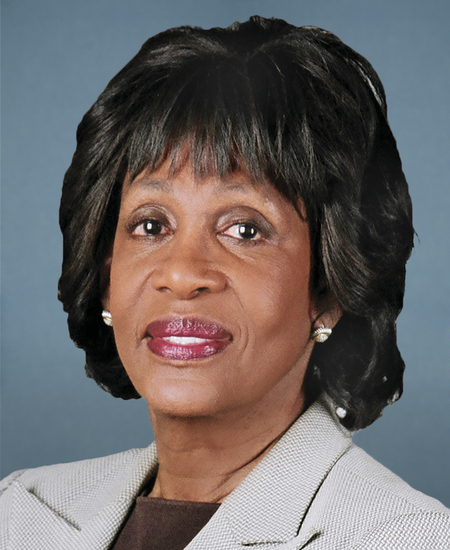
Photo of Maxine Waters
D United States House · District 43 · California On the 2026 ballot

Rep. Maxine Waters

Compare
Total votes
2,837
all sessions
Attendance
96%
106 missed
Lower than 78% of chamber peers
With party
96%
of cast votes
Near the chamber average
Bipartisan score
2%
crosses aisle rarely
Near the chamber average
Sponsored
926
bills & resolutions
Near the chamber average
Committees
1
assignment
926 bills and resolutions

Sponsored bills

Total
926
Primary
118
Co-sponsor
808
This page
926
matching current filters
Co-sponsor HR 3501
In committee · Indiana House · Co-sponsor
To amend title XVIII of the Social Security Act to provide for certain cognitive impairment detection in the Medicare annual wellness visit and initial preventive physical examination.

Maddy summaryHR 3501 would require Medicare providers to screen beneficiaries aged 65 and older for cognitive impairment during annual wellness visits and initial preventive physical exams, using tools approved by the National Institute on Aging. The screening must be documented in the patient’s medical record. This change applies to visits starting January 1, 2026, and aims to support early detection of conditions like Alzheimer’s through standard preventive care. The bill directly affects Medicare beneficiaries, providers, and caregivers by integrating cognitive screening into routine preventive services.

In committee May 19, 2025 1 co-sponsor
Co-sponsor HR 3449
In committee · Indiana House · Co-sponsor
Stronger Communities through Better Transit Act

Stronger Communities through Better Transit Act This bill requires the Department of Transportation (DOT) to establish a grant program to support operating projects for public transportation and related service improvements, particularly in underserved communities and areas of persistent poverty. Specifically, the bill requires DOT to allocate funding under the program for urbanized areas, states, and Indian tribes that are recipients of funds under either the Federal Transit Administration's (FTA's) Urbanized Area Formula Funding program or Formula Grants for Rural Areas program. Eligible recipients may use funding for operating costs associated with projects that improve public transportation service for transit-dependent populations and support increased transit ridership (e.g., service expansion, information technology enhancements, and workforce development). DOT must apportion the funding so that recipients receive funds that are proportional to their share of operating costs. The bill also provides for an increased federal cost share for operating assistance for projects or programs carried out in areas of persistent poverty or underserved communities. DOT must set up a multimodal access measurement interface for public agencies to aid transit agencies in determining and reporting on access to jobs and essential services. A grant recipient must (1) report specific information to the FTA for inclusion in the National Transit Database, and (2) survey transit riders and non-riding residents regarding transit service improvements. Further, the bill expands the purposes of the public transportation programs to include supporting public transportation's role in combating climate change through growing/retaining transit ridership.

In committee May 16, 2025 1 co-sponsor
Co-sponsor HR 3442
In committee · Indiana House · Co-sponsor
SNAP Administrator Retention Act of 2025

SNAP Administrator Retention Act of 2025 This bill directs the Food and Nutrition Service (FNS) to pay Supplemental Nutrition Assistance Program (SNAP) state agencies for 100% of SNAP administrative personnel costs. The bill also requires that state SNAP agency administrators be paid at least the same amount as federal employees. (Under current law, FNS generally pays 50% of a state's administrative costs for SNAP.) Specifically, FNS must pay a state agency for 100% of all SNAP administrative personnel costs that are part of an FNS-approved state agency personnel wage plan. This must include all costs associated with hiring and training new employees, maintaining those personnel costs, and complying with wage standards. The state agency must use these funds (1) to supplement, not supplant, nonfederal funds used for existing administrative personnel costs; and (2) for existing or additional full-time positions that are above the number of positions that were held in FY2024. The bill also requires that the wage standards for SNAP state agency administrators be (1) at least the same amount as the General Schedule (GS) pay rate for federal employees; and (2) updated annually based on any increase in the GS pay rate, including locality adjustments.

In committee May 15, 2025 1 co-sponsor
Co-sponsor HR 3415
In committee · Indiana House · Co-sponsor
Nurse Staffing Standards for Hospital Patient Safety and Quality Care Act of 2025

Maddy summaryThis bill establishes minimum nurse-to-patient ratios for hospital units across the country, requiring hospitals to maintain specific staffing levels (such as 1:1 in trauma units, 2:1 in critical care units, and 3:1 in emergency rooms) to improve patient safety and quality of care. Hospitals must develop transparent staffing plans that account for patient acuity, involve direct care nurses in planning, and document actual staffing levels for each shift. The bill includes strong whistleblower protections for nurses who object to unsafe staffing levels and prohibits hospitals from retaliating against nurses who report violations. It requires hospitals to comply with these standards as a condition for receiving Medicare and Medicaid payments, with enforcement through audits and civil penalties of up to $50,000 for repeated violations. The bill also includes provisions to support nurse recruitment and retention through workforce initiatives and training programs.

In committee May 14, 2025 1 co-sponsor
Co-sponsor HR 3335
In committee · Indiana House · Co-sponsor
Children Don't Belong on Tobacco Farms Act

Maddy summaryThis bill amends the Fair Labor Standards Act to prohibit children under 18 from having direct contact with tobacco plants or dried tobacco leaves on farms. It directly affects minors who might work on tobacco farms and tobacco farm employers who currently allow such employment. The key change adds tobacco farming to the list of occupations where children under 18 cannot work, closing a loophole that previously permitted this activity. This update explicitly excludes tobacco-related agriculture from exceptions allowing minors in certain farm jobs under federal law.

In committee May 13, 2025 1 co-sponsor
Co-sponsor HR 3376
In committee · Indiana House · Co-sponsor
Water Affordability, Transparency, Equity, and Reliability Act of 2025

Maddy summaryHR 3376 creates the Water Affordability, Transparency, Equity, and Reliability Trust Fund, funded by increasing the corporate tax rate from 21% to 24.5% starting in 2025, with annual funding capped at $35 billion or 1/20th of 20-year infrastructure needs. The bill allocates funds to clean water programs (42%), safe drinking water programs (42.5%), household water well systems (1%), colonias assistance (0.5%), and Indian health services (3%), requiring specific prioritization of low-income and minority communities for many programs. It mandates an EPA study on water affordability, discriminatory practices, and civil rights violations in water service, including data collection on service disconnections affecting vulnerable populations. The bill also includes provisions for lead service line replacement, PFAS contamination response, and job training grants for water system operators with specific requirements to prioritize low-income communities.

In committee May 13, 2025 1 co-sponsor
Co-sponsor HR 3306
In committee · Indiana House · Co-sponsor
Truth in Tariffs Act

Maddy summaryHR 3306, the Truth in Tariffs Act, requires retailers selling goods to U.S. consumers to clearly display the portion of a product's price caused by applicable tariffs (called a "tariff surcharge"). This applies to most retailers but exempts small businesses as defined by the Small Business Act. The Federal Trade Commission (FTC) will enforce this rule, treating violations as unfair or deceptive practices under existing law, with penalties similar to those for other FTC violations. The law takes effect 30 days after enactment, covering tariffs imposed by the President after January 20, 2025.

In committee May 8, 2025 1 co-sponsor
Co-sponsor HR 3243
In committee · Indiana House · Co-sponsor
Therapeutic Fraud Prevention Act of 2025

Maddy summaryHR 3243, the Therapeutic Fraud Prevention Act of 2025, bans the provision of paid conversion therapy aimed at changing a person's sexual orientation or gender identity, and prohibits advertising such therapy as effective, safe, or without risk. It directly affects LGBTQ+ individuals and their families who might be targeted by these practices, as professionals have determined conversion therapy is ineffective and harmful. The law treats violations as deceptive acts under consumer protection laws, empowering the Federal Trade Commission and state attorneys general to enforce it through civil actions. It explicitly excludes legitimate gender transition support and non-discriminatory counseling from the ban.

In committee May 7, 2025 1 co-sponsor
Primary HR 3224
In committee · Indiana House · Lead sponsor
International Financial Institution Improvements Act of 2025

Maddy summaryThe International Financial Institution Improvements Act of 2025 requires U.S. representatives at institutions like the World Bank and International Monetary Fund to advocate for greater transparency, human rights protections, and accountability in their operations. Key provisions mandate public disclosure of loan agreements, require meaningful consultation with civil society organizations including women's rights groups and anti-corruption organizations, and strengthen anti-corruption measures in lending practices. The bill also directs advocacy for debt relief mechanisms for countries affected by climate disasters and includes specific requirements for U.S. participation in capital increases for development banks. These provisions directly affect how the U.S. engages with international financial institutions, shaping their policies on transparency, human rights, and accountability.

In committee May 6, 2025 0 co-sponsors
Co-sponsor HR 3139
In committee · Indiana House · Co-sponsor
Public Service Worker Protection Act

Maddy summaryThis bill expands OSHA safety protections to cover public employees, including teachers, police, and sanitation workers, who were previously excluded from federal workplace safety regulations. It directly affects state and local government workers by amending the Occupational Safety and Health Act to explicitly include "the United States, a State, or a political subdivision of a State" under OSHA coverage. The key mechanism is a technical amendment to the law’s definition of covered employees, ensuring public service workers fall under the same safety standards as private-sector employees. The bill takes effect 90 days after enactment for most workplaces, with a 36-month delay for state/local governments without existing OSHA plans.

In committee May 1, 2025 1 co-sponsor
Showing 191 to 200 of 926 bills
Previous 1 … 19 20 21 … 93 Next