

Maddy summaryHRES 578 is a non-binding House resolution calling for the immediate release of Eyvin Hernandez, a U.S. citizen and Los Angeles County public defender wrongfully detained by Venezuela since March 2022. The resolution urges U.S. officials, including the President and Secretary of State, to press Venezuela for his release and condemns Venezuela’s practice of detaining U.S. citizens for political purposes. It specifically references Hernandez’s wrongful detention without evidence or fair trial, noting his status as a Department of State-designated wrongfully detained individual. The resolution expresses support for Hernandez and other Americans detained abroad, without creating new legal requirements or funding.
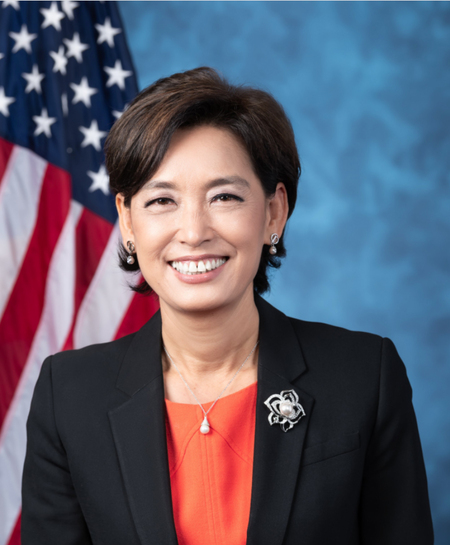
Rep. Young Kim
Sponsored bills
Maddy summaryThis bill expands employee ownership in S corporations by extending tax deferral for selling company stock to employee ownership plans (ESOPs), creating a Treasury Department office to provide education and technical assistance for ESOPs, and amending small business rules to maintain eligibility for government programs after ESOP ownership exceeds 49%. It establishes a new Labor Department "Advocate for Employee Ownership" to coordinate federal efforts, educate stakeholders, and recommend policy improvements. The bill directly affects S corporations using ESOPs, their employees who become owners, and small businesses that might lose government program access due to ESOP acquisitions. Key provisions include tax incentive extensions, new support offices, and updated small business classification rules.
Maddy summaryThis bill establishes a Senior Advisor and Task Force within the State Department to coordinate and oversee the AUKUS trilateral security partnership (U.S., UK, Australia). The Senior Advisor, appointed from existing State Department leadership, will coordinate implementation across agencies, engage with UK/Australia partners, and streamline defense trade barriers. The Task Force must meet quarterly, track defense transactions, create vendor lists, and report to Congress every 90 days on progress, delays, and compliance issues. It also modifies the Arms Export Control Act to allow streamlined licensing for AUKUS-related defense trade, requiring annual reports on transactions and reduced review times. The oversight structure expires after 7 years unless renewed by the Secretary of State.
Maddy summaryThe KOALA Act streamlines defense trade between the U.S., Australia, and the U.K. by removing the usual licensing requirements for defense exports and transfers under the Arms Export Control Act, specifically for activities related to the AUKUS security partnership announced in 2021. It directly affects U.S. defense exporters and Australian defense entities by allowing faster transfers of defense articles and services without individual licenses. Key provisions include requiring the President to submit semiannual reports to Congress on these transfers and establishing a process for Congress to disapprove exemptions via joint resolution. The bill modifies reporting and certification requirements for these transactions and increases civil/criminal penalties for violations. It takes effect 180 days after enactment.
Maddy summaryThis bill modifies the Arms Export Control Act to streamline defense trade between the U.S., United Kingdom, and Australia under the AUKUS security partnership. It removes licensing requirements for defense exports and transfers between these three nations, specifically for items related to the multilateral cooperation announced in September 2021. The President must submit semiannual reports to Congress on these transfers and provide 90-day post-transfer notifications for defense items moving among the three countries. This directly affects U.S. defense companies exporting to the U.K. and Australia and simplifies trade under the AUKUS framework.
Maddy summaryThis bill authorizes the U.S. President to sell up to two nuclear-powered attack submarines (Virginia-class) from the U.S. Navy inventory to Australia over a 15-year period to support the AUKUS security partnership. It requires Australia to cover all costs, including repairs performed at U.S. shipyards, and mandates detailed certifications to Congress on national security impacts, U.S. industrial capacity, and Australia's ability to operate the submarines. The bill also requires annual reports for 15 years on submarine transfers, defense service exports, and production schedules. This directly affects Australia's naval capabilities and U.S.-Australia defense cooperation under the AUKUS framework.
Maddy summaryHR 1776, the End Tuberculosis Now Act of 2023, would amend U.S. foreign assistance law to strengthen global tuberculosis (TB) programs. The bill requires U.S. assistance to align with the World Health Organization's End TB Strategy, aiming to reduce TB deaths by 95% and incidence by 90% by 2035. It mandates annual reporting on TB diagnosis and treatment progress, prioritizes research for new diagnostics and treatments, and emphasizes integrating TB services into primary health care. The legislation affects U.S. government agencies, global health partners, and countries with high TB burdens, particularly focusing on low- and middle-income nations.
Maddy summaryThis bill directs the U.S. Treasury to mint commemorative coins marking the Marine Corps' 250th anniversary in 2025. It authorizes three coin types: $5 gold coins (max 50,000), $1 silver coins (max 400,000), and half-dollar coins (max 750,000), with surcharges of $35, $10, and $5 respectively. The surcharge proceeds will fund the Marine Corps Heritage Center's educational programs, with no net cost to taxpayers as the Treasury must recover all minting costs through the surcharges. The coins can only be issued during 2025, and the Treasury must ensure all costs are covered before distributing funds to the Heritage Foundation.
Maddy summaryHR 984, the Commitment to Veteran Support and Outreach Act, authorizes $50 million annually (2024-2028) for grants to states and tribes to improve outreach to veterans and their families. The bill provides funding to hire more county/Tribal veterans service officers, expand existing outreach programs, and ensure equitable access to benefits for vulnerable groups like American Indian veterans, elderly veterans, and women veterans. States and tribes must submit detailed plans, track how quickly veterans receive benefits, and report annually on progress toward outcome measures set by the Veterans Affairs Secretary. Grants must supplement, not replace, existing state/local funding and prioritize areas with critical officer shortages or high veteran suicide rates.
Maddy summaryHR 4157, the "Not Just a Number Act," requires the Department of Veterans Affairs (VA) to produce annual reports on veteran suicide rates and their connection to VA healthcare and benefits. The reports must break down suicide rates by age, gender, and race, and examine how engagement with VA services (like Vet Centers, healthcare enrollment, benefits claims, and housing loans) correlates with suicide trends. The bill also mandates a VA toolkit for state/local coroners to improve veteran suicide death reporting, and a study on creating a dedicated VA suicide prevention office. These measures aim to standardize data collection and identify effective prevention strategies, directly affecting VA operations, congressional oversight, and veteran care systems.